


Invisible Inc is built on an apparent contradiction: it is a turn-based tactics game that rarely feels relaxed. Turn-based design usually invites players to pause, inspect the board, calculate possibilities, and make decisions without the immediate pressure associated with action games. Klei Entertainment's espionage strategy game absolutely allows that kind of careful thought. Yet it transforms every extra moment spent thinking, looting, waiting, or taking a longer route into another source of tension.
That tension comes from the way its systems fit together. Invisible Inc gives players unusually clear tactical information, removes much of the genre's dependence on random hit chances, and lets agents take actions with dependable outcomes. At the same time, every turn strengthens the opposition. The result is a stealth game where the question is not merely whether a plan can work. It is whether that plan can work quickly enough.
Set in a late-21st-century corporate espionage world, the game follows the remnants of Invisible, a private intelligence organization under attack from powerful companies. Players guide its surviving operatives through hostile facilities, gathering money, equipment, intelligence, and the resources necessary to survive a larger campaign. The ultimate objective is to strike at enemy headquarters and disable their systems, but reaching that point means repeatedly infiltrating offices, laboratories, vaults, and other heavily secured locations.
A stealth game where information is a weapon
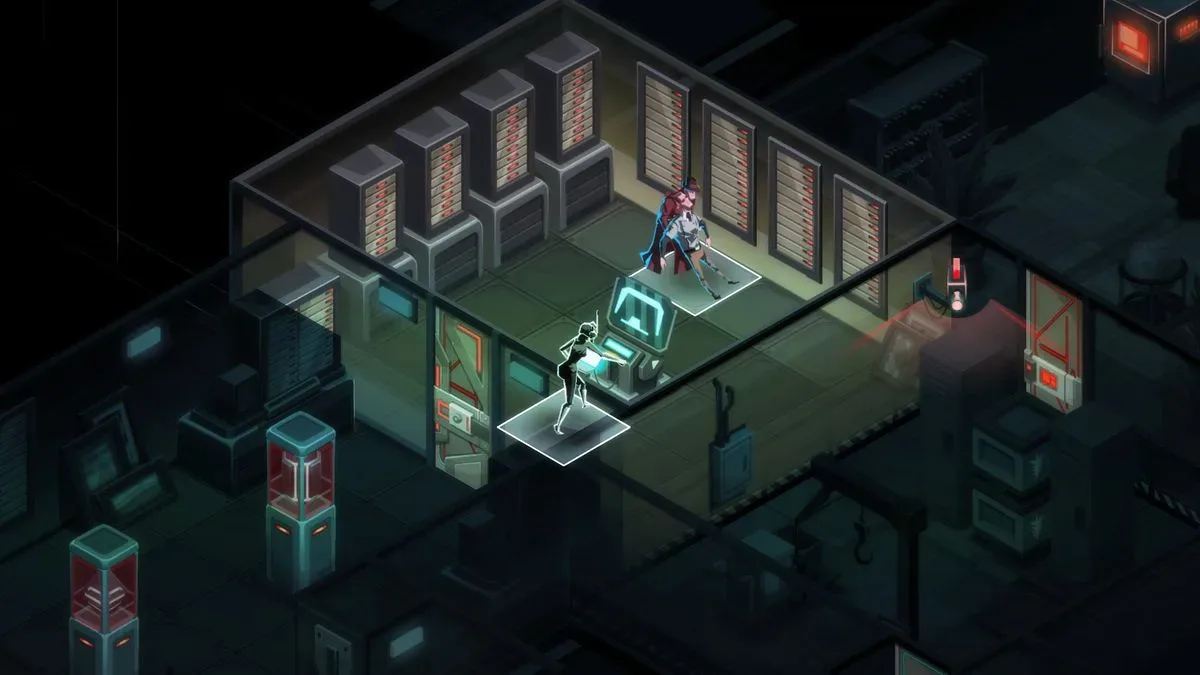
At first glance, the foundations are comfortably familiar. Missions take place on grids, agents have a limited number of action points, and cover matters. Players move through rooms one square at a time, open doors, avoid patrols, search containers, and try to avoid open confrontations. Starting teams are small, though additional operatives can be rescued over the course of a run.
For useful background on this topic, read Drunken Goddess Reflux Scraps Public Steam Demo Over AI Copycat Fears.
What immediately separates Invisible Inc from many tactical games is its treatment of uncertainty. Procedurally generated facilities begin as mysteries. An infiltration may start in a bare room with only a few exits, while the mission objective, extraction point, guard placements, security terminals, and valuable loot remain hidden deeper in the building. The player does not know the shape of the maze or the dangers ahead until exploration reveals them.
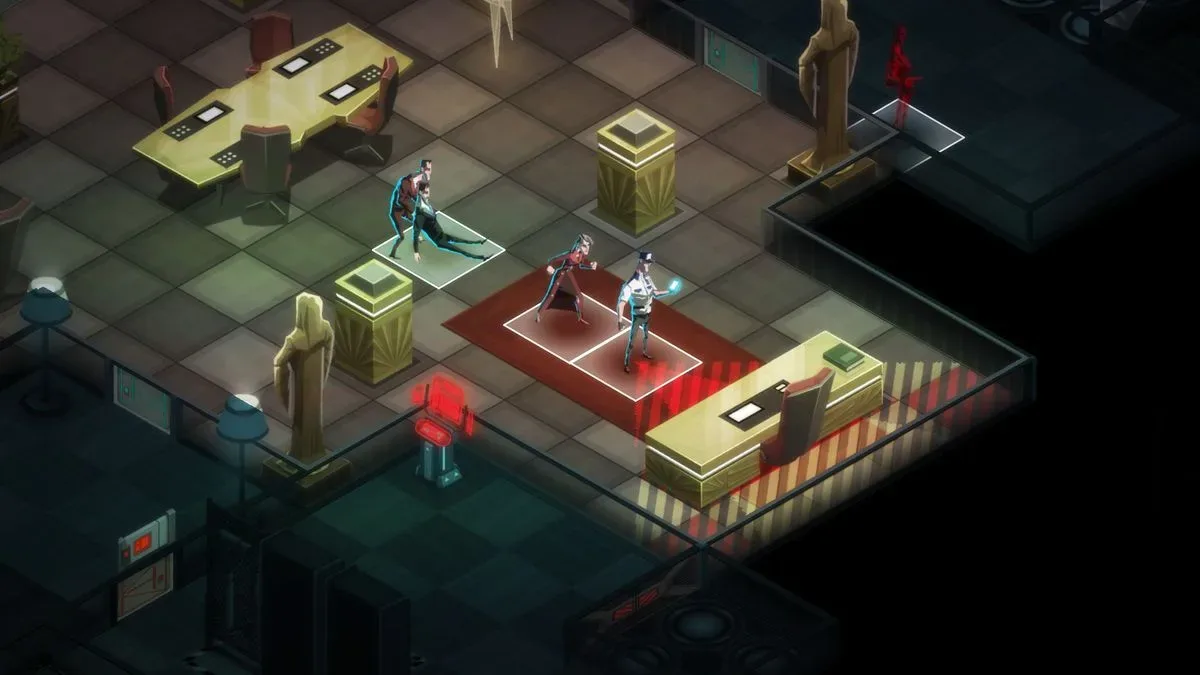
However, once something is visible, the game becomes remarkably generous with its intelligence. Guards reveal their equipment, armor, capabilities, and vision cones. Players can spend an action point to preview a guard's next patrol movement. Security devices are clearly identified, as are the systems that can be hacked or exploited. This clarity carries forward ideas from Klei Entertainment's earlier stealth work, Mark of the Ninja, where line of sight also provided immediate and useful information about enemies and environmental hazards.
The effect is crucial. Invisible Inc does not ask players to gamble blindly on vague odds. A visible guard behaves predictably. If an agent has the correct weapon to incapacitate an enemy, the result is assured. If they do not have the proper tool, there is no lucky percentage roll waiting to save the situation. Combat is intentionally stark: either an option succeeds or it does not.
That certainty changes the nature of tactical play. Instead of worrying about whether a 70 percent shot will fail at the worst possible moment, players study routes, sightlines, resources, and timing. A guard can be manipulated by briefly entering peripheral vision before retreating to cover, drawing their attention toward a specific area. That opening may allow another agent to pickpocket the guard, slip past, or reach a safer route. The game makes the rules understandable, then challenges players to use those rules with discipline.
Power is as important as action points
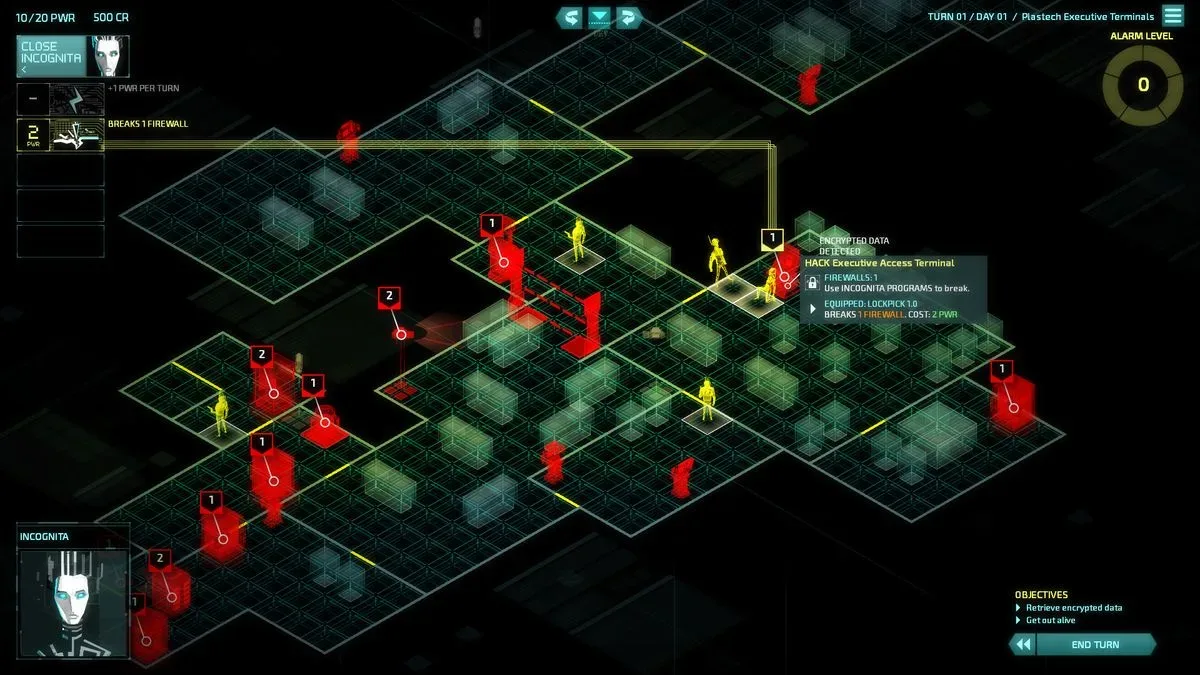
Movement alone cannot solve most infiltrations. Invisible Inc's hacking layer introduces a second resource that is just as central as action points: power. Security cameras, drones, laser grids, locked safes, workstations, and other systems stand between agents and their goals. To overcome them, players rely on remote hacking and on a supply of power that must be managed throughout a mission.
Power can be replenished through specific programs or acquired by draining on-site terminals, but it is never simply a background number. Spending it on an immediate solution may be the difference between a clean escape and a disastrous encounter. Saving it, meanwhile, may leave a dangerous camera active or delay access to a critical objective. A player may need to decide whether to spend a major portion of their available power on a rapid hack now, or take a slower approach and hope that the delay does not create a worse problem.
That is especially meaningful because some valuable systems are protected by daemon programs. A safe, facility map, or other tempting target may offer a substantial benefit, but interfering with it can activate a hostile effect against the player's own tools. This makes loot a tactical proposition rather than an automatic reward. The best option is frequently not the richest-looking room, but the room that can be cleared without derailing the entire operation.
The alarm clock that never stops ticking
The game's most effective source of momentum is its alarm system. Every mission begins with the player undetected, but the corporate security network becomes more alert after each turn. As the alarm level rises, the facility gains additional threats. New cameras may activate, firewalls become more difficult to breach, and more guards can enter the field.
Mistakes accelerate that escalation. Being seen, triggering trapped systems, and using lethal force can push the alarm upward even faster. As a result, turns themselves become the most precious resource in the game. Action points matter. Power matters. Equipment matters. But time, measured in turns, is the pressure that turns every other resource into a difficult trade.
This is why Invisible Inc can make even inaction feel dangerous. Waiting for power to recharge before hacking a safe might be tactically sensible in isolation. But each turn spent waiting hardens the facility and narrows the team's eventual route to safety. Taking a long detour around a guard is safer than confronting them, until the accumulating alarm makes that detour more expensive than a quick incapacitation.
The game repeatedly asks questions with no universally correct answer. Should agents split up to reveal more of the map and cover ground faster, or stay close enough to support one another? Is it better to knock out a guard and carry their unconscious body along to keep them from waking, or leave them behind and accept that they will soon join the search? Should a team fully explore a wing for money and equipment, or abandon those rewards to preserve a clean escape?
These are not abstract dilemmas. The answers shift with every room layout, every patrol pattern, every available program, and every newly discovered objective. A player can understand the system completely and still face an agonizing choice because the cost of delay is always changing.
Procedural missions create different kinds of panic
Because facilities are generated anew, Invisible Inc avoids turning its stealth puzzles into fixed routines. One mission may contain broad spaces where several patrol routes intersect, forcing players to work around overlapping vision cones and carefully time their movements. Another may be built from narrow rooms and corridors where stationary guards create a different set of obstacles. The location of the exit relative to the main objective can completely reshape an operation as well.
A distant extraction point encourages advance planning and makes every detour more costly. An exit located near the objective can create a tempting opportunity to complete the job and flee early, but that temptation competes with the desire to keep searching for better gear and more money. The structure consistently pushes players toward greed, then makes them live with its consequences.
That is where the game earns its heist-movie energy. A mission may begin with measured scouting and controlled hacking, only to turn into a frantic final dash as guards converge and security escalates. The team might technically only need one surviving agent to reach the exit and keep the campaign alive. In practice, leaving allies, uncollected resources, or mission rewards behind can make future operations much tougher. Extraction is never as simple as reaching a door; it is a calculation about what can be saved without sacrificing everything.
Roguelike stakes without pure cruelty
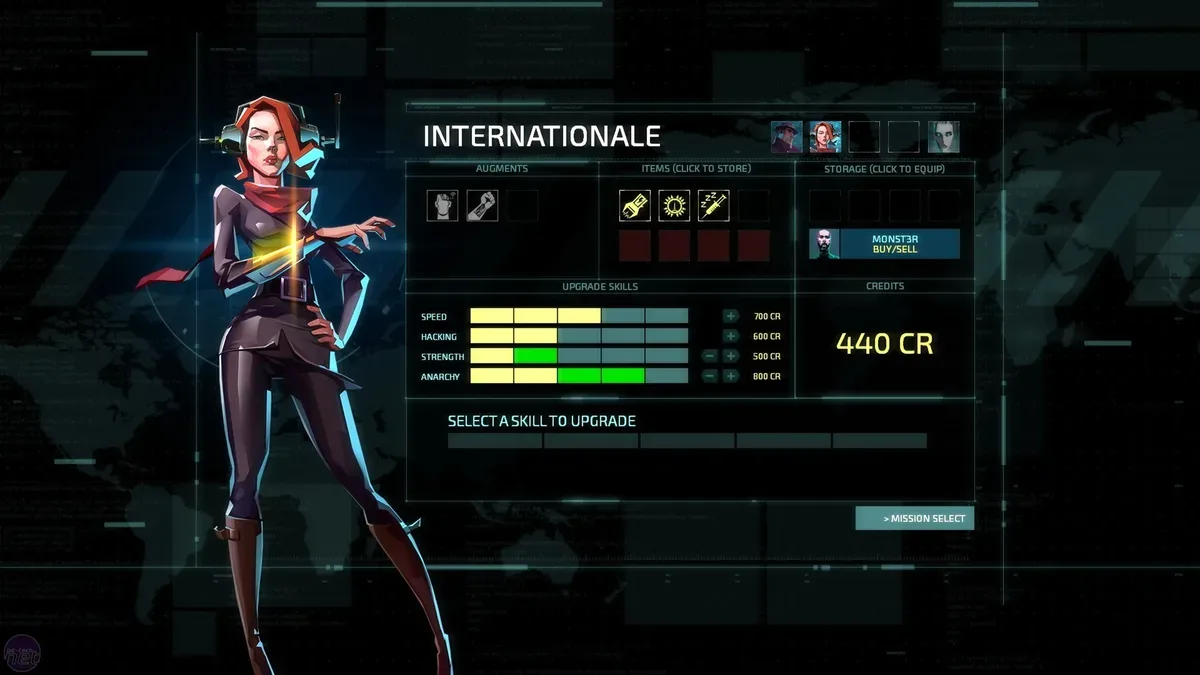
Invisible Inc also balances the repeatable structure associated with roguelikes against the longer arc of a conventional campaign. Its campaign can be completed in roughly six hours, and the Beginner setting is designed to teach the core systems in a way that can make a successful first run achievable. The deeper appeal arrives through repeat attempts, higher difficulty levels, different starting operatives, and alternative hacking programs that reshape the options available from the opening mission.
The missions do not need radically different visual concepts to remain interesting because the changing combination of layouts, tools, agent abilities, and player priorities produces fresh tactical problems. A substantial DLC package further expands that experience, but the central design is already robust: provide clear rules, create uncertain environments, and make time the force that prevents perfect play.
Permadeath is present, particularly carrying weight on Expert and Expert Plus, but it is not treated as a sudden, arbitrary punishment. A downed agent can sometimes be revived or carried to the exit once the situation is under control. Teams also include multiple operatives, meaning one loss does not necessarily end a campaign. There is even a limited rewind feature that can allow players to replay entire turns.
Those safeguards do not erase failure. A run can still collapse, including near the end. They do, however, ensure that disaster usually unfolds as a tactical problem to solve rather than a single unlucky moment. Players have room to test desperate plans, reconsider positioning, and decide what sacrifice is worth making.
A design built around meaningful opposites
Invisible Inc remains compelling because its opposing ideas reinforce one another. It is deliberate but urgent, transparent but unknowable, methodical but often chaotic in its final moments. It gives players the information needed to make intelligent decisions, then refuses to let them deliberate forever. It minimizes random chance, yet keeps every operation risky by making the clock itself hostile.
Success therefore feels earned without feeling absolute. A clean extraction can hinge on a final turn, a carefully saved point of power, or the choice to abandon one more safe rather than chase it. Victory often looks less like domination than survival on a narrow edge between caution and boldness.
For a game about covert corporate espionage, that balance is exactly right. The best missions do not end with overwhelming force. They end with a team slipping through an exit just before the whole facility closes around them.


Community
Discussion
Start the conversation.
No comments have been posted yet.