

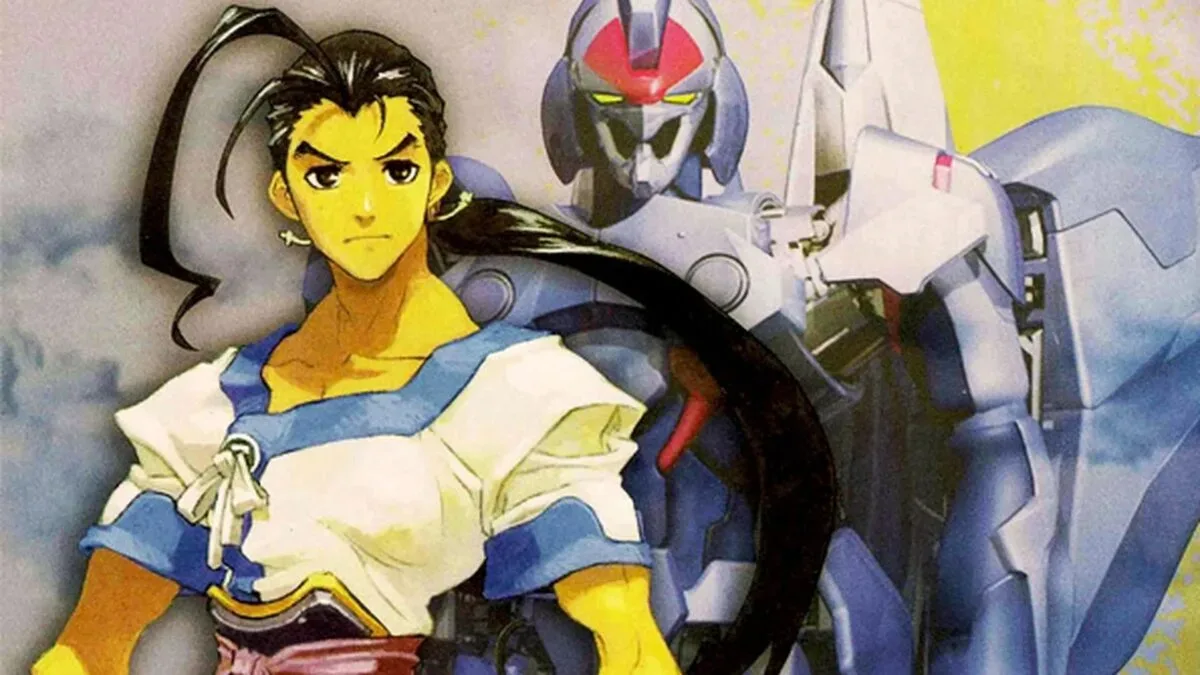
For many fans of PlayStation-era Japanese RPGs, Xenogears remains one of the most important games that modern platforms have left behind. Square Enix's 1998 cult favorite has not received a remake, a remaster, or even a straightforward contemporary port. Its last official digital availability came through the PlayStation 3-era store ecosystem, and the planned 2027 closure of the PS3, PSP, and PS Vita storefronts means that route to legally obtaining the game digitally is set to disappear as well.
That situation makes every mention of Xenogears feel significant. But comments from Final Fantasy VII Revelation director Naoki Hamaguchi suggest that a lavish remake in the mold of Final Fantasy VII Remake would be an enormous undertaking rather than an obvious next step. Speaking about the game, Hamaguchi said he remembered playing it when it originally launched, but had not revisited it since. Drawing on his experience working through the Final Fantasy VII remake project, he characterized rebuilding a title from Xenogears' generation as a difficult proposition.
That is not a formal statement that Square Enix has ruled out Xenogears. It is also not confirmation that a remake is being planned. Still, it is a sobering assessment for a game whose followers have spent years waiting for any indication that the publisher might return to it. The challenge is not merely converting old visuals into high-definition assets. Xenogears is a huge, strange, ambitious game with a famously complicated history, an incomplete-feeling final stretch, and storytelling ideas that would need careful handling in a modern production.
A Final Fantasy-adjacent origin with a life of its own
Xenogears occupies a distinctive place within Square Enix history. The project began from an idea connected to Final Fantasy VII, before eventually taking shape as its own role-playing game. The connection has remained part of the game's mythology for decades, and Final Fantasy VII itself included a nod to Xenogears.
For useful background on this topic, read Roadhouse Simulator Opens Its Doors on Steam, Bringing Route 66 Management and Brawls to PC.
A Xenogears reference has also been confirmed in Final Fantasy VII Revelation. Hamaguchi said he had not known that the reference had made it into the game, suggesting it was likely added as a playful inclusion by Kazushige Nojima or Motomu Toriyama, both of whom were involved with the original Final Fantasy VII.
That kind of internal remembrance matters to longtime players. Xenogears has not been forgotten culturally, even if it has largely been absent commercially. It is regularly discussed alongside the most daring RPGs of its era because of its blend of turn-based combat, mech battles, religious and philosophical imagery, political conflict, and sprawling science-fiction storytelling. Its reputation is inseparable from its flaws, but its high points are strong enough that the game continues to attract new interest nearly three decades after its debut.
The remake problem is bigger than new graphics
Modern remakes can take many forms. Some preserve the original design with visual and quality-of-life updates. Others reconstruct an older game from the ground up, reworking combat, environments, pacing, voice performances, cinematics, and narrative presentation. Final Fantasy VII Remake and its follow-ups sit firmly in the latter category, expanding a single 1997 RPG into a massive multi-part modern project.
Applying that philosophy to Xenogears would be particularly demanding. The original is far from a compact adventure. Its narrative is dense, its world is broad, and its systems move between on-foot character combat and Gear-based battles. Recreating every major location, story sequence, character moment, and mechanical layer at the scale expected of a current big-budget RPG would require major time, money, and coordination.
There is also the issue of the game's second disc. Xenogears is widely known for a late-game structural shift that presents substantial portions of its story through extended narration and static presentation, punctuated by battles. Fans have long associated that unusual format with a development that could not fully realize every planned element. A remake would have to make a difficult creative choice: preserve that approach as part of the original's identity, or substantially expand and reimagine the material that was condensed.
Either decision would invite scrutiny. Staying close to the original could disappoint people hoping to see its most underdeveloped material fully realized. Expanding it would create questions about how far a new version should depart from the game players remember. That is before considering the practical realities of adapting a story with themes and plot developments that were written for a very different era of RPG production.
Square Enix has reportedly acknowledged comparable scale concerns around other classics. The idea of remaking Final Fantasy VI with the level of detail associated with the Final Fantasy VII remake series has been described by company figures as a project that could consume more than a decade. Xenogears may not have Final Fantasy VI's worldwide recognition, but its scope and narrative density make clear why a full reconstruction would not be a simple preservation project.
Why a smaller-scale return may make more sense
A remake is not the only way for Xenogears to return. For a title that is becoming harder to access through official means, a careful remaster or HD port could be the more realistic and immediately valuable solution. Such a release could bring the original game to current PlayStation systems and PC while preserving its core structure, perhaps with sharper presentation, interface improvements, modern display options, and better support for contemporary controllers.
That approach would not address every complaint directed at the original, especially its compressed later hours. But it would ensure that players can experience Xenogears as it exists, rather than leaving it restricted to aging hardware and soon-to-close legacy storefronts. Preservation is especially important for a game whose influence is often discussed more readily than it can be officially played.
Square Enix's record with reviving its catalog has varied widely. The company has produced successful remasters and remakes, and it has recently revisited less obvious titles as well, including SaGa Frontier 2 Remastered. At the same time, other beloved games remain unavailable in updated form. Vagrant Story, another frequently requested PlayStation classic, has likewise yet to receive an HD remaster.
That inconsistency leaves room for optimism but offers little basis for predicting what comes next. Xenogears may be an especially difficult case because a technical update is only one part of the discussion. Its legacy is tied closely to the people and studios that followed its release.
The Monolith Soft connection adds another layer
Xenogears director Tetsuya Takahashi now leads Monolith Soft, the Nintendo-affiliated developer behind the Xenoblade games. After Xenogears, Takahashi's creative path continued through the Xeno name in projects spanning multiple consoles and narrative continuities. That lineage includes the Xenosaga trilogy and, later, the Xenoblade series.
For fans, the connection makes Monolith Soft seem like a natural participant in any major Xenogears revival. The studio has extensive experience building large-scale science-fiction RPG worlds, and its present-day work carries thematic and creative echoes that players associate with Xenogears. Yet a partnership of that kind would be far from straightforward. Square Enix holds Xenogears, while Monolith Soft operates under Nintendo. A substantial collaboration would involve business arrangements between companies whose interests and platform strategies do not automatically align.
That uncertainty also feeds speculation about exclusivity. If Nintendo and Monolith Soft were central to a full remake, it is easy to imagine players wondering whether the result would be tied to Nintendo hardware. But there is no announced Xenogears project, no confirmed development partnership, and no confirmed platform plan. The prospect remains hypothetical.
There has also been a rumor that Nintendo may have quietly acquired the rights to Xenosaga from Bandai Namco. Given the companies' relationship, the idea has prompted interest among Xeno fans, but it remains unconfirmed. Even if it proved accurate, it would not resolve Xenogears' separate ownership situation.
Modern access should be the immediate priority
The dream scenario for many players is expansive: a collection that makes Xenogears and the Xenosaga trilogy accessible on modern systems, perhaps arriving alongside the next chapter in the Xenoblade franchise. It is an appealing vision because it would put the major branches of the broader Xeno legacy within reach of a new audience.
But the more urgent issue is simpler. Xenogears itself needs a reliable official home. Its historical importance, memorable systems, and exceptional narrative ambition deserve more than a place on discontinued digital stores. A ground-up remake may indeed be a tough game to make, as Hamaguchi indicated. That does not mean the original has to remain stranded.
An HD port would not fulfill every fan wish, and it would not erase the game's famous rough edges. It could, however, preserve an ambitious PlayStation RPG for players who missed it the first time and for veterans who want to revisit it without relying on obsolete storefronts. Until Square Enix signals otherwise, that may be the most practical hope for Xenogears: not an immediate blockbuster reconstruction, but a meaningful return that keeps one of the genre's most singular games playable.
Community
Discussion
Start the conversation.
No comments have been posted yet.