

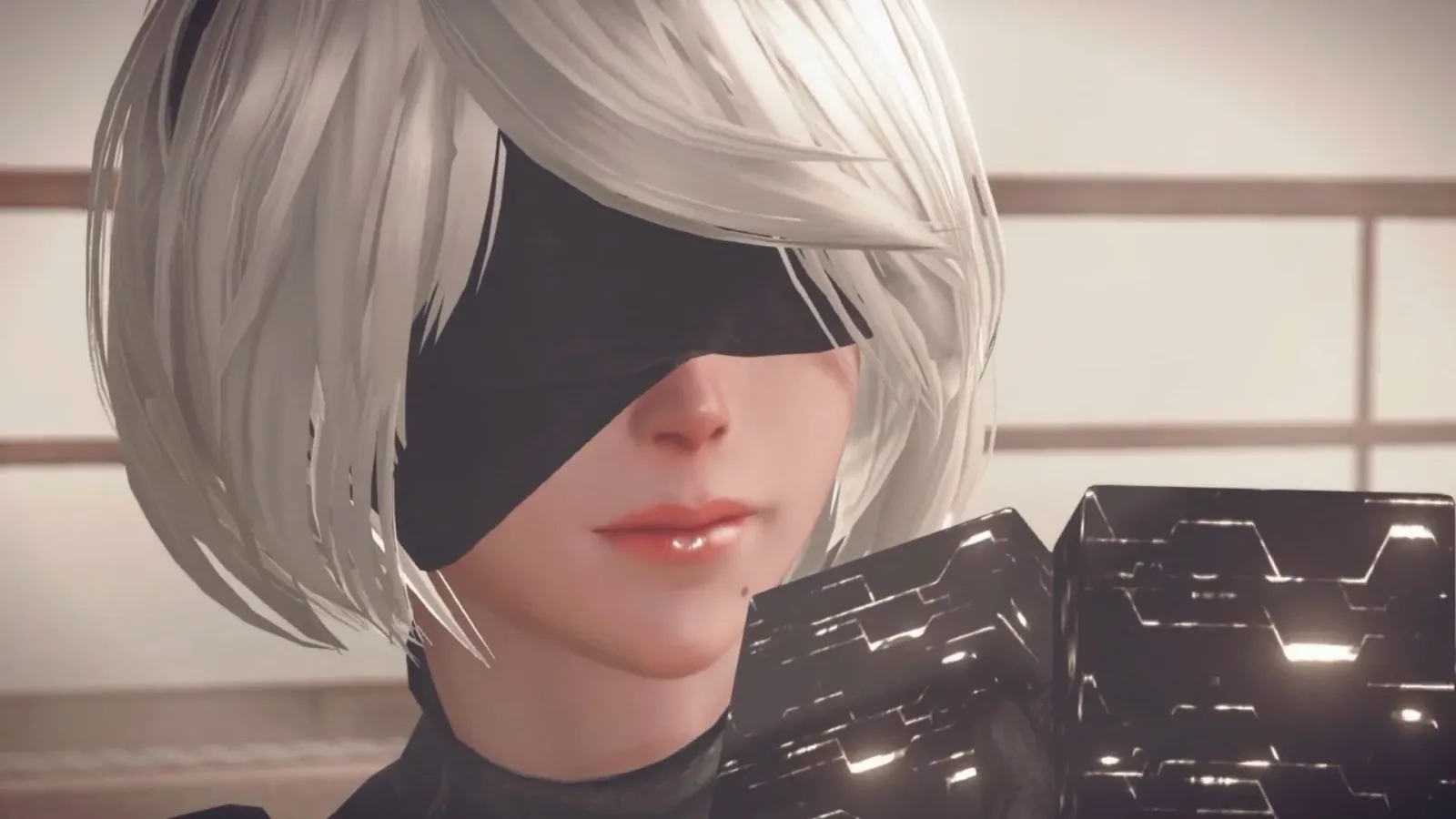
Nier: Automata is now one of the most recognizable action RPGs of its era, but director Yoko Taro has described its creative starting point in remarkably unceremonious terms. Rather than setting out with a tightly defined demographic or a plan to manufacture a mainstream hit, he says he simply made the game he wanted to make--and tried to keep as much distance as possible from Square Enix while doing it.
That statement fits the public image of a creator frequently associated with unconventional storytelling, bleak themes, layered perspectives, and the distinctive Emil mask he wears for public appearances. Yet it also highlights an important part of Nier: Automata's success. The game's unusual ideas did not arrive as a rejection of accessibility. Instead, its emotional and philosophical ambitions were delivered through a fast, approachable action game that could reach well beyond a small cult audience.
Released in 2017 as the follow-up to the original Nier, Nier: Automata became a breakout success, eventually surpassing 10 million copies sold. Its reception helped transform a series once known primarily for passionate fans and peculiar narrative experiments into one of gaming's biggest modern action RPG properties. For Yoko Taro, however, the process appears to have been less about consciously chasing that result than having room to follow his own instincts.
From an uncertain first Nier to a defining sequel
The path to Nier: Automata was not guaranteed by the first game's commercial performance. The original Nier launched in 2010 in different versions. On Xbox 360, it featured an older, rougher protagonist, while the PlayStation 3 edition in Japan used a younger lead. Western releases used the older protagonist across both versions.
For useful background on this topic, read Werwulf Trailer Unveils Medieval Terror as Full-Moon ARG Begins.
Yoko Taro had previously said that this approach did not result in major sales, leading the team to stop overthinking that particular decision. The original game nevertheless developed a devoted audience, with players responding to its music, melancholy, repeated playthrough structure, and willingness to reframe what initially seemed like a familiar fantasy story.
That foundation mattered. Nier had already established a style of storytelling that was not afraid to challenge the player's assumptions or ask them to revisit events from new angles. But Nier: Automata expanded the scale of that approach dramatically. It presented an immediately striking science-fiction setting, android protagonists, machine lifeforms, kinetic combat, and a story whose meaning continues to change as players progress through its multiple routes and endings.
Importantly, it also made those ideas easier to encounter. The game could be enjoyed for stylish combat, spectacular boss encounters, its acclaimed soundtrack, or the striking character designs of 2B, 9S, and A2. Those elements drew in a broad audience, while the deeper narrative material gave players ample reason to discuss, replay, and reinterpret what they had seen.
Creative freedom without a fixed target
Yoko Taro has said that, for Nier: Automata, he was not instructed to aim at a particular audience. His response was to make what interested him personally, while attempting to remain as hidden from the publisher as possible. The comment is characteristically humorous, but it also points to a real creative philosophy: games can become less distinctive when every decision is made in pursuit of a narrowly defined consumer profile.
That does not mean Nier: Automata was made carelessly or without an understanding of players. Quite the opposite. The game is full of decisions designed to maintain momentum and curiosity. Its combat shifts between action, shooting, side-scrolling, and top-down perspectives. Its world is structured to invite investigation without becoming incomprehensible. Its major revelations are paced across a format that asks players to return with new knowledge.
The game's apparent contradictions became one of its greatest strengths. It is severe but playful, philosophical but frequently absurd, stylish but willing to be ugly, and emotionally devastating while also making room for jokes. A player can encounter an existential meditation on consciousness and war, then be sent to retrieve an item for an eccentric machine or watch an android react to a mundane side quest.
That tonal flexibility helped Nier: Automata avoid feeling like a remote work made only for players seeking dense symbolism. It has layers, but it rarely requires the player to understand every reference or interpretive possibility in order to feel its central emotions. The questions about identity, purpose, grief, and empathy remain legible even when the larger lore becomes complicated.
"Normal games" for players who enjoy the strange
Despite the reputation attached to his work, Yoko Taro has argued that he makes normal games for normal people. In his view, the oddness may emerge when people who enjoy unusual things find those games and embrace them as something especially strange. He has joked that this may simply mean there is something wrong with him.
It is a self-deprecating assessment, but it also gets at why Nier: Automata connected so widely. What seems bizarre from a distance often functions as a direct expression of familiar human feelings. The setting may involve android soldiers fighting machines on a ruined Earth, but the characters wrestle with loneliness, duty, loss, resentment, and the need to believe their actions matter.
The game's famous structural choices similarly serve emotional clarity rather than novelty for its own sake. Repetition is not merely repetition; it changes the player's relationship to characters and events. Perspective shifts are not included just to surprise the audience; they expose the limits of what any one character can know. Its endings do more than provide alternate conclusions, turning the player's investment in the game into part of the story's final emotional gesture.
That combination of clear feelings and unusual construction is likely why Nier: Automata has endured beyond the boundaries usually placed around cult RPGs. It provides immediate pleasures for players who want responsive action and memorable spectacle, while rewarding those who wish to sit with its larger questions. A person can finish it feeling moved without having a definitive answer to every piece of its mythology.
A collaboration that gave the sequel momentum
Nier: Automata's appeal was never solely about its script or its director's personality. Its action design was a major part of the package, helping translate its ambitious narrative into a game that felt good moment to moment. Combat is fast, expressive, and readable, while the Pod system adds ranged attacks and customization to close-quarters encounters.
The game also knew when to change its language. One moment may ask players to perform combos in an open environment; another becomes a bullet-hell sequence, a hacking minigame, or a side-scrolling platforming section. These transitions reinforce the idea that the game is not bound to one genre convention, but they are also useful pacing tools. Nier: Automata rarely lets a single activity define the entire experience.
Its audiovisual identity was equally central. The ruined cityscapes, desert machinery, abandoned amusement park, and other locations give the world an atmosphere of both beauty and decline. The music has become especially celebrated for the way it supports changing situations and emotional stakes. Together, the visuals, combat, and soundtrack made the game accessible on a sensory level even before players reached its most complicated narrative turns.
Why the sequel's impact continues
More than 10 million sales represent an extraordinary outcome for a sequel to a game that did not initially become a massive commercial success. Nier: Automata proved that a work can retain a singular voice while finding a much larger audience. Its success did not depend on sanding down every strange edge. Instead, it showed that unusual storytelling can become widely appealing when it is paired with strong fundamentals and emotions players recognize.
The lesson is not necessarily that every game should be made by avoiding publisher oversight or refusing to identify an audience. Game development is collaborative, expensive, and shaped by practical constraints. But Yoko Taro's comments underline the value of allowing creators some room to pursue ideas that do not fit easily into marketing categories.
For Nier: Automata, that space led to a game that can be described in many ways: an action RPG, a science-fiction tragedy, a reflection on artificial life, a genre-hopping spectacle, and a story about trying to find meaning after certainty has collapsed. Its ability to be all of those things at once is precisely why it still inspires conversation.
Yoko Taro may frame his approach as making ordinary games that happen to be discovered by people who enjoy the unusual. Nier: Automata's legacy suggests something slightly different: a game does not need to choose between being welcoming and being strange. Sometimes the most memorable games invite everyone in, then reveal just how far they are willing to go.
Community
Discussion
Start the conversation.
No comments have been posted yet.