

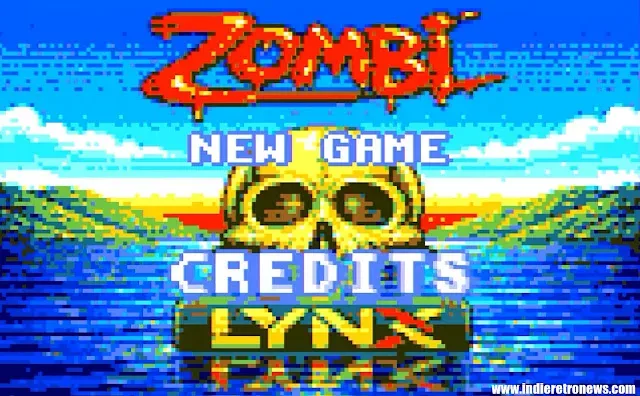
Ubisoft's earliest action-adventure game is receiving an unexpected new life on one of Atari's most technically distinctive handhelds. Zombi, the 1986 horror adventure that predated many of the conventions now associated with zombie games, has been remade as a work-in-progress demo for the Atari Lynx.
The project comes from developer kikems and was created for the Silly Venture competition. Its timing is particularly fitting: the original Zombi reaches its 40th anniversary in 2026. Rather than simply revisiting the game on contemporary hardware, this version takes on the much more specialized task of translating its colorful, detailed world to the Lynx, Atari's early-1990s portable system.
That means the demo is not only a nostalgic nod to an influential Ubisoft release. It is also a technical showcase for a machine that has long attracted homebrew developers because of its unusual capabilities and its equally unusual constraints. The Atari Lynx could display vivid color visuals for its era, but making a substantial adventure game fit and run within its limited memory requires careful choices at every stage of development.
An early Ubisoft horror game revisited
Released in 1986, Zombi holds an important place in Ubisoft history. It was the company's first action-adventure game, arriving at a time when the studio was still in its formative years. The game drew inspiration from Dawn of the Dead, George A. Romero's landmark zombie film, and placed its survival-horror atmosphere years ahead of the genre's later commercial boom.
For useful background on this topic, read Fire Emblem: Fortune's Weave Reviews Hail Its Tactical Depth, but Its Massive Scale Divides Critics.
The original game is remembered for mixing exploration, danger, and a setting shaped by a zombie outbreak. While the word "zombie" is now inseparable from a huge range of games, films, television series, and comics, the 1986 release came from a period when video-game adaptations of that kind of claustrophobic horror were far less common. Its relationship to Romero's film was central to its identity, helping establish the tension between the living, the undead, and the enclosed spaces where survival becomes increasingly difficult.
Ubisoft would eventually return to the name decades later with ZombiU, though the new Atari Lynx project is rooted specifically in the company's original 1986 game. That distinction matters. This is a retro-minded remake of an early action-adventure rather than an attempt to reduce a later first-person survival game to handheld form.
The result also underlines how broad the legacy of early Ubisoft can be. Modern audiences often associate the publisher with globally recognized series and enormous open-world productions, but projects such as this are reminders of the smaller, more experimental games that formed part of its earliest catalog.
For another perspective on this story, read Zombi Demo Brings Ubisoft's 1986 Horror Adventure to Atari Lynx.
Why the Atari Lynx is a demanding target
The Atari Lynx occupies a fascinating place in handheld history. It was technologically ambitious, with a color screen and hardware that gave developers tools not commonly found in portable gaming at the time. Those strengths are part of the appeal for modern programmers. A Lynx game can look strikingly different from software made for monochrome portable systems of the same broad era.
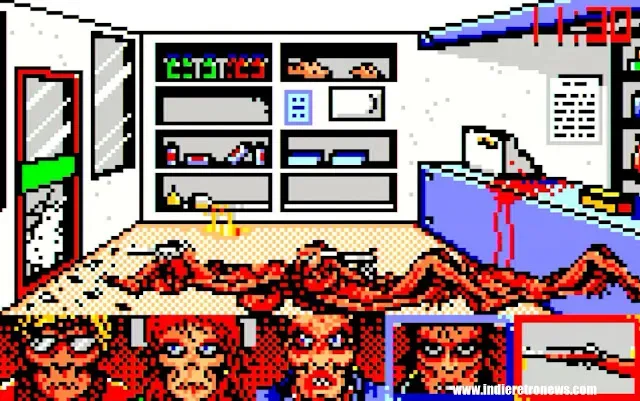
Yet raw visual potential does not remove the difficulties of building for the platform. The Zombi demo had to accommodate the game's graphics, its display requirements, and the program itself within a 64KB RAM limit. For a title based on an adventure with a detailed visual presentation, that is a major constraint.
Memory is especially important in a project like this because graphics consume space quickly. A colorful screen, character imagery, environmental art, and interface elements all have to be stored, loaded, or constructed in ways compatible with the machine's available resources. The developer also had to account for a double-buffered display, a technique that can help visual output remain smooth by preparing one frame while another is shown, but which adds to memory demands.
The demo makes use of the Lynx's Suzy chip and central processor to deliver its speed. Suzy is one of the handheld's most notable hardware components and is closely tied to the system's graphics handling. Leveraging the machine's hardware effectively is essential when trying to retain the feel of a game designed around rich, color-heavy presentation while still working inside such a narrow RAM budget.
The project's core program was built with CC65, the C compiler suite widely used across several 6502-based retro platforms. Even with suitable tools and an understanding of the machine, the process remains a balancing act: more visual detail can mean less room for code, while extra buffering or game data can force compromises elsewhere. In that context, getting a recognizable version of Zombi running on the Lynx is an achievement of optimization as much as design adaptation.
A demo rather than a confirmed full release
It is important to frame the project for what it currently is. Zombi has been presented as a demo made for Silly Venture, not as a confirmed complete commercial release or a finished full-game conversion. No release date, distribution method, price, or broader availability details have been announced.
That does not make the project any less interesting. Retro competition entries and demos often provide a snapshot of active development communities, where creators explore hardware limits, rebuild beloved games, or create entirely new works for systems that have been commercially dormant for decades. Some later expand into larger projects, while others remain compact demonstrations designed around a particular event or technical idea.
For now, the notable story is the existence of a functioning Lynx interpretation of Zombi and the challenges behind it. The demo brings a 1986 title, itself shaped by a celebrated 1970s horror film, to hardware released years after the original game. It is an unusual chain of gaming history: cinematic zombie horror influencing an early computer adventure, which is then reworked for a portable console in the modern homebrew scene.
Preserving a different kind of retro experience
Retro remakes are often discussed in terms of visual upgrades, modernized controls, or new platforms with greater power. The Atari Lynx Zombi demo takes the opposite route. Its appeal comes from reinterpreting a game under the limitations and characteristics of older hardware. It is not about making the original bigger or more technically elaborate; it is about seeing how its identity can survive translation to a specific handheld environment.
That approach can reveal what is most essential about an older game. When storage and RAM are limited, developers must decide which imagery, mechanics, and atmosphere need to take priority. The choices are more visible than they would be in a large-scale remaster. A port becomes an act of preservation, but also of interpretation.
For Atari Lynx enthusiasts, the demo adds another notable project to a library that continues to grow through dedicated fans and independent creators. The Lynx may have had a comparatively short commercial lifespan, but it remains relevant to programmers interested in its color capabilities, distinctive architecture, and the challenge of building games for a system with strict technical boundaries.
For Zombi fans, meanwhile, the project offers a chance to revisit a foundational Ubisoft game through a format it never originally received. The company's 1986 adventure is not usually the first title mentioned when discussing zombie games, yet it represents an early example of the medium drawing from Romero-style horror and turning that influence into interactive exploration.
A fitting anniversary experiment
Four decades after Zombi first appeared, the Atari Lynx demo demonstrates how much curiosity still surrounds gaming's older catalogs. The project is not relying on a major publisher revival or a modern hardware launch. Instead, it is driven by a developer bringing a historically significant game to a platform where it can pose a fresh technical puzzle.
The combination makes the anniversary especially appropriate. Zombi began as an ambitious horror-inspired adventure in 1986. In 2026, kikems' Silly Venture demo asks a new question of it: how can that game's color, speed, and mood be reconstructed on the Atari Lynx while fitting graphics, double buffering, and CC65 code into 64KB of RAM?
That question is at the heart of retro development. The limitations are not merely obstacles; they are part of the creative premise. And for one of Ubisoft's earliest action-adventure games, the journey to Atari's color handheld is a remarkably fitting way to mark 40 years of zombie history.

Community
Discussion
Start the conversation.
No comments have been posted yet.