

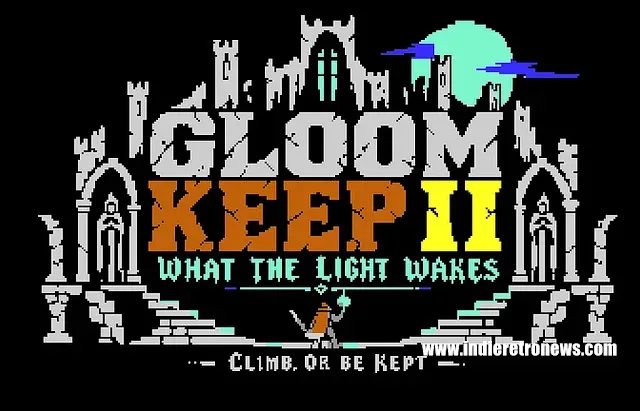
GloomKeep II: What the Light Wakes is bringing a tense new dungeon escape to the Commodore 64. Developed by J5, the turn-based crawler continues directly from the events of the first GloomKeep, placing the player in possession of the stolen Idol of Orcus following a successful escape. That apparent victory does not last long. The relic is luminous, dangerous, and seemingly impossible to ignore.
The goal in the sequel is straightforward in the most intimidating possible way: climb through ten monster-filled dungeon floors and reach the surface before dawn. What makes that journey distinctive is the game's central relationship with illumination. The Idol is the player's lantern, making rooms, routes, and threats visible. At the same time, carrying it announces the player's position to the dungeon's ten lethal guardians.
Rather than treating light as an automatic comfort or a simple quality-of-life feature, GloomKeep II makes it a tactical liability. Each floor becomes a careful exercise in deciding when visibility is worth the risk, when darkness offers protection, and how long a player can afford to move without knowing exactly what lies ahead.
The Idol of Orcus Is Both Objective and Threat
Many dungeon crawlers ask players to bring an important artifact to an exit. GloomKeep II builds its entire survival loop around a harsher version of that familiar structure. The Idol of Orcus is essential to progress, but holding it can wake enemies that would otherwise remain dormant. The artifact reveals the dungeon, yet it also turns its bearer into a target.
For useful background on this topic, read Fire Emblem: Fortune's Weave Review -- A Grand Tactical Epic Tangled in Too Much Busywork.
Players can put the Idol down and disappear into the dark. In those moments, the dungeon's creatures cannot simply track a glowing target through the halls. This creates opportunities to slip around threats, study the implications of a route, and move with a stealthier approach. But abandoning the relic is never a permanent answer. The stairs leading onward are sealed until the Idol has been recovered.
That rule gives the game a built-in rhythm of separation and return. A player may carry the Idol into a dangerous area to establish the layout, drop it before guardians converge, navigate through darkness to create distance, then make a nerve-racking trip back for the relic once a path to the stairs has been planned. Every floor demands not only a route upward, but also a viable plan for returning to the light at the right moment.
In GloomKeep II, darkness is not merely an obstacle. It is an active hiding place, while light becomes the condition that can awaken a dungeon's deadliest resistance.
For another perspective on this story, read GloomKeep II Turns the Idol of Orcus Into a Dangerous Light Source on Commodore 64.
Ten Floors, Ten Guardians, and No Easy Way Out
The ascent consists of ten treacherous levels populated by monsters, with ten guardians serving as the central lethal danger. Because the game is turn-based, its tension is likely to come less from reflexes than from consequences. A decision to take one more step with the Idol, to leave it behind one room earlier, or to return along a familiar corridor may change the state of a floor and the enemy response to the player's presence.
The premise also reverses a common fantasy-game instinct. Usually, entering darkness means accepting uncertainty, while finding a lantern makes exploration safer. Here, the lantern may make navigation easier, but it simultaneously compromises the player's security. The safe-looking option can be the action that begins the real danger.
This makes map knowledge particularly important. A player who has learned the shape of a floor can potentially use darkness more confidently, while an unexplored section remains threatening even if the guardians cannot immediately locate them. The Idol therefore has value beyond its role as a key for the stairs: it is the source of information needed to understand the dungeon. Deciding how much information is worth the attention it draws appears to be at the core of the game's tactical identity.
A Sequel Built Around a Different Kind of Roguelike Pressure
GloomKeep II is described as a direct sequel and as a game that reshapes traditional roguelike ideas. Its hook is not simply randomized danger or difficult combat. Instead, its pressure comes from the artifact the player must protect and carry. The relic is effectively part objective, part navigational tool, and part alarm system.
The concept creates a game of hide-and-seek inside a dungeon rather than a simple march toward an exit. When the Idol is in hand, players gain sight but risk activating the opposition. When it is left behind, players trade certainty for concealment. Since the stairs cannot be used without it, neither approach can be maintained indefinitely.
That structure may give individual floors a puzzle-like quality even while the larger quest remains a desperate escape. It is not enough to identify the stairs. Players need to think about where the Idol can safely be dropped, which corridors can be crossed in shadow, whether enemies have been led into inconvenient positions, and how to reclaim the relic without walking directly into the guardians' awareness.
The deadline adds another layer to the premise. Reaching the surface before dawn establishes a clear urgency, ensuring that extreme caution cannot be viewed as an unlimited solution. Even without additional details about how time is represented in play, the stated objective frames the climb as an escape that must be executed decisively.
Built for Commodore 64 in 6502 Assembly
J5 created GloomKeep II in 6502 assembly, using ACME during development and VICE for testing. That technical foundation places the sequel firmly within contemporary Commodore 64 development, where new games are made for classic hardware and for players using compatible emulation setups.
The game's presentation draws on the established GloomKeep style while introducing newly made material for this entry. Its monster glyphs, guardian designs, dungeon character art, and music are all new creations based on that original visual and musical direction. The sequel also includes fresh arrangements and dungeon effects.
For a dungeon crawler on the C64, readable visual language matters. Monster glyphs and tile-based stonework must communicate position, threat, and navigable space efficiently, particularly in a game where knowing what is visible--and knowing when not to make it visible--is so central. GloomKeep II's light mechanic gives every revealed section of the dungeon added meaning. An illuminated corridor is not just art on screen; it is knowledge gained at a potential tactical cost.
The stonework tile sets are credited to willibab and monsteretrope under a CC BY license. The project also notes AI-assisted work involving code, graphics, sounds, and text. These production details provide useful context for how the sequel was assembled while leaving the game's main appeal rooted in its deliberately designed tactical loop.
Why the C64 Format Fits the Idea
Commodore 64 dungeon games have a natural connection to deliberate, grid-oriented exploration. GloomKeep II leans into that heritage rather than attempting to disguise it. Turn-based movement gives the player room to think, but it also ensures that each action is a commitment. The low-light premise fits the platform's atmospheric strengths: constrained visibility, symbolic enemies, strong tile contrast, and music that can make a quiet hallway feel unsafe.
The game's design also has an appealing clarity. Players do not need a lengthy list of systems to understand the central dilemma. Carry the Idol to see, but become detectable. Drop the Idol to hide, but lose vision and delay access to the stairs. It is a simple rule set with room for difficult decisions, and its importance should intensify as the player climbs closer to the surface.
That clarity could make failure instructive as well. A lost attempt can reveal a different approach to handling a guardian, a better location for leaving the Idol, or a safer order for exploring rooms. In a dungeon escape structured around information and exposure, learning the consequences of light is likely to be as important as learning the terrain.
A Dangerous Climb Toward Dawn
GloomKeep II: What the Light Wakes has an unusually focused premise for a retro dungeon crawler. It does not merely ask whether players can survive a monster-filled maze. It asks whether they can survive while carrying the one thing they need most--and whether they know when to let it go.
With ten floors to climb, ten guardians able to react to the Idol's glow, and sealed stairs that require the relic to advance, J5's sequel turns every act of illumination into a potential invitation to disaster. For Commodore 64 players looking for a methodical dungeon game with a stealth-oriented twist, the journey from the depths to the surface promises a demanding contest between knowledge, fear, and the dangerous pull of the light.
Community
Discussion
Start the conversation.
No comments have been posted yet.