

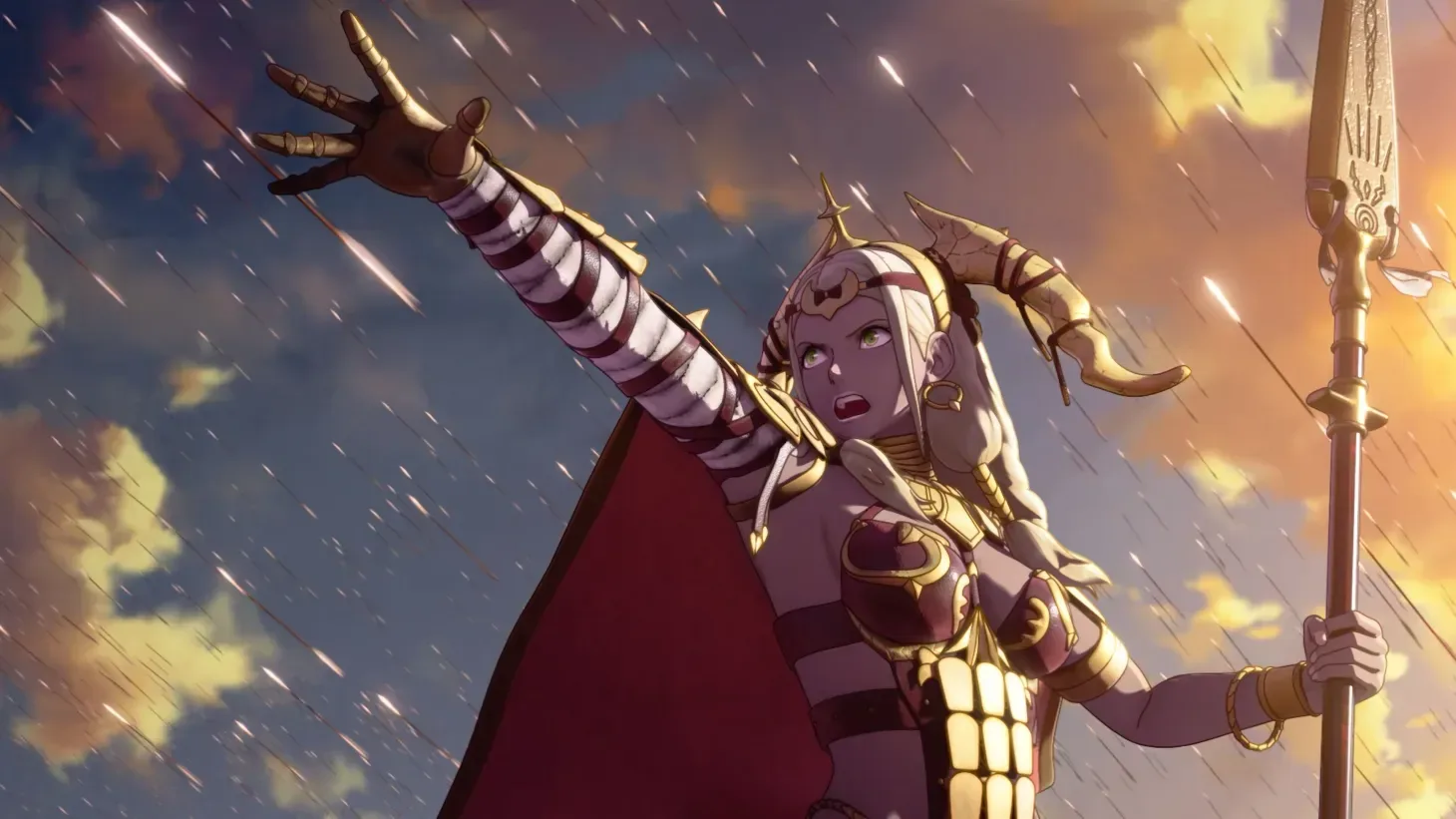
Fire Emblem: Fortune's Weave is an enormous strategy RPG built around the kind of ambition that can be both exhilarating and exhausting. It has a superb setting, some of the most exciting tactical maps in the series, a striking gladiatorial atmosphere, and a cast that becomes increasingly rewarding to follow across its sprawling structure. It also has too many systems competing for attention, repetitive dungeon expeditions, and enough recurring chores to occasionally turn an epic adventure into an administrative routine.
Still, the scale pays off more often than it collapses under its own weight. Fortune's Weave is a huge game that asks for a huge investment, but it uses that time to build a world of gods, legacy, war, revenge, and survival. For players willing to push through its less inspired detours, this Switch 2 entry offers a dramatic and deeply satisfying Fire Emblem campaign.
A story that begins at the end
Fortune's Weave opens amid catastrophe. After creating the mysterious Pale Raven, players enter a world already crumbling beneath the threat of the living dead. The avatar and Fortuna, a goddess of fate, are among the few survivors left standing. Their answer is not simply to confront Balor, the lord of the underworld, immediately, but to retreat beyond time and reshape the histories of the people who might have been able to stop him.
The central structure follows four Flame Lords of Dagda: Cai, Theodora, Dietrich, and Leda. Each arrives in the capital city of Dagsion for the Heroic Games, a grand contest overseen by Divine Emperor Solel. The prize is as extravagant as the event itself: one wish granted to the ultimate victor. Each lord has a different reason for entering. Cai wants to save his imprisoned father from execution. Queen Theodora seeks to restore land vital to her people. Leda pursues vengeance for her father's murder. Dietrich, fittingly, is drawn by the promise of battle.
For useful background on this topic, read Trails in the Sky 2nd Chapter Takes Early 2026 Review Lead Ahead of Launch.
The narrative can initially sound complicated, and it is. Yet that complexity serves the scope of the story. The Heroic Games become a meeting point for conspiracies, old secrets, shadowy organizations, and nearly every major figure with something to gain or lose in Dagda. Seeing events from different perspectives is one of the game's greatest strengths. A seemingly minor conversation in Cai's route can take on an entirely different meaning when revisited through Dietrich's journey. These overlapping viewpoints give the story a satisfying sense of density rather than making its routes feel like disconnected campaigns.
Players are technically free to confront Balor without completing every path. In practice, gathering more Flame Lords and their recruits makes the final campaign more manageable and dramatically more fulfilling. The individual stories add vital context to the world and provide the emotional foundation for the later acts. Skipping them may be possible, but it would mean bypassing much of what makes Fortune's Weave special.
Three acts, four heroes, and a tremendous amount of game
Each Flame Lord's story begins in the Heroic Games, but this opening section is only the first act. Completing a lord's competition arc unlocks a second part that follows the character into a war that erupts after the games. Survive that chapter, and the lord and their recruited allies can join the final campaign against Balor. The conclusion adds another schedule of activities as well as a broader layer of grand strategy.
The result is a game of remarkable volume. Reaching the credits can take more than 130 hours, even while leaving some scenes and events undiscovered. This is not a compact tactical adventure with a few optional diversions. It is a months-long undertaking for anyone hoping to see all four lords, follow their recruits, complete side stories, and carry the complete assembled force into the final confrontation.
That length enables some excellent long-form storytelling. Ideas planted early in the Heroic Games can receive powerful resolutions in the final act. The story is willing to start from personal motives--family, territory, revenge, glory--and expand toward questions about mortality and the lives people choose to lead. It repeatedly returns to the meaning of legacy: what societies preserve, what individuals protect, and what is worth doing with the limited time given to them. Those themes lend real weight to a plot filled with supernatural threats and political maneuvering.
At its best, the tactical combat is exceptional
The core turn-based battles remain the reason to play, and Fortune's Weave is at its strongest whenever it focuses on carefully designed maps and creative unit-building. Standard overworld encounters are solid, but the major chapter battles are the highlights. The arena battles in Dagsion are especially impressive, combining the spectacle of the Heroic Games with scenarios that demand close attention to positioning and party composition.
Charging chariots, environmental mechanisms, and specialized combat spaces give these coliseum encounters an identity beyond simple enemy elimination. They feel appropriately theatrical without losing the tactical precision that defines Fire Emblem. Several of these maps stand among the series' most memorable battles because they ask players to understand their units rather than merely overpower opponents.
Character development is equally flexible. Units can pursue meaningful class branches, allowing familiar archetypes to take surprising directions. An aspiring mercenary such as Mu can become a devastating sword specialist built around lethal critical strikes, while Cai can be trained in magic and transformed into a mounted Caldarius capable of wielding spells in the most demanding fights. The range of options makes experimentation worthwhile across the different routes.
Fortune's Weave also steps away from the traditional weapon triangle. Instead, it places more emphasis on practical matchups: magic is useful against armor, lances excel against mounted foes, and each weapon type has clearer individual strengths. Combat Arts further reward specialization, while each Flame Lord brings distinctive Blaze Arts to the field. Leda's spellsongs and Dietrich's shadowstep are not just visual flourishes; they are strategic tools that can create openings, support allies, or close out difficult maps. The system gives every route a distinct tactical flavor.
Too many activities dilute the best ideas
For all of its strengths, Fortune's Weave often struggles to know when to stop adding things. Chapters include free time in and around Dagsion, initially offering a pleasant assortment of meals, training, recruiting, and relationship-building. Before long, however, the available tasks grow to include continental exploration, side quests, resource collection, overworld battles, dungeon excursions, and route-specific mechanics. Theodora can recruit battalions, for example, while Leda can perform at taverns to gain resources and influence.
Individual systems can be engaging. Time-sensitive quests, paralogues, and deadlines can create satisfying pressure, especially when preparation for an upcoming battle matters. But the routine often becomes burdensome. Building support levels for a desired recruit, accumulating enough renown, and hunting the necessary resources can feel less like strategic planning and more like ticking items off a list. Random events may be easy to miss, marked only by a subtle ripple on the Dagsion map, which encourages frequent checking rather than meaningful discovery.
The recurring dungeon exploration is the weakest part of the package. Returning from Echoes: Shadows of Valentia, these sections turn Fire Emblem into a smaller-scale dungeon crawler with exploration, direct engagements, and turn-based fights. The concept is reasonable, but the dungeons do not grow substantially more engaging or challenging over time. Their battles become familiar enough that auto-battle increasingly feels like the sensible response. When a game already offers massive tactical maps, repeating reduced versions of those encounters inside dungeons is rarely an improvement.
The final hours can also bog down under map traversal, resource collection, and unit administration. Fortunately, quality-of-life features help soften the burden. Cross-path progression boosts and cleared side quests reduce unnecessary repetition for players pursuing the complete experience. They do not solve every pacing problem, but they show an awareness of how intimidating this structure could otherwise become.
A world and ensemble worth the commitment
What carries Fortune's Weave through its most repetitive stretches is the strength of its world. The Romanesque imagery of gladiatorial contests gives the Heroic Games a bold identity, while gods walking among mortals make the setting feel both mythic and politically charged. The soundtrack, with its evocative plucked-string textures, supports that atmosphere beautifully. Character and class designs are equally impressive, lending visual personality to both the heroes and the many roles they can inhabit.
The supporting cast is a particular success. Fighters such as Fabio, Lilian, Mu, Anatolia, Dante, Talimun, and Orchel gain dimension through support conversations, battlefield developments, and casual banter. The writing also uses side content to explore the setting rather than treating it as disposable filler. Theodora's route examines a people commanded by their patron god not to write down their history, and the danger that tradition may gradually erase the culture it seeks to preserve. Leda's story considers revenge, grief, and the value of music after loss. Dietrich's more battle-hungry perspective opens onto mysteries surrounding the wider world.
Who should play Fire Emblem: Fortune's Weave?
This is a strong recommendation for players who want a slow-burning, content-rich tactical RPG and are comfortable committing to a very long campaign. Fans who enjoy experimenting with classes, maximizing relationships, following multiple perspectives, and taking on elaborate objective-driven maps will find plenty to love. It is also an appealing choice for anyone who values Fire Emblem's character writing and support systems as much as its combat.
Players seeking a streamlined strategy game should approach with caution. The repetition is real, and the sheer number of activities can make progress feel slower than it needs to be. Those who dislike dungeon crawling, daily schedules, or resource-management loops may find the detours frustrating, even when the main story and tactical encounters remain excellent.
Final takeaway
Fire Emblem: Fortune's Weave makes massive swings, and not every one lands cleanly. Its dungeons are overused, its management systems sometimes become chores, and its scale can feel intimidating. Yet its finest moments are outstanding: inventive arena maps, satisfying character builds, a gorgeous audiovisual presentation, and a multi-route narrative that earns its biggest emotional payoffs.
It is a sprawling, sometimes unwieldy strategy epic, but it is also one with the confidence to ask large questions and the tactical imagination to make its climactic battles sing. For players ready to give it the time it demands, Fortune's Weave is a rewarding journey through the Heroic Games and well beyond them.
Community
Discussion
Start the conversation.
No comments have been posted yet.