

NHL 27 is caught between two identities. On the ice, EA Vancouver's latest hockey simulation makes a persuasive case that the series' underlying action is moving in the right direction. Skating has greater purpose, passing is easier to read, defense is less dependent on repetitive exploits, and the pace through the neutral zone gives both online and offline games more room for genuine hockey ideas. Away from the puck drop, however, the package struggles to justify its number. Familiar modes return with only modest movement, a celebrated connected-league concept comes back with notable limitations, and presentation upgrades repeatedly stop just short of the immersion they promise.
That contrast defines NHL 27 on PlayStation 5. This is not a broken hockey game, nor is it a lazy one in terms of its core mechanics. The fundamentals have arguably rarely felt this sturdy. But it is an annual sports release in need of bolder direction, deeper systems, and a more complete layer of polish. Its best changes make every shift more enjoyable, while its omissions make the overall season feel like an update that arrived before its most important features were ready.
Opening Verdict: Better Hockey, Limited Momentum
NHL 27's greatest success is that it understands where modern hockey games are won and lost: not simply on spectacular goals, but in the motion that creates them. The series' Ice-Q foundation continues to use real NHL Edge information to differentiate players through attributes such as speed, shooting power, and positioning. This year, that data-driven approach is felt more clearly through movement and decision-making rather than being treated as a background bullet point.
The resulting games have a healthier rhythm. Puck movement is more intuitive, especially when working dump-in angles, cycling below the goal line, and searching for lanes around tighter board coverage. Defensive tools such as poke checks, stick lifts, pins, and general awareness have more value, which reduces the sense that every possession needs to follow the same high-percentage trick. The old reliance on left-trigger exploits has also been reduced, encouraging players to create chances with better positioning and timing.
For useful background on this topic, read NBA 2K27 Review: Elite Basketball, Familiar Baggage.
That balance changes the importance of player builds and abilities. X-Factor skills that enhance mobility or saucer passing are more valuable in a game that rewards quick reads and puck support, while simplistic enforcer-first approaches are less dominant. NHL 27 does not abandon physical hockey, but its hitting is no longer as recklessly disruptive as it has been in prior installments. The sport's speed remains intact without turning every rush into a collision course.
Skating, Defense, and Goaltending Find a Better Flow
The improved neutral zone is one of the clearest examples of NHL 27's stronger foundation. Smarter AI adjustments make transitions feel less congested and more fluid, allowing users to construct entries instead of endlessly forcing the puck into the same predictable areas. The game creates more opportunities to use the width of the ice, change sides, delay at the blue line, or establish possession before looking for a seam.
Goaltenders are also a noticeable step forward in pure reaction speed. Netminders challenge breakaways and two-on-one rushes more aggressively, and top-tier starters are better equipped to handle dangerous setups and one-timers that would often have left them stranded in earlier games. This adds tension to scoring chances without making goals feel impossible to earn.
There is still an important caveat: crease awareness remains unreliable. A goalie can make an excellent initial read, then lose track of the developing situation around the net. That inconsistency prevents the position from feeling fully solved. Still, the broader improvement matters because it complements the more considered offensive and defensive flow. NHL 27 is at its most convincing when a patient cycle, a defended passing lane, and a well-timed save all work together to create an authentic back-and-forth shift.
Team Playbooks Sound Promising but Need Stronger Execution
New team-specific playbooks are meant to make every NHL club feel tactically distinct. Rather than drawing from a handful of shared presets, teams receive individual identities informed by real-world positional data. In principle, that could lead to recognizable possession entries, aggressive forechecks, slot-protecting defensive structures, and contrasting responses to pressure.
It is an appealing idea, especially for franchise-focused players who want the league's personalities to extend beyond jerseys and ratings. Some teams are built around controlled puck possession, others collapse physically around the crease, and more aggressive clubs are designed to generate chaos in front of the net. The contrast between defensive-minded teams such as the New York Islanders or Detroit Red Wings and high-pressure opponents such as the Carolina Hurricanes or Philadelphia Flyers has the potential to make a long season far more varied.
In practice, the distinction is often difficult to see. CPU teammates do not consistently pinch, maintain formations, or follow through on a tactical identity after faceoff wins. The playbooks become a promising layer that fails to reliably shape actual games. Online competitive play introduces another frustration: team strategies are locked to those identities and cannot be edited. There is some personalization in breakout options and contextual adjustments, but the inability to freely determine whether a line cycles or shoots undercuts the idea of playing hockey your own way.
Atmosphere Is Improved, but the Broadcast Still Needs Work
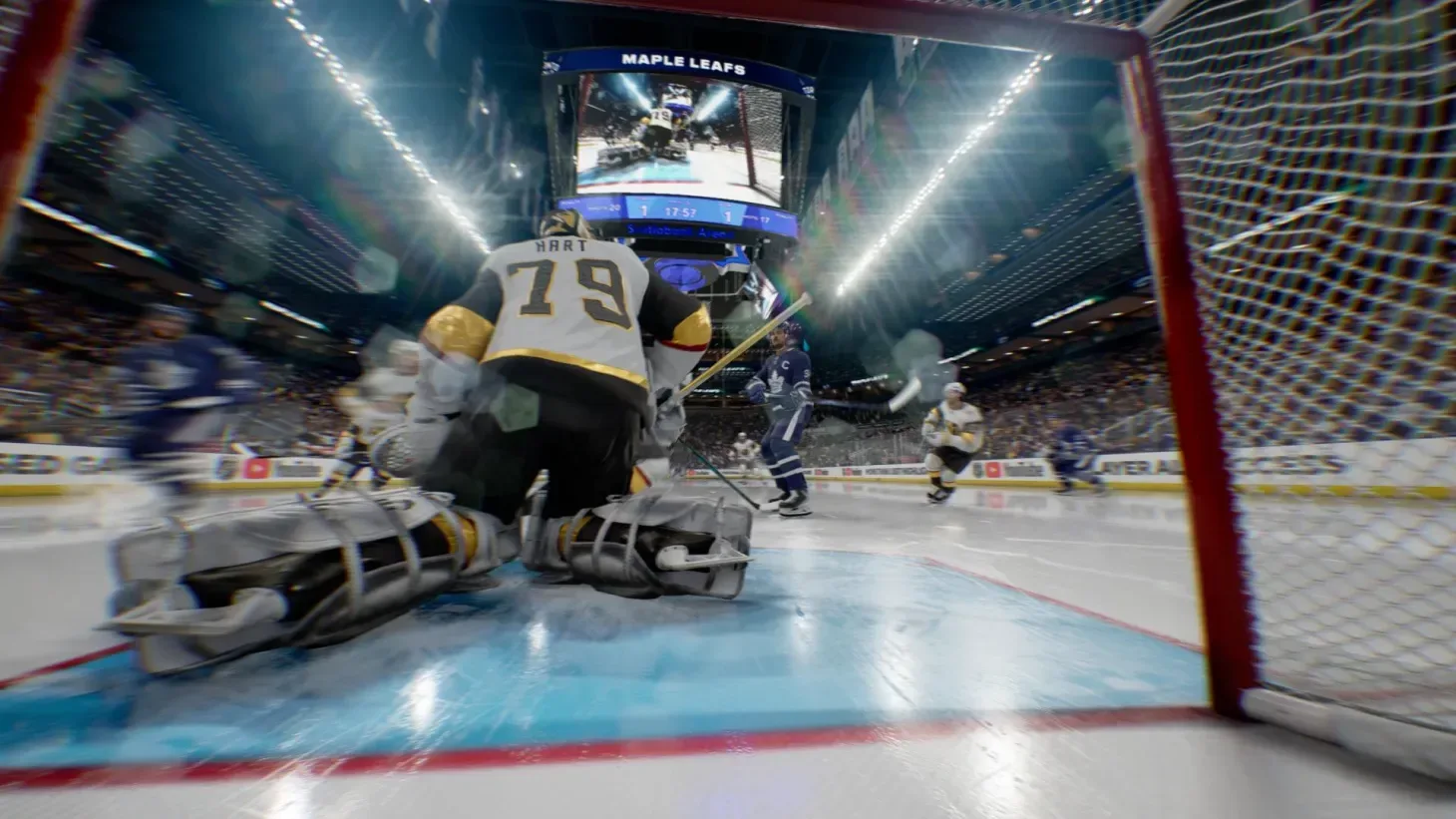
NHL 27 makes a welcome investment in team atmosphere. All 32 NHL arenas have been rebuilt around distinctive lighting, real jumbotron footage, and licensed goal songs. The changes help games feel more connected to their home buildings, particularly for fans familiar with venues such as Montreal's Bell Centre or Nashville's Bridgestone Arena. Replacing the series' usual punk-leaning musical identity with more venue-specific audio gives the presentation a stronger local character.
Yet here too, the work feels incomplete. Team introductions are largely identical, with no meaningful tunnel walks, locker-room moments, or unusual flourishes that could sell each club's personality. A building can look and sound more authentic, but the pregame ritual still lacks the details that make sports broadcasts feel alive.
The new commentary team of ESPN's John Buccigross and TNT's Darren Pang brings different voices to the booth, but the expanded commentary library has a significant problem. Generative AI voice lines produce awkward phrasing, dated vocabulary, and poor name pronunciations often enough to become distracting. Sports commentary is difficult to expand annually, and any large call library takes time to build. Still, these lines diminish the broadcast talent rather than supporting it, creating moments that sound less natural than the action deserves.
Connected Franchise Returns, but Not in Full Form
Connected Franchise is the headline mode addition, reviving the social league spirit associated with GM Connected. It supports a hockey world with up to 32 user-controlled teams, customizable rosters, and flexible salary structures. For groups that have wanted a modern way to operate rival franchises together, its return is undeniably welcome.
However, the format does not fully serve the range of communities it hopes to attract. Smaller friend groups cannot comfortably fill out their experience with CPU opponents, and the structure pushes participants toward a full 82-game schedule that can become repetitive as the same few user teams meet repeatedly. The mode also lacks meaningful offseason development, weakening the long-term management fantasy that should be central to a connected franchise.
Elsewhere, Be A Pro returns with a greater focus on team captaincy, Hockey Ultimate Team expands on its ranked introduction and line-combination features, and World of CHEL continues to recycle user inventories. None of these components receives the kind of transformational change needed to make NHL 27 feel like a new chapter. They are functional, familiar, and too often static.
Who Should Play NHL 27?
NHL 27 is best suited to dedicated hockey fans who value improved gameplay above all else. Players looking for smoother skating, more deliberate puck battles, improved goalie reactions, and a less exploit-driven competitive experience will find meaningful value here. Franchise enthusiasts may also appreciate the enhanced arena detail and the possibility of building a large connected league with a committed group.
Those hoping for a major reinvention should temper expectations. Players who spend most of their time in Be A Pro, World of CHEL, or deep management modes will encounter limited evolution. Likewise, anyone especially sensitive to awkward sports commentary may find the generative AI additions hard to ignore.
Final Takeaway
NHL 27 proves that the series still knows how to make hockey feel good. Its skating, passing, defending, and goaltending improvements produce more believable games and create a stronger platform for the future. But that platform needs more ambitious modes, dependable tactical AI, more flexible customization, and presentation that matches the quality of the action.
At 6.5 out of 10, NHL 27 is a respectable but restrained entry. It is worth considering for players who want the most refined current version of the on-ice experience, particularly on PlayStation 5. Everyone else may see a capable foundation waiting for the fuller, more confident sequel it could become.
Community
Discussion
Start the conversation.
No comments have been posted yet.