

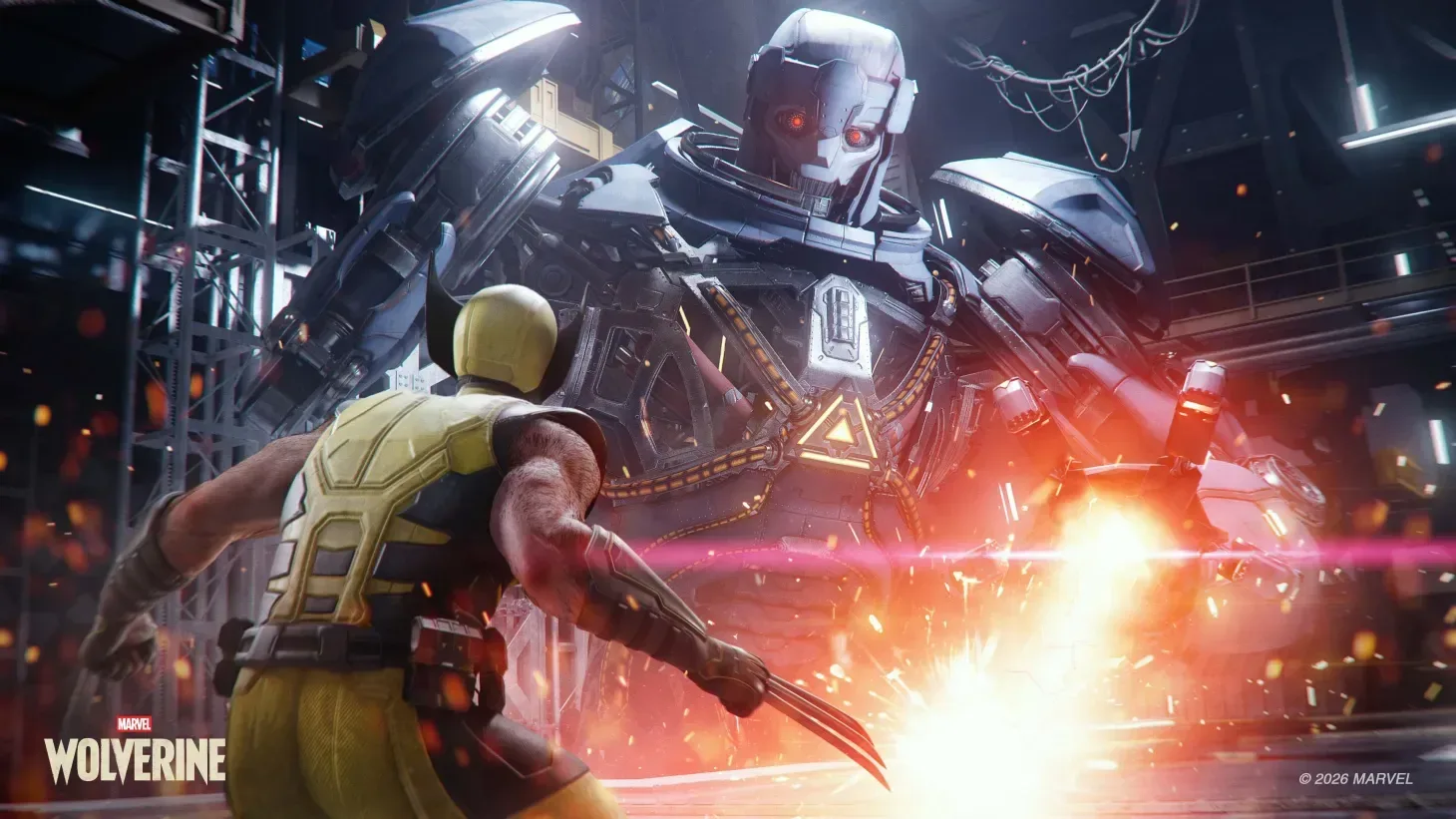
Marvel's Wolverine succeeds because it understands the central appeal of Logan better than almost any previous game or screen adaptation: he should feel terrifyingly difficult to stop. Insomniac Games has created a PlayStation 5 action adventure defined by velocity, violence, and forward pressure. Wolverine does not merely trade blows with enemies; he tears through them, recovers from punishment, builds rage, and keeps driving ahead. That relentless combat identity gives the game an immediate and lasting charge.
It is also a notably different kind of superhero game from Insomniac's earlier work. Anyone arriving in search of broad open-world sightseeing, a large city to patrol, or a leisurely checklist of activities should reset expectations. This is a compact, linear action game with a clear destination and a heavy emphasis on close-quarters encounters. The narrower scope is not a weakness by itself. In fact, it allows the game to commit fully to Wolverine's particular style of mayhem. The trade-off is that the story and the occasional slower, more controlled scenes have less room to breathe than the combat does.
Verdict: Logan's claws are the main event
The most impressive achievement here is how naturally Wolverine's brutality translates into play. His claws are not simply a visual flourish attached to familiar third-person action controls. Every major system supports the fantasy of being an aggressive, resilient brawler who is strongest when he maintains momentum. Attacks, evasive moves, and parries all feed into loops that support healing and rage, making passivity feel like the wrong answer. The game encourages players to read incoming threats, react decisively, and then turn a successful defense into an immediate counterattack.
This produces fights that are fast without becoming mindless. Basic enemies can be overwhelmed once Logan's toolkit begins to expand, but the satisfaction comes from earning that dominance. The rhythm of closing distance, slashing through a target, avoiding a counter, and launching back into the crowd fits Wolverine exceptionally well. Bigger encounters ask for more care and make stronger use of the dodge-and-parry systems, ensuring that raw aggression is tempered by timing and awareness.
For useful background on this topic, read NHL 27 Review: Strong Hockey Fundamentals Trapped in a Familiar Package.
The result is a combat model with a clear sense of escalation. New attacks and abilities arrive steadily, giving players additional means of tearing through ordinary foes while also broadening their options against more demanding opponents. It is an approach that keeps the fundamentals recognizable while preventing the action from becoming static. Wolverine's kit grows, enemy pressure rises, and the game keeps finding opportunities to make its hero feel more dangerous.
A violent, momentum-driven combat loop
Marvel's Wolverine earns its mature tone through the intensity of its action. The violence is not incidental window dressing; it is fundamental to the game's portrayal of Logan as a fighter. His healing factor and berserker instincts become playable ideas rather than just comic-book lore. Sustaining momentum powers the systems that help him endure, and the game repeatedly rewards the player for meeting danger head-on.
That does not mean every battle is identical. The strongest moments emerge when the game mixes groups of enemies, more nuanced threats, and demanding bosses into encounters that require a player to use the whole toolset. Longtime fans hoping to see Wolverine clash with a particularly anticipated opponent will find that the game delivers at least one intense confrontation worthy of that anticipation. These set-piece duels stand out because they let the combat mechanics and the character fantasy reinforce one another.
For another perspective on this story, read Marvel's Wolverine Review: Claws Out, Story Map Folded Wrong.
The campaign is wisely restrained in length. It reaches its endpoint before even the most ferocious exchanges begin to feel exhausted. That discipline matters in a game so committed to a single emotional register. There is only so long that nonstop claw-driven combat can remain fresh without new contexts, and Marvel's Wolverine generally recognizes that limit. Rather than stretching its central idea across an oversized map or an inflated runtime, it gives the player a concentrated dose of what it does best.
A bleak X-Men story with uneven payoff
Its story presents a darker variation on X-Men mythology, shaped in part by the conspicuous absence of Professor Xavier and Magneto. Without those familiar figures exerting their usual influence, the game has greater freedom to explore altered relationships and world dynamics around Logan. The character-to-character scenes benefit from a strong voice cast, whose performances meet the high intensity of the material. When the game is moving through tense, feral confrontations and emotionally charged exchanges, the drama has real force.
However, the story is less consistent than the action. Several quieter sections slow the pace for character development, but they are highly guided and offer little meaningful choice in how events unfold. Linear storytelling is not inherently a problem, especially in a focused action title, yet these moments can feel overly on-rails because the player is asked to participate without being given much agency. The contrast is pronounced after combat encounters that make Logan feel so immediate and expressive.
The larger issue arrives in the second half, where revelations and hints concerning Wolverine's mysterious past begin to accumulate. Some of those developments are difficult to parse, and the game can appear more invested in setting up future possibilities than in fully resolving its current relationship arcs. Players deeply familiar with the many twists and contradictions surrounding Logan may still need to pause and consider the implications. Newcomers to his famously tangled history may find the material even less accessible.
That uncertainty does not erase the strengths of the cast or the atmosphere, but it does limit the emotional payoff. Marvel's Wolverine tells a story with intriguing ingredients, a bleak mood, and compelling individual interactions. It simply does not always assemble those elements into a conclusion that feels as complete as its action systems.
Focused structure, striking presentation
PlayStation 5 players should approach Marvel's Wolverine as a linear adventure, not an open-world superhero playground. There is no attempt to reproduce the expansive exploration associated with other Insomniac superhero releases. The game instead moves from story beats to combat arenas and major encounters with purpose. This directness suits the character: Logan is most compelling here when he is pushing into the next threat rather than pausing to clear a city full of icons.
The presentation reinforces that focus. The game is beautiful to look at and listen to, with visuals and audio that support its harsh, high-intensity tone. Animation is especially important in a game built around claws, evasions, counters, and rapid shifts between offense and defense, and the action carries the needed weight and clarity. Wolverine's movements communicate both animalistic aggression and practiced combat instinct, helping each successful sequence feel sharp rather than chaotic.
After the main campaign, secondary challenge stages offer additional tests of skill. Some take the form of difficult wave-based gauntlets, giving players a place to demonstrate mastery of the combat loop outside the story. New Game + also allows for higher difficulty, revisiting favored fights, and spending more time in the claw-filled frenzy. These extras are welcome, but they feel like a bonus rather than the foundation of a deep replay structure. The main draw remains the initial run and its strong sequence of battles.
Who should play Marvel's Wolverine?
This is an easy recommendation for fans of Wolverine who have wanted a game willing to embrace the character's viciousness rather than soften it. It is also a strong fit for players who enjoy tightly animated, demanding third-person melee combat in the vein of modern cinematic action games. Those who value forceful encounters, responsive defensive mechanics, and a steady sense of progression will find plenty to appreciate.
Players primarily looking for free-roaming exploration or a sprawling superhero sandbox may be less satisfied. Similarly, anyone hoping for a fully self-contained and crystal-clear X-Men narrative should be prepared for some uneven storytelling, particularly as the game turns toward Wolverine's past and future narrative threads. The combat is strong enough that these caveats do not derail the experience, but they are important expectations to set.
Final takeaway
Marvel's Wolverine does not try to be every kind of superhero game. It concentrates on one vital question: can a player feel like Wolverine at his most ruthless and unstoppable? The answer is emphatically yes. Its momentum-based combat, savage visual identity, polished presentation, and memorable major fights make it a powerful action showcase on PlayStation 5.
The story occasionally stumbles under the weight of its mythology and its own future-facing ambitions, while the linear design leaves little room for player expression outside combat. Yet Logan's claws consistently hit where they need to. For all the narrative loose ends and narrow corridors, Marvel's Wolverine delivers an intense, satisfying ride that understands exactly where its strength lies.
Community
Discussion
Start the conversation.
No comments have been posted yet.