

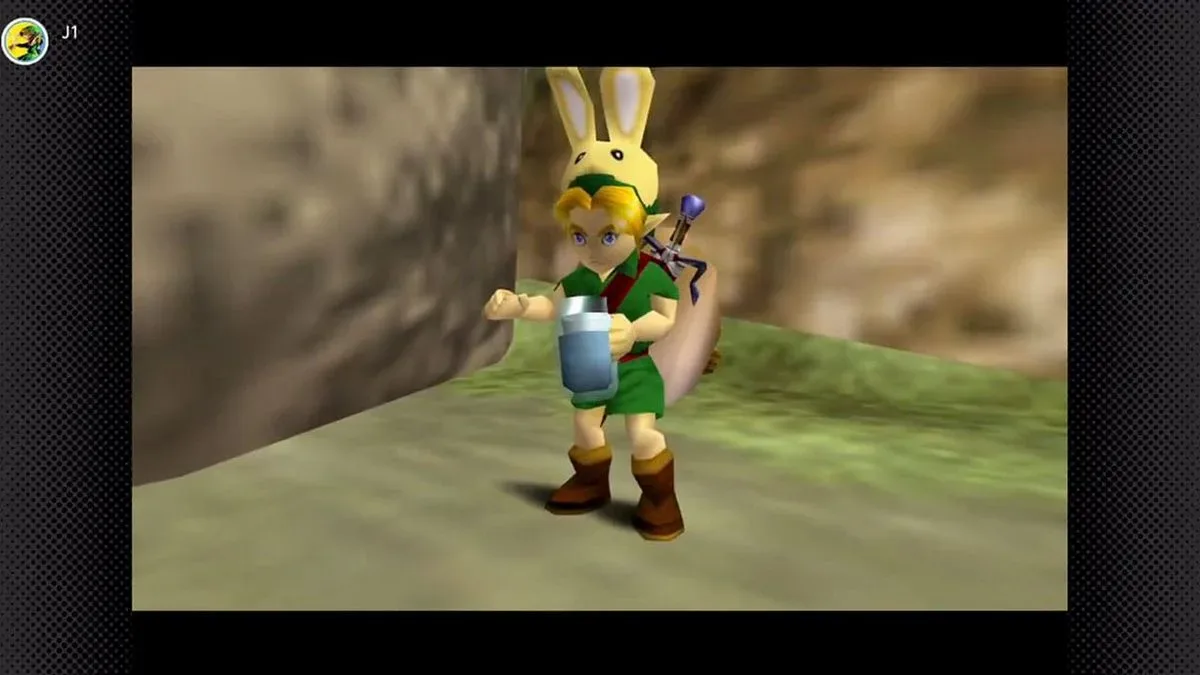
More than two decades after its original release, The Legend of Zelda: Majora's Mask is still capable of surprising players. A newly shared glitch demonstrates an especially strange interaction: Link can apparently destroy a boulder not with a bomb, a weapon, or a powder keg, but by pouring water onto the ground after performing a Spin Dash.
The discovery was shown in a video shared by Sera68. In the footage, Link executes the Spin Dash and then immediately empties spring water near a boulder. Rather than simply leaving water on the ground, the sequence causes the boulder to explode. The result looks much like the game has registered the impact of a conventional explosive item.
On its face, it is an absurd bit of Zelda logic. Water is not meant to function as demolition equipment, and the game plainly does not present spring water as a substitute for a powder keg. Yet the timing-sensitive interaction seems to persuade the game's systems to do precisely that. Players who have attempted the technique have also reported positive results, suggesting this is more than a one-off visual oddity in the original clip.
Embedded X/Twitter post
How the water-and-boulder trick appears to work
The visible steps are deceptively simple. First, Link performs a Spin Dash. He then needs to pour spring water on the ground close to the target boulder immediately afterward. When the timing and positioning line up, the rock detonates.
For useful background on this topic, read Mario Kart 8 Deluxe 4.0.1 Fixes Switch 2 Online Obstacle Issue.
That description should not be mistaken for a fully mapped explanation of the glitch. There is no confirmed technical breakdown yet of exactly why the interaction occurs, what internal state the Spin Dash produces, or why water poured during that state is able to trigger the boulder's destruction. It may depend on a narrow timing window, collision behavior, item-state handling, or an unusual overlap between actions that were never expected to occur in succession.
Still, the clip is compelling because the effect is so clear. This is not a subtle animation error or an object shifting slightly out of place. The boulder is destroyed in a way normally associated with explosive tools, making the unexpected cause immediately understandable even to someone who has never experimented with Zelda glitches.
A Spin Dash, followed by a quick pour of spring water, can apparently make a boulder react as though Link used an explosive.
Anyone looking to test it should expect the usual caveat attached to newly documented game exploits: reproducibility can hinge on tiny details. Link's exact position, the boulder selected, the order of inputs, and the speed of the transition from Spin Dash to water-pouring may all matter. A successful demonstration is strong evidence that the interaction exists, but it does not necessarily mean every similar rock in the game will respond in the same way.
Why late discoveries remain exciting
Glitches like this are a reminder that a finished game is not always a fully exhausted game. Millions of people may have played Majora's Mask, but the number of possible player actions, positions, item uses, and timing combinations is enormous. Even a game that has been studied for years can retain corners that ordinary play never exposes.
This particular find is especially entertaining because it transforms an everyday utility item into something that looks wildly overpowered. Spring water has an expected role within the game world. Blowing up a rock with it is another matter entirely. The gap between what players expect and what happens on screen is exactly what makes the clip memorable.
There is also a practical side to discoveries like this. If the method proves reliable, it could offer an alternate solution for at least some obstacle-clearing situations. That does not automatically make it useful for every playthrough or route, of course. A standard explosive option may remain easier, faster, or more accessible depending on where the boulder is and what equipment the player already has. But unusual methods are valuable to glitch hunters, challenge runners, and players who enjoy seeing just how flexible an older game can become when its rules are bent.
For casual players, it is simply a funny experiment. The normal approach to a destructible boulder is obvious: bring something explosive. Discovering that water can achieve the same result under bizarre circumstances gives a familiar obstacle a completely different personality.
Majora's Mask was built under extraordinary pressure
The continuing appearance of odd behavior in Majora's Mask feels fitting given the game's unusual development history. The project was created on an exceptionally demanding schedule, using assets and technology from The Legend of Zelda: Ocarina of Time. Building a full Zelda adventure in roughly a year was a formidable undertaking, even with that foundation already in place.
The finished game is consequently one of the series' most distinctive releases. Its repeating three-day cycle, transformation masks, densely connected locations, side quests, and shifting schedules required many interlocking systems to behave consistently. Players are constantly changing forms, moving between areas, managing time, manipulating events, and interacting with objects in ways that are more varied than in a straightforward action adventure.
Complexity creates opportunity for surprising edge cases. That is not a criticism of the game's achievement; it is often the opposite. Games with many systems, states, and possible interactions can leave behind rare combinations that only emerge when somebody experiments far outside the intended path. A bizarre water-based explosion is the sort of result that can remain hidden for years because few players would naturally think to attempt the exact sequence needed to produce it.
It is also worth separating discoveries like this from ordinary gameplay secrets. A secret is generally an intentionally placed reward or mechanic waiting to be found. A glitch is an unintended behavior produced by the game's code and systems. Both can generate the same sense of discovery, particularly in an older game where players assume they already know its boundaries.
A community effort, not just a single clip
Sera68's video brought attention to the technique, but the follow-up attempts from other players are an important part of the story. In game preservation and glitch research, a dramatic clip is often the starting point rather than the final word. Other players repeat the steps, alter the setup, identify the conditions, and eventually determine whether an oddity is consistent enough to become a known technique.
That process can turn an amusing accident into useful knowledge. Communities may eventually establish which boulders are vulnerable to the trick, whether the water must be spring water specifically, whether certain versions behave differently, and whether the method has any implications for challenge runs or speedrunning. At present, the core fact is straightforward: the shown Spin Dash-and-water sequence can make at least one boulder explode.
Even if it never develops into a broadly useful route, it has already earned its place among the stranger pieces of Zelda trivia. There is something inherently delightful about a game mechanic intended for one purpose accidentally gaining the destructive force of an entirely different item.
An excuse to revisit a classic
For longtime fans, the new glitch is another reason to revisit Majora's Mask with a more experimental mindset. Instead of only following the intended solutions, players can try unconventional action sequences and see what the game permits. The most interesting old-game discoveries often emerge from that curiosity: an input performed at the wrong moment, an item used in an unexpected state, or two ordinary mechanics colliding in an extraordinary way.
There is no need to treat the trick as the "correct" way to clear a boulder. Using intended explosive tools remains the conventional solution, while the water method is a glitch-driven novelty. But that novelty is the point. A boulder exploding after Link pours spring water nearby is exactly the kind of unexpected event that keeps a beloved retro game feeling alive long after players think they have seen everything it has to offer.
Whether the technique becomes a dependable piece of advanced knowledge or remains a spectacular party trick, it demonstrates that Majora's Mask still has room for surprise. In a game renowned for its strange world, transformations, time loop, and uneasy atmosphere, turning water into makeshift ammunition somehow feels like an appropriately weird new chapter.
Community
Discussion
Start the conversation.
No comments have been posted yet.