

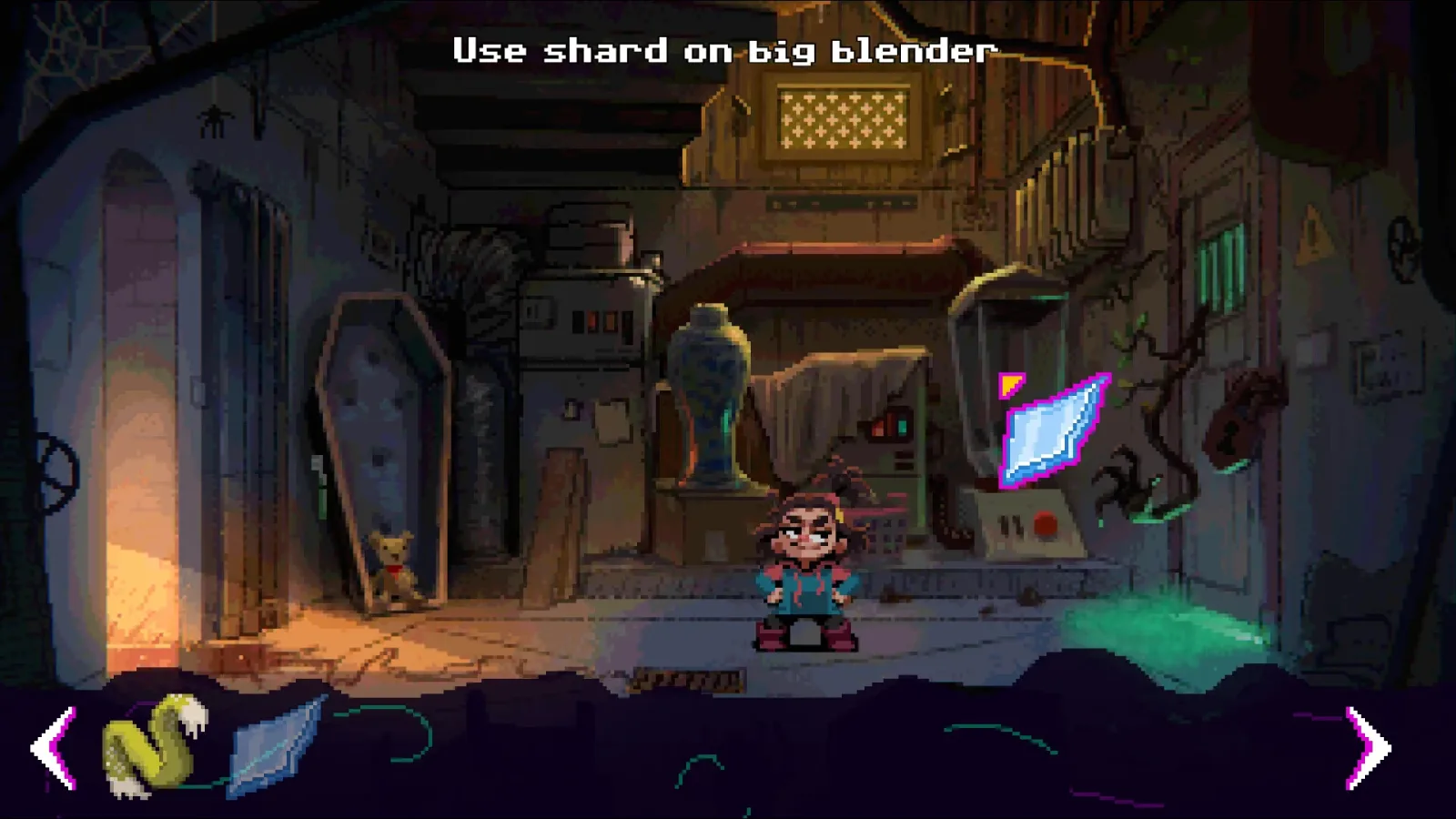
Ghost Haunting now has a free demo on Steam, giving point-and-click adventure fans an early opportunity to meet its destructive heroine, Gigi, and explore the supernatural mission that begins with a family discovery. The demo launched on November 4, 2026, during the Steam Point & Click Showcase, and will remain available after the event concludes.
Developed by Three Headed Monkey Studios and published by Daedalic Entertainment, Ghost Haunting is a 2D adventure built around hand-crafted pixel art, dark comedy, inventory-style puzzles, and a deliberately old-school approach to clicking on everything in sight. Its creative foundation reaches back to the point-and-click games of the 1990s, while its feature set includes usability options intended to make the format more approachable for a modern audience.
The full game is currently planned for 2027 on PC, Mac, Xbox, PlayStation, Switch 1, and Switch 2. The Steam demo focuses on the PC version and provides an initial sample of the game's tone, visual style, and puzzle-solving philosophy.
A Family Secret Opens the Door to the Afterlife
Ghost Haunting begins when Gigi learns that her grandfather, Giovanni, is not simply a grandfather with an unusual past. He is a legendary ghost hunter. Rather than treating that revelation as a reason to stay safely out of trouble, Gigi sets out on a mission to visit the dead and bring her grandmother home.
For useful background on this topic, read The Elder Scrolls 6: Sentinel Teaser Sparks Hammerfell, Sailing and Eye of Magnus Theories.
It is a premise that immediately frames the game as something more playful than a traditional horror story. Gigi is not approaching the paranormal with solemn caution. Her methods are impulsive, messy, and frequently hostile to the condition of nearby furniture. The game's description makes a point of characterizing destruction as part of her problem-solving toolkit, suggesting that players should expect solutions that lean into cartoon logic and comic escalation rather than strict realism.
Gigi is not alone on the journey. She is joined by Baron Butt(er)nut, a talking pumpkin demon whose presence adds another layer of absurdity to an adventure already populated by ghosts and family secrets. Getting Giovanni's approval does not appear to be a major concern for Gigi, which should give the story room to play with the familiar adventure-game tradition of protagonists making bad decisions with enormous confidence.
The newly released trailer provides another look at this supernatural setup and the game's pixel-art presentation. It also reinforces the balance Ghost Haunting is aiming for: a spooky premise delivered with humor, exaggerated personalities, and a willingness to make the afterlife feel strange rather than merely frightening.
For another perspective on this story, read Ghost Haunting Demo Is Now on Steam, Bringing Gigi's Furniture-Wrecking Ghost Hunt to PC.
Built in the Spirit of 1990s Adventures
For players who remember the era of densely illustrated screens, oddball conversations, item combinations, and puzzles that rewarded curiosity, Ghost Haunting is clearly pursuing a recognizable lineage. The team cites the LucasArts classics of the 1990s as an inspiration, placing the game in a tradition where comedy and exploration are as important as mystery.
That influence is especially apparent in the central ingredients described for the game. Ghost Haunting uses a 2D point-and-click structure, handcrafted pixel visuals, and a comedic tone shaped around eccentric characters. Those components are not just aesthetic callbacks. They establish expectations for how players will engage with the world: inspect locations, uncover interactions, speak to unusual inhabitants, collect useful objects, and gradually turn seemingly unrelated details into a path forward.
Pixel art is particularly suited to this kind of adventure because every screen can function like an interactive illustration. The format encourages developers to fill environments with visual jokes, suspicious objects, and background details that reward close attention. In a ghost-hunting game starring someone willing to break furniture to advance, a carefully packed scene could be both a puzzle space and a delivery system for the game's humor.
At the same time, Ghost Haunting is not presented as a pure recreation of the 1990s. The goal is to capture the sensation of finding an adventure game from that period without necessarily importing every inconvenience associated with older designs. That distinction matters for a genre whose beloved classics are sometimes remembered as much for their opaque logic as for their writing and atmosphere.
Modern Tools Accompany Classic Puzzle Design
The complete release will include a hint system, hotspot highlighting, fast travel, and a score system. Together, those features suggest an adventure designed to support different player preferences without abandoning its classic identity.
- Hint system: A built-in hint option can help players who are stuck while allowing them to stay within the game rather than immediately looking elsewhere for help.
- Hotspot highlighting: This can make interactive elements easier to identify, reducing the need to sweep every corner of a screen with the cursor in search of a tiny usable item.
- Fast travel: Moving quickly between previously visited locations is especially useful in adventure games, where later puzzles often send players back to an earlier area with a new object or idea.
- Score system: A scoring structure may encourage additional exploration or give players another reason to examine optional interactions and experiment with the world.
None of these systems automatically makes a puzzle easier, but they can improve the pace of an adventure. Hotspot highlighting addresses visibility, fast travel addresses backtracking, and hints address the occasional impasse that can halt momentum in a puzzle-heavy game. The score system, meanwhile, may offer a way for completion-minded players to pursue a more thorough playthrough.
For Ghost Haunting, these tools fit the stated aim of combining classic point-and-click design with contemporary conveniences. The game can retain inventory puzzles and deliberately crafted environments while giving players more control over how much friction they want in the experience.
Demo Supports Multiple Languages
The Steam demo includes full English and German voice acting. It also supports text localization across 12 languages in total. English and German receive full localization, while the interface and subtitles are localized in French, Italian, Spanish as used in Spain, Brazilian Portuguese, Traditional Chinese, Simplified Chinese, Japanese, Korean, Polish, and Russian.
That is a substantial language offering for an early public demo, particularly for a narrative-focused adventure where dialogue, jokes, and character personality carry much of the appeal. Point-and-click games often rely on carefully written item descriptions and conversations to guide players toward their next objective, so text support can be as important as visual readability.
The availability of English and German voice performances also gives players a chance to hear how Gigi and the rest of the cast are being characterized before the full game arrives. With a talking pumpkin demon and a premise centered on an unauthorized trip to the realm of the dead, vocal delivery may be a meaningful part of selling the game's comic timing.
What the Steam Preview Means for Adventure Fans
The demo is a useful chance to see whether Ghost Haunting's particular blend of nostalgia and quality-of-life features lands as intended. The point-and-click genre remains closely associated with its earlier giants, but modern games working in that space often succeed by identifying what made the classics enduring: memorable settings, expressive characters, purposeful exploration, and jokes that make even a failed interaction worth trying.
Ghost Haunting's premise gives it a flexible canvas for that approach. A protagonist crossing into the world of the dead in search of her grandmother can encounter ghosts, supernatural rules, bizarre locations, and puzzles that would be difficult to justify in a more grounded setting. Gigi's reckless attitude also provides a natural excuse for comic interactions, whether she is speaking to the dead, handling haunted objects, or treating a seemingly important room as something to be dismantled.
Its announced interface aids could also make it appealing to players who like the spirit of vintage adventures but have less patience for their rougher edges. A player can use hints when needed, highlight hotspots rather than searching for pixels, and travel quickly once an area has been understood. Those are practical additions, but they can have an outsized impact on how welcoming a puzzle game feels.
Ghost Haunting's Road to 2027
There is no specific 2027 release date announced yet, but Ghost Haunting is confirmed for PC, Mac, Xbox, PlayStation, Switch 1, and Switch 2. The current Steam demo marks an early milestone in that path, giving players a chance to experience the project well before its planned full launch.
For now, the demo's continued availability means interested players do not need to treat the Steam Point & Click Showcase window as their only opportunity to try it. Anyone drawn to pixel-art adventures, dark humor, supernatural stories, or the chaotic energy of a heroine who views furniture as a potential puzzle solution can check out Gigi's first ghost-hunting steps on Steam.
Ghost Haunting has a clear identity already: it wants to evoke a long-lost 1990s adventure, but it does not want players to be stranded in the past. Whether its puzzles, characters, and comic timing can fully deliver on that promise will become clearer as development continues toward 2027. The demo is the first opportunity to find out how much mischief Gigi can cause on the way to bringing Grandma back home.
Community
Discussion
Start the conversation.
No comments have been posted yet.