
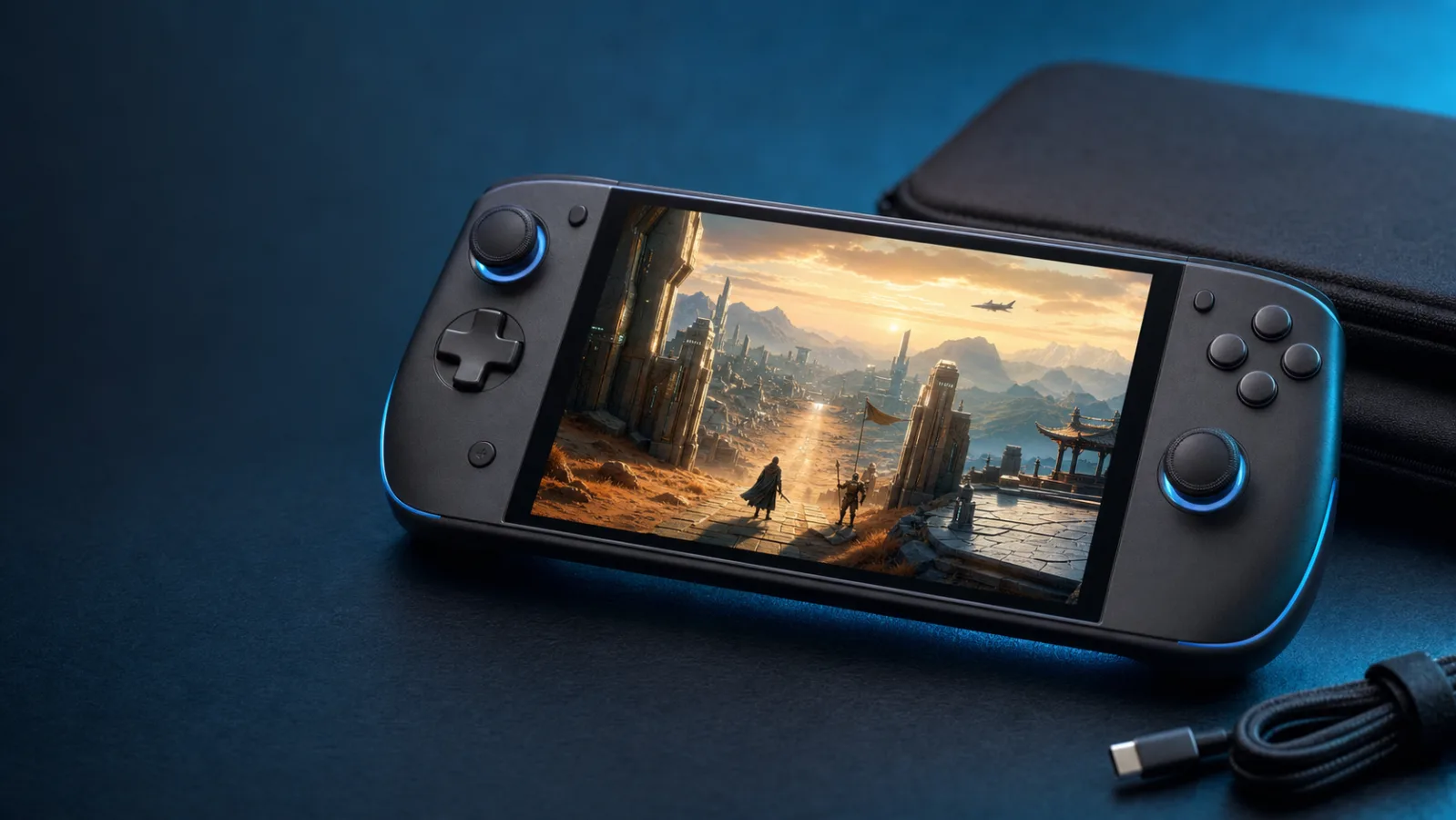
Handheld gaming is not one single hobby. It is a flexible way to play: a few minutes during a break, a focused hour on the sofa, a long journey with headphones, or a late-night session when a television is not practical. The best starting point is not buying every device or chasing the largest release. It is understanding what kind of portable experience you actually want, then choosing games that make the strengths of a handheld matter.
For some players, handheld play means short arcade challenges with immediate restarts. For others, it means a deep tactical campaign that can be paused after every turn. It can also mean exploring a 2D fantasy world, working through a clever puzzle, building a custom character in a storybook adventure, or revisiting the compact design of older systems. Modern portable options overlap with console, PC, and mobile gaming, but their best games tend to respect interruptions, clear controls, readable objectives, and the pleasure of making progress in small sessions.
This guide uses a varied group of action, strategy, puzzle, fighting, role-playing, and shooter games to explain how to begin. Rather than treating every portable game as interchangeable, it will help you match a game's pace and structure to your available hardware and your habits.
Start with your play style, not a genre label
The simplest buying question is not "What is the best handheld game?" It is "What do I want this device to do for me?" A player who has ten spare minutes at a time should make different choices than someone looking for an involved campaign. Likewise, a newcomer who wants to relax should not begin with a demanding scoring shooter merely because it looks exciting.
- For quick, repeatable sessions: arcade shooters, fighting games, and survivors-style action are natural fits. Their rules are often easy to grasp, while improving performance can remain rewarding for a long time.
- For thoughtful sessions: tactical role-playing and strategy games work beautifully in portable form because decisions can be made at a measured pace. They suit players who enjoy planning rather than reflex-only challenges.
- For exploration: platform adventures and role-playing games offer a strong sense of personal progress. They are best for players who like secrets, new abilities, map discovery, and longer-term goals.
- For creative or lower-pressure play: puzzle adventures can offer a welcoming entry point, particularly when their central idea is easy to understand and the game gives the player room to experiment.
- For atmosphere: story-driven thrillers and horror-leaning adventures can be memorable on a portable screen with headphones, but their tone may make them less suitable as a casual first purchase.
Genre tags are useful, but a game's rhythm matters more. A tactical game can be easier to fit into daily life than an action game if it lets you think at your own speed. A shooter can be more welcoming than a huge role-playing game if you value instant feedback and do not mind repeating stages. Choose the rhythm you will genuinely return to.
Know the main handheld paths
Nintendo Switch and Nintendo Switch 2
Nintendo Switch is the broadest entry point among the listed platforms because it hosts games from many styles: action, tactical strategy, shooters, platform adventures, puzzle games, fighting games, and retro-inspired releases. It supports both home-console and portable contexts, which makes it useful for players who do not want to separate their television library from their travel library. Nintendo Switch 2 is also listed for some upcoming games, including The Road of Dust and Sorrow and Warhammer Survivors.
Do not assume that every game on a hybrid device has the same portable appeal. Dense visual shooters may demand concentration and a comfortable viewing situation, while a turn-based campaign can be excellent in nearly any setting. Consider text size, the importance of precise timing, and whether you expect to play in short bursts before choosing.
Nintendo 3DS and New Nintendo 3DS
Nintendo 3DS remains a meaningful route for players interested in games designed around dedicated portable hardware. Fire Emblem Warriors is listed for Nintendo 3DS, New Nintendo 3DS, and Nintendo Switch, while Elliot Quest is listed for Nintendo 3DS. A dedicated handheld can be especially appealing if you prefer a compact device and a library shaped around portable play rather than a television-first ecosystem.
When selecting a version across devices, focus on convenience and the style of play you prefer instead of assuming that one platform automatically suits everyone. The Switch version may be desirable for players who like moving between handheld and larger-screen play; the 3DS route is for those who already favor that portable ecosystem.
Mobile as a genuine portable option
Mobile is worth considering when you want a game always within reach. The supplied library includes Android and iOS versions of Espgaluda II, Draw a Stickman: Epic 2, and the upcoming Warhammer Survivors. The deciding issue is control comfort. A puzzle-focused adventure may fit touch-oriented play differently from an intense vertical shooter, where clarity and rapid reactions are central to the experience.
Mobile works best when you embrace its strengths: immediate access, brief sessions, and a device you already carry. It is less ideal when you know you strongly prefer physical controls or you intend to spend long, uninterrupted stretches with a game.
Retro handheld and retro-minded play
Older handheld games are not merely historical curiosities. They show how much focused design can fit into a small format. Fatal Fury: First Contact was released for Neo Geo Pocket Color and is the only Fatal Fury title released for SNK's color handheld. Its hardware context shaped its roster and removed the background and foreground battle-plane system found in its source material, but it retained fighting-game identity through Breakshots and S. Power and P. Power attacks.
Retro play asks for a slightly different mindset. Expect clear, concentrated mechanics rather than modern-scale feature lists. A game may offer less surface complexity yet demand more attention to timing, spacing, route learning, or deliberate strategy. That directness is a major part of the appeal.
Build a first library around different moods
A new handheld owner does not need ten versions of the same experience. A better first library has contrast. Pick one game for the moment you want focused progression, one for short action sessions, and one for exploration or puzzle-solving. This approach protects you from the common mistake of abandoning a device because one purchase happened not to fit your current mood.
For tactical planning: Fire Emblem Warriors and Fire Emblem: Monsho no Nazo
Fire Emblem Warriors is the accessible choice for players who want strategy ideas without leaving action behind. It places heroes from across the Fire Emblem universe into large-scale battles against legions of soldiers and monsters. You directly control heroes including Marth, Xander, and Corrin, but the important beginner lesson is that combat is not only about attacking whatever is nearby. You can issue strategic commands while fighting, pair heroes for powerful combined attacks, unlock additional playable characters, and learn the distinct weapons, moves, and special attacks of each hero.
It is a strong pick for someone who wants immediate spectacle but also likes having several units to consider. Start by learning one character's basic rhythm, then gradually use commands and pair-ups more actively. Trying to master every hero at once is unnecessary. The game's variety is a reason to return, not a checklist to complete immediately.
Fire Emblem: Monsho no Nazo, also known as Fire Emblem: Mystery of the Emblem, is a very different recommendation for a different kind of player. This Japanese tactical role-playing game is divided into two books: the first remakes Fire Emblem: Ankoku Ryu to Hikari no Ken, while the second continues the story with the same characters. Its listed platforms include Nintendo Switch, Super Famicom, Super Nintendo Entertainment System, and Wii.
This is for the player who enjoys turn-based strategy as the main event. The portable advantage is obvious: make a decision, pause, reflect, and return later. Newcomers should accept a patient pace. Think about unit positioning and the immediate objective of each turn rather than rushing toward the largest possible attack. It is an important reminder that handheld gaming can support long-form concentration as well as quick distractions.
For action strategy: F-117A Stealth Fighter
F-117A Stealth Fighter combines shooter, simulator, and strategy elements. You control a stealth fighter designed to evade enemy base radars, use equipment that increases as the game progresses, and can deploy bonus weapons such as X-Press missiles against UFOs. Its missions include settings in Libya, Israel, Korea, and Russia during the latter years of the Soviet Union.
It is a better fit for players curious about older, systems-oriented action than for those seeking an uncomplicated arcade blast. The useful beginner mindset is to treat survival and radar evasion as part of the objective, not as obstacles before the "real" action. Games that blend simulation and shooting often reward attention to the tools at hand. Its listed Nintendo Switch platform also makes it relevant to players building a portable library that includes older design traditions.
For arcade mastery: Eschatos, Espgaluda II, and Earth Defense Force
Shooters are among the strongest handheld genres because a stage, a run, or a score attempt can have a clean beginning and end. The challenge is learning which type of shooter speaks to you.
Eschatos is a science-fiction arcade shooter in which the Purple Erosion spreads across the Moon and launches an invasion of Earth. Your fighter has a long-range Front Shot, a short-range Wide Shot, and a regenerative shield that can absorb bullets but deteriorates if used too heavily. Original, Advanced, and Time Attack modes offer different ways to engage, and the six-stage campaign uses timing-based scoring around waves and bosses.
For a newcomer, the shield is the key teaching tool. Do not think of it as a panic button to hold without consequence. Learn when it prevents a dangerous situation and when movement or the correct firing mode is the better answer. Begin in Original mode to understand the stage flow, then move toward Advanced or Time Attack if score pursuit becomes the appeal. It is ideal for players who want a demanding game with clear skills to improve.
Espgaluda II is a manic vertical shooter from Cave, set after the Great Shinra War devastates Soma and destroys much of its plant life. Its story follows the Galuda siblings Ageha and Tateha after their connection to Project Espgaluda brings their hidden life to an end. It is listed for Android, iOS, Nintendo Switch, Arcade, and Cave platforms.
This is the choice for players who specifically want bullet-hell intensity and a vertical-shooter identity. Start with an attitude of observation. Your first goal is not a perfect run; it is recognizing how enemy patterns claim space on the screen. Mobile players should be especially honest about their control preference, while Switch players may value a more traditional handheld-control arrangement.
Earth Defense Force is an action shooter about defending the galaxy from AGYMA after more than 200 years of peace. It is listed across platforms including Super Famicom, Super Nintendo Entertainment System, Nintendo Switch, Wii, Wii U, iOS, Arcade, and Satellaview. Choose it if you are drawn to the classic premise of a direct space-defense mission and want another route into retro shooter design.
For exploration and adventure: Elliot Quest and Flashback
Elliot Quest is an especially good first pick for players who want a portable adventure with a strong sense of discovery. Elliot cannot die, but his vitality is steadily consumed by a demon called a Satar. He searches for a cure after his wife disappears and a Sage explains the curse. The adventure takes place in the open world of Urele, where you gather abilities and spells, seek the Guardians' aid, explore five dungeons, fight 16 unique bosses, and work toward multiple endings.
Its structure supports a satisfying handheld routine: explore one region, find one secret, pursue one new ability, or attempt one boss. Beginners should avoid trying to clear the world in a single sweep. Let new abilities change the way you read familiar spaces. It is a fine choice for anyone who likes platform games with role-playing progression and a world that rewards curiosity.
Flashback offers a more urgent science-fiction premise. Set in 2142 AD, it follows a protagonist stranded on a bizarre alien planet after his memory is artificially erased. He must fight mutant forces and find a route back to Earth. With action, adventure, and platform elements, it is listed for Nintendo Switch alongside PC, Mac, PlayStation 4, Xbox One, and Sega Dreamcast.
Choose Flashback when you want a focused narrative premise paired with platform action rather than an open-ended fantasy map. It can be a useful complement to Elliot Quest: one emphasizes broad exploration, while the other begins from a concentrated struggle for memory, survival, and escape.
For creativity and puzzles: Draw a Stickman: Epic 2
Draw a Stickman: Epic 2 is a welcoming option for players who want imagination to be part of the interaction. You create your own stickman and see it come alive in a magical storybook world of creatures, mysteries, puzzles, secrets, and collectible drawings. It blends adventure, indie, puzzle, and role-playing elements and is listed for Android, iOS, Nintendo Switch, Wii U, PC, PlayStation 4, Xbox One, and Windows Phone.
This is a particularly good choice if traditional combat-heavy games have not held your attention. Approach it with a willingness to experiment and explore. The appeal lies not only in reaching the next area but in the playful connection between your own creation and the storybook setting. It also demonstrates why handheld gaming need not be defined by twitch reflexes or lengthy tactical systems.
For fighting-game fundamentals: Fatal Fury: First Contact
Fatal Fury: First Contact is a compact fighting-game choice with real mechanical character. Based on Real Bout Fatal Fury 2: The Newcomers, it includes Breakshots, special moves performed while blocking, plus strong S. Power and P. Power attacks. The initial roster includes Andy Bogard, Terry Bogard, Joe Higashi, Mai Shiranui, Kim Kaphwan, Ryuji Yamazaki, Rick Strowd, Li Xiangfei, Billy Kane, Wolfgang Krauser, and Geese Howard.
New fighting-game players should resist swapping characters after every loss. Select one fighter whose style feels comfortable, learn a dependable basic approach, and spend time understanding defensive situations. Breakshots make blocking an active part of play, which is a useful lesson for anyone used to treating defense as simply waiting. Its Super-Deformed artwork style and Neo Geo Pocket Color origin also make it an appealing retro choice for players who value handheld-specific history.
Upcoming games: plan, but do not buy around promises
Two listed games are future releases, and they are worth watching if their concepts match your preferences. The Road of Dust and Sorrow is scheduled for December 3, 2026 on Nintendo Switch, Nintendo Switch 2, PC, PlayStation 5, and Xbox Series X|S. It is described as a short, intense pixel-art thriller combining adventure and puzzle gameplay with survival-horror elements. This is for players who want mood, tension, and a compact story-driven experience.
Warhammer Survivors is scheduled for December 31, 2026 on Android, iOS, Nintendo Switch, Nintendo Switch 2, PC, PlayStation 5, Xbox One, and Xbox Series X|S. It is a fast-paced roguelite survivors game spanning Warhammer 40,000 and Warhammer: Age of Sigmar, with playable characters, collectible and evolving iconic weapons, endless enemy swarms, and bullet-hell combat. It should appeal to players who enjoy repeatable runs and escalating action.
For a starter library, however, future games should be a bonus rather than the foundation of a device decision. Begin with games you can play now, learn what session length and controls you prefer, then use upcoming releases to guide future additions.
A sensible first-month handheld plan
- Pick one anchor game. Choose Elliot Quest for exploration, Fire Emblem Warriors for action and commands, or Fire Emblem: Monsho no Nazo for turn-based strategy.
- Add one short-session game. Choose Eschatos, Espgaluda II, or Fatal Fury: First Contact if you want a game that remains engaging in small bursts.
- Add one contrast game. If your anchor is intense, try Draw a Stickman: Epic 2. If your anchor is slow and thoughtful, add a shooter or fighting game.
- Use manageable goals. Reach a new area, learn one character, clear one stage more cleanly, or investigate one unexplored route. Small goals make portable play feel satisfying even when time is limited.
- Let enjoyment guide expansion. If you keep returning for high scores, look further into shooters. If you remember maps and unanswered questions, prioritize adventures. If you enjoy commanding several units, seek more tactical games.
The best beginner choice
There is no universal first handheld game, but there is a clear way to choose well. Pick the game that matches the time you have, the controls you enjoy, and the feeling you want from portable play. Draw a Stickman: Epic 2 is a friendly creative entry point. Elliot Quest suits explorers. Fire Emblem Warriors suits players who want action with strategic direction. Fire Emblem: Monsho no Nazo rewards patient planners. Eschatos and Espgaluda II serve score-focused shooter fans, while Fatal Fury: First Contact offers a distinct retro fighting route.
Handheld gaming becomes most rewarding when it fits naturally into your life. Start small, choose variety over excess, and give each game enough time for its particular rhythm to become clear. The right portable library is not the biggest one. It is the one that consistently makes you want to pick up the device again.
Community
Discussion
Start the conversation.
No comments have been posted yet.