

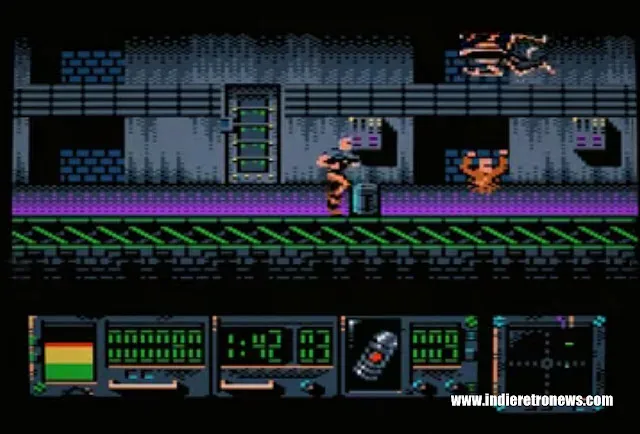
Alien 3, the 1990s action platformer originally developed by Probe Software for the Commodore 64, has received a new adaptation for the Amstrad CPC Plus. The project revisits the game's hostile-colony escape scenario on Amstrad's enhanced 8-bit machine, while taking advantage of hardware features that distinguish the Plus range from the earlier CPC models.
Rather than simply moving the Commodore 64 version onto another computer, the port has been designed around the Amstrad CPC Plus's capabilities. Its presentation uses the system's dedicated hardware sprite functions for major moving objects, including Ellen Ripley, Xenomorphs, stage Guardians and weapon fire. Those elements use a palette separated from the scenery behind them, helping characters and threats remain distinct amid the game's dark, industrial locations.
The result is an especially interesting release for retro players because it approaches a familiar licensed 8-bit game from a different technical angle. Alien 3 was already built around the tension of navigating an enemy-infested facility under pressure. On the CPC Plus, that structure remains intact, but the new version aims to make movement, action and audiovisual feedback feel more at home on Amstrad's later hardware.
A mission through a hostile colony
Alien 3 places players in control of Ripley as she pushes through an alien-infested colony. The objective is not merely to reach the end of a level. Across the game's 15 action stages, players must locate and free hidden prisoners, deal with the threats standing in their way, and eventually confront enemies at the conclusion of individual objective-driven missions.
For useful background on this topic, read Ace Combat Zero Will Become a Standalone PC App Following Player Backlash.
That setup gives the game a more deliberate rhythm than a straightforward left-to-right platform run. Progress depends on exploring dangerous areas, finding the people who need to be rescued and keeping enough resources available to finish the job. The colony is not presented as a safe place to hunt for bonuses at leisure; every room can become a problem when Xenomorphs are nearby and the clock is counting down.
A static heads-up display keeps the essential survival information visible. Players can monitor Ripley's health, ammunition, motion-tracking radar and remaining time from the HUD. The radar is particularly appropriate for an Alien game, giving players another tool for judging danger while preserving the pressure of uncertain encounters. It does not remove the threat of an attack, but it reinforces the need to pay attention to the space around the player rather than treating levels as simple obstacle courses.
Time is another important resource. The countdown system means that batteries matter: finding a replacement can be the difference between continuing the mission and losing the opportunity to complete it. That makes searching and route choice meaningful. A player may need ammunition, may need to find a prisoner, or may need to secure enough power to prevent the mission from ending before those other goals are met.
One life, limited supplies and no room for complacency
The CPC Plus version retains the game's unforgiving survival framework. Players have just one chance to complete the mission, putting extra weight on health, ammunition and battery management. With no spare life to absorb a major mistake, encounters with aliens and other enemies demand caution. The game's pressure comes not only from what is on screen, but also from the knowledge that poor resource use can have consequences much later in a stage.
This single-attempt design is well suited to Alien 3's setting. The film's prison-colony environment is remembered for its bleakness and desperation, and the game's objectives reflect that mood through limited equipment and constant urgency. Finding prisoners is framed as a rescue task, but it is never separated from Ripley's own fight to survive. Each completed area is a step through a hostile environment where ammunition and time cannot be taken for granted.
For players returning to older 8-bit action games, the structure also provides a reminder of how much tension can be created with a small number of clearly communicated systems. Health shows how close the player is to failure. Ammo determines whether they can respond aggressively. The radar hints at danger. The timer limits exploration. The battery extends the possibility of success. Together, those systems create a loop in which every pickup and every detour has potential value.
Built around CPC Plus hardware
The central feature of this conversion is its use of Amstrad CPC Plus hardware sprite support. Dedicated sprites allow important animated elements to be drawn separately from the background scenery. Ripley, enemies, Guardians and weapon bursts can therefore use their own palette rather than being constrained by the background's colour choices.
That separation is more than a visual flourish. In a fast action game, readable sprites are important. The player needs to identify Ripley's position, understand where enemies are approaching from and recognize weapon fire amid detailed scenery. Giving moving elements a detached palette is intended to provide contrast between the characters and the colony environments, while retaining the atmosphere expected from an Alien adaptation.
The port also uses fine hardware pixel scrolling. Smooth scrolling can substantially affect the feel of a platform game, particularly when the player is traversing wide corridors and multi-screen areas populated by moving threats. Here, it supports the flow of the action as the camera follows the player through the colony rather than making the world feel like a series of disconnected static screens.
These choices give the CPC Plus edition a visual identity of its own. It remains rooted in the same game and the same broad mission design as the Commodore 64 original, but it is not positioned as a deliberately slow or bare-bones transfer. The technical work focuses on exploiting the enhanced machine's strengths while preserving the 8-bit character of the material.
Classic music adapted for the AY chip
The audio has also been reworked for the Amstrad platform. The original Commodore 64 soundtrack has been adapted for the CPC's AY sound chip, bringing the game's music to a different audio architecture while maintaining its role in the experience. For a title based on Alien 3, sound is a major part of establishing tension, and the adaptation gives the Amstrad version its own sonic interpretation rather than relying on silence between action sequences.
Explosive effects are handled through the CPC Plus ASIC's DMA hardware. That division between music and effects is a notable technical detail, as it allows the game's gunfire and explosions to play alongside the soundtrack using the Plus hardware's advanced audio features. The aim is not only to make individual shots feel more forceful, but also to make busy moments sound as energetic as they look.
As with the sprite and scrolling work, the audio approach illustrates the project's broader purpose: this is an Amstrad CPC Plus version designed to embrace the characteristics of its target system. Retro ports can vary widely in ambition, from direct conversions to substantial reinterpretations. This release sits in between those extremes, preserving the identity of Probe Software's game while reshaping its technical presentation for another 8-bit platform.
A new route to an old Alien game
Licensed Alien games have taken many forms across decades of hardware, from arcade-style action to survival horror and tactical experiences. This particular Alien 3 adaptation belongs firmly to the compact, demanding style of early-1990s home-computer action games. Its appeal lies in the combination of platforming, shooting, exploration and strict resource management, all filtered through an Alien setting built for pressure.
The Amstrad CPC Plus release provides a fresh way to experience that design, especially for enthusiasts who enjoy seeing what later revisions of classic 8-bit hardware can accomplish. Its 15 stages, prisoner-rescue objectives, end-of-mission confrontations, HUD-based survival systems and single-life challenge retain the game's core. At the same time, dedicated sprites, smooth hardware scrolling, AY-adapted music and ASIC-driven effects give it a distinct CPC Plus personality.
The port is credited to Devil-System and GPT, with JAMSI credited to Devil-System. For Amstrad fans, Alien followers and collectors of ambitious homebrew and conversion projects, it is a notable return to a difficult game world where the radar is always worth watching, ammunition never feels plentiful and one fresh battery can decide the entire mission.
Community
Discussion
Start the conversation.
No comments have been posted yet.