

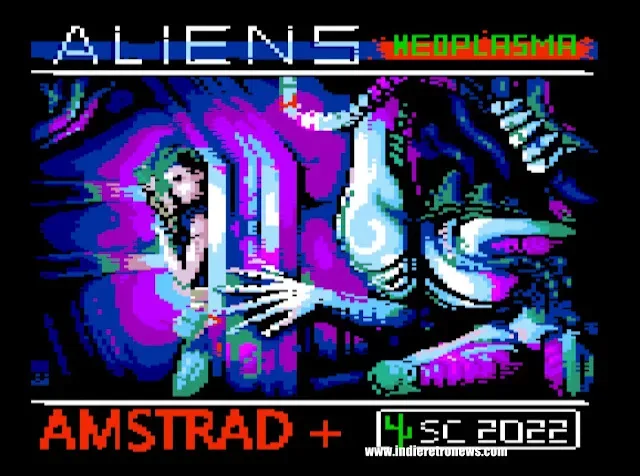
Aliens NeoPlasma, the atmospheric survival-horror platformer originally released for the ZX Spectrum, has received an unofficial conversion for the Amstrad CPC Plus. Developed by Devil System with AI assistance, the new version adapts Ashley Smith's bleak escape from the starship Achilles for Amstrad's enhanced 8-bit hardware, with a visual presentation designed around the machine's higher-resolution display mode and its ASIC sprite capabilities.
The game comes from the Sanchez Crew's acclaimed ZX Spectrum release, preserving its central premise: Ashley awakens on board a spacecraft where an apparently ordinary trip has gone catastrophically wrong. With danger waiting in the ship's shadowy passages, players must guide her through an enclosed network of platforms, ladders and automated doors while trying to locate the medical bay. It is not simply a race to the next screen. Survival depends on careful movement, exploration and a close eye on the limited tools available.
For Amstrad CPC Plus owners, the conversion is notable because it does more than place the original game on a different platform. Its presentation specifically makes use of features associated with the Plus range, aiming to give the horror adventure a sharper and smoother look while retaining the oppressive, sci-fi atmosphere that defines its setting.
A nightmare begins aboard the Achilles
Aliens NeoPlasma puts players in control of Ashley Smith immediately after an unsettling awakening. The Achilles is no longer the safe vessel it was meant to be, and the player's task is to find a way through a hostile interior before the dangers roaming its corridors end the journey. The medical bay represents a vital destination, but reaching it requires navigating a maze-like ship whose layout turns every route into a potential risk.
For useful background on this topic, read PS Plus November 2026 Catalog Adds Death Stranding 2, Dragon Quest III and More.
The game's tension is grounded in its setting. Rather than offering wide-open arenas or an abundance of safe spaces, the Achilles is built around tight corridors and connected traversal challenges. Ladders lead to elevated platforms, doors regulate progress, and each area can demand a different approach. This structure supports a slower, more deliberate kind of platforming, where advancing without considering the next threat or the next escape route can be costly.
That pressure is reinforced by the game's limited resources. Ammunition and grenades cannot be treated as endlessly available solutions, so players are encouraged to judge when combat is worth the expense. In a horror game set inside a compromised starship, scarcity does more than make encounters difficult: it helps sell the idea that Ashley is isolated, under-equipped and fighting to stay alive with whatever the ship still provides.
Terminals and counters found throughout the vessel are also important to the journey. Players will need to make use of the systems they encounter while continuing toward safety. The result is a game where survival is tied to observation as much as reflexes. Looking for useful locations, learning the shape of the environment and keeping enough supplies in reserve all matter when the corridors are filled with unseen or approaching terrors.
An enhanced conversion for the Amstrad Plus
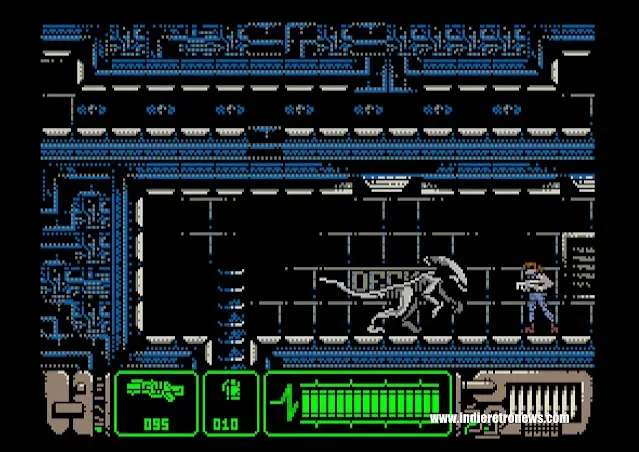
The Amstrad version is described as an enhanced effort that takes advantage of the CPC Plus hardware. During gameplay, Aliens NeoPlasma uses MODE 1, the system's higher-resolution display mode. That choice gives the active play areas a more defined appearance, well suited to the game's platform layouts, ladders and mechanical interiors.
MODE 1 is not the only technical element being used. The conversion also incorporates custom sprite colours and hardware-accelerated ASIC sprites. These features are intended to help character and enemy motion remain smooth and fluid on screen, a valuable consideration in a game where responsive navigation and readable moving threats are essential. On older systems, visual ambition always has to coexist with performance, and the Plus hardware offers developers extra tools for handling sprites beyond the base CPC specification.
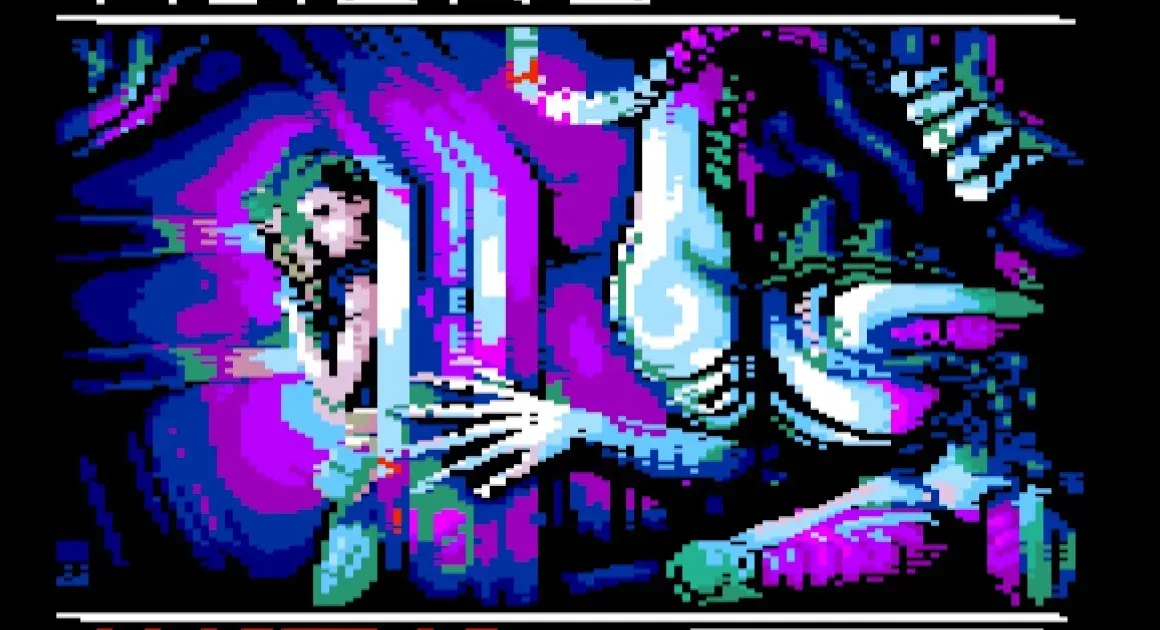
The production does not use one visual mode for every element. While gameplay favours the sharper MODE 1 approach, the cover artwork and title screen employ the more colourful MODE 0. This creates a division between the game's presentation and its active play spaces: MODE 0 can be used to make the introductory and decorative imagery feel more vibrant, while MODE 1 prioritises the detailed readability required once Ashley is moving through the Achilles.
It is a fitting approach for a conversion of a game with such a strong visual mood. Aliens NeoPlasma is built around darkness, confinement and the implication of danger beyond the immediate view. A high-resolution gameplay display can help define the ship's architecture, while the colour-rich title and cover imagery give the release a more striking opening impression before the player enters its hostile labyrinth.
Platforming where every resource matters
At its core, Aliens NeoPlasma remains a horror platformer. Players move across platforms, climb ladders and pass through automatic doors as they investigate the ship and seek the route to the medical bay. Yet the genre label only tells part of the story. The survival component changes how those familiar actions feel. A missed jump, an ill-timed encounter or a wasteful use of ammunition can have consequences later in the run.
Grenades offer another option when circumstances become especially dangerous, but they are part of the same resource-management pressure. The game asks players to decide when an immediate threat justifies spending valuable equipment. That can make even short stretches of the Achilles feel tense, particularly when the player is uncertain what waits ahead or how far the next useful terminal may be.
This kind of design is a natural match for the science-fiction horror premise. Ashley is not portrayed as a character who can casually overpower the situation. She is trying to endure it. The ship's mechanical systems, sparse supplies and maze-like construction all work together to frame the adventure as an escape from a disaster already in progress.
The need to interact with terminals and counters adds another layer to that atmosphere. These are not merely background details in an abandoned spacecraft; they are part of the player's attempt to survive long enough to find safety. Combined with automated doors and the multi-level structure of the ship, they give the Achilles the character of a functioning but deeply compromised environment.
A new destination for a Spectrum favourite
The arrival of an unofficial Amstrad CPC Plus version gives retro players another way to experience Aliens NeoPlasma's desperate journey through the Achilles. The original ZX Spectrum release earned substantial praise, and this conversion brings its core horror-platforming structure to a machine with different audiovisual strengths.
Rather than abandoning the game's original identity, the Amstrad Plus edition appears focused on presenting it through the capabilities of its new home. The use of MODE 1 during play, paired with custom colours and ASIC sprite support, targets clarity and motion. Meanwhile, MODE 0 remains available for the title screen and cover presentation, where richer colour can take priority. It is a hardware-conscious adaptation that acknowledges the distinct characteristics of the CPC Plus.
For fans of 8-bit home computers, that platform-specific work is part of the appeal. New releases and conversions keep older machines active not only through nostalgia, but through the challenge of seeing how contemporary developers interpret their capabilities. Aliens NeoPlasma's move from ZX Spectrum to Amstrad Plus places a tense, resource-starved science-fiction adventure in that tradition.
Ashley Smith's objective remains simple in principle and frightening in practice: stay alive inside the Achilles, use what can be found, manage every round and grenade, and reach the medical bay before the horrors in the corridors close in. The Amstrad CPC Plus conversion gives that struggle a new technical presentation, while preserving the dark journey at the heart of the game.
Community
Discussion
Start the conversation.
No comments have been posted yet.