

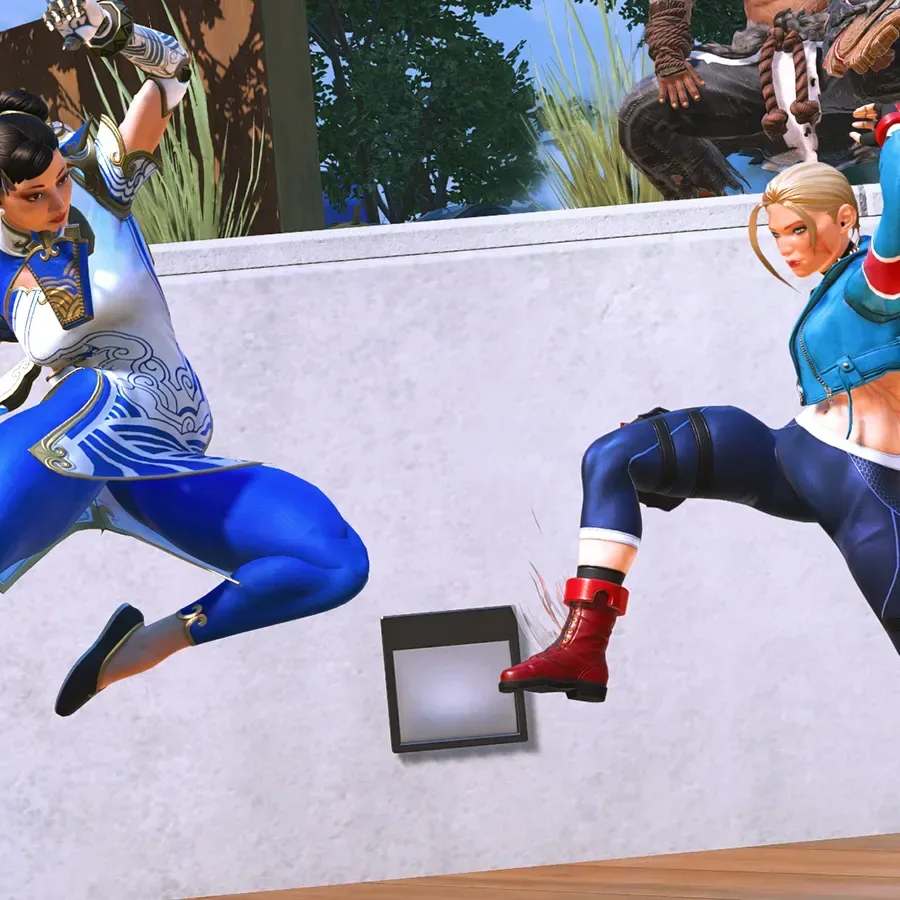
Apex Legends is preparing to bring the World Warriors into the Outlands on September 22, and the game's art team has apparently had to stretch its usual character-model boundaries to make the crossover work. The upcoming Street Fighter 6 collaboration will give several Legends costumes based on Capcom's iconic fighters, alongside a themed point of interest, weapon cosmetics, a Wildcard Takeover, and combat-inspired event activities.
For art director Alisa Rastorgueva, the central challenge was not simply recreating recognizable costumes. Street Fighter's fighters are famous for dramatically stylized builds, pronounced muscles, and silhouettes that can be identified almost immediately. Apex Legends has a different overall look: its cast is stylized but presented with a more semi-realistic approach. Combining those two visual languages meant the developers had to make some unusually bold choices with character proportions.
Rastorgueva said the Street Fighter skins resulted in some of the thickest thighs the Apex Legends team has ever created. It is a playful detail, but it reflects a serious production consideration behind crossover cosmetics. A costume needs to read as the guest character at a glance while remaining believable on the body, animation rig, and gameplay model of an existing Legend.
Eight Legends Become Street Fighter Favorites
The September 22 event will include eight crossover pairings. Sparrow will take on the appearance of Ryu, while Alter is being matched with Chun-Li. Mirage receives a Luke look, Caustic becomes Blanka, Wattson is styled after Cammy, Gibraltar takes inspiration from Akuma, Bangalore becomes Elena, and Pathfinder is set to appear as Dhalsim.
For useful background on this topic, read Wardogs Reaches 2 Million Sales in Five Days After Explosive Steam Early Access Launch.
Those choices cover a broad range of Street Fighter personalities and fighting styles. Ryu and Chun-Li are among the most recognizable figures in the franchise, making Sparrow and Alter especially important pairings for communicating the collaboration immediately. Meanwhile, characters such as Blanka, Dhalsim, and Akuma bring more extreme shapes and distinct costume elements that can make the event feel less like a standard collection of themed outfits.
That does not mean every potential Street Fighter character could make the transition. The team considered a larger selection before narrowing the field. Rastorgueva explained that collaborations involve input across internal departments as well as the partner that owns the guest property. The goal was to ensure Street Fighter characters remained identifiable after being adapted to Apex Legends, rather than simply applying familiar colors or accessories to unrelated models.
In particular, the developers found that Ryu and Chun-Li read clearly when translated onto Sparrow and Alter. That clarity mattered enough for the team to test character pairings before settling on the final roster. Crossover design often begins with obvious fan requests, but visual recognition, fit with a game's established cast, and practical production constraints can lead to less predictable decisions.
Muscles, Proportions, and an Apex-Sized Challenge
Street Fighter has long embraced heightened anatomy. Its fighters frequently have huge shoulders, imposing legs, sharply defined arms, and exaggerated stances intended to make them memorable in motion. Street Fighter 6 continues that tradition with highly detailed character models whose physiques convey each combatant's history and personality.
That creates a particular challenge in a shooter such as Apex Legends. Legends have established body types, recognizable animation sets, and gameplay readability requirements. Players need to identify opponents quickly, even when they are wearing elaborate cosmetics. The art team therefore had to push the models closer to Street Fighter's powerful visual exaggeration without losing the essential identity and readability of the Apex cast.
Rastorgueva compared the issue with the team's experience adapting other major properties. Each collaboration creates its own problem to solve. A previous Gundam crossover, for example, involved the task of fitting Apex Legends characters into the oversized visual language of giant mechs. Street Fighter's obstacle was different: achieving stronger muscle definition and more extreme proportions while still working inside Apex Legends' art direction.
The result suggests that the event skins will not be restrained interpretations. The developers appear to have treated Street Fighter's physicality as a foundational part of the crossover rather than a detail that could be minimized. For fighters such as Chun-Li and Cammy, whose designs are closely associated with powerful legs and athletic builds, that approach is likely essential to making the references land.
It also highlights why licensed skins can involve more work than simply dressing an existing character in a new outfit. Costume elements, materials, body shapes, silhouettes, animations, first-person considerations, and in-game visibility all need to function together. The more recognizable the guest design, the more noticeable even a small mismatch can become.
Gameplay Helped Determine the Roster
The crossover's selection process was not based on appearance alone. Senior technical game designer Chris Ruvolo said gameplay compatibility played a major role in deciding which Street Fighter characters were viable for Apex Legends.
Apex is primarily a first-person battle royale shooter, even if its Legends possess a wide range of abilities. Street Fighter is a one-on-one fighting game built around close-range attacks, throws, grapples, special moves, spacing, and fighting-game-specific systems. Those foundations do not translate evenly. Ruvolo pointed to Zangief as an example of a character the developers would have liked to include but could not easily fit into the shooter's framework. A grappler is an exciting archetype in a fighting game, but that focus is harder to adapt naturally to an FPS event.
Instead, the team prioritized characters associated with projectiles or area-of-effect attacks. That direction is a much clearer fit for Apex Legends, where players are already accustomed to ranged threats, zones of control, explosive pressure, and ability-driven encounters. The developers also played Street Fighter 6 extensively, including its fighter passes, while exploring which characters might translate best into the Apex setting.
The approach explains several choices in the final list. Ryu's Hadouken is perhaps one of the most instantly recognizable projectile attacks in video games. Dhalsim's unusual reach and elemental attacks, Blanka's electric identity, and Akuma's aggressive energy-based techniques all have concepts that can feel at home in an action shooter event. Even when the crossover is centered on cosmetics, the broader event framing benefits from fighters whose signature ideas can be communicated through Apex-style combat activities.
Wildcard Takeover Brings the Brawl to Apex
The Street Fighter 6 collaboration will not stop at skins. Apex Legends players will be able to enter a new Wildcard Takeover connected to the event. The crossover also includes a decorated point of interest and weapon skins, giving the collaboration a larger in-game footprint than a shop-only cosmetic drop.
Players will be able to punch destructible cars during the event, an appropriately arcade-like addition for a crossover built around legendary combatants. The event will also let players perform a Hadouken, bringing one of Street Fighter's defining moves into the battle royale environment.
Details on exactly how all of those elements will function have not been outlined here, so players will need to see how the takeover's rules, abilities, and map interactions are implemented once it goes live. Still, the stated features indicate that the collaboration aims to capture more than Street Fighter's wardrobe. The destructive objects and Hadouken mechanic point toward a temporary mode designed to make players feel some of the energy of a fighting game within Apex Legends' fast-moving multiplayer structure.
That is an ambitious balance to strike. A successful crossover has to satisfy fans of both series while ensuring that Apex Legends remains Apex Legends. The developers' comments suggest that the selection of Street Fighter fighters, the exaggerated cosmetic work, and the event gameplay were all shaped by that same question: what can be recognized immediately as Street Fighter while still making sense in a hero-based shooter?
A Crossover Built Around Recognition
Licensed events often succeed or fail on recognizability. Players want to see the defining qualities of a guest franchise, whether that means a costume silhouette, a signature attack, a famous color palette, or a familiar arena-like spectacle. With Street Fighter 6, those qualities include oversized martial-artist physiques as much as they include headbands, gloves, uniforms, and special moves.
For the Apex Legends art team, pushing the cast to its most muscular proportions yet was part of respecting that identity. The final skins will need to convince players that Sparrow can evoke Ryu, Alter can evoke Chun-Li, and the remaining Legends can carry the presence of their respective Street Fighter counterparts. At the same time, they must still feel appropriate for the Outlands and remain readable during chaotic matches.
The Apex Legends x Street Fighter 6 collaboration begins September 22. When it arrives, players will be able to see how far those model changes go in motion, test the event's Wildcard Takeover, and decide whether a Hadouken belongs in the middle of an Apex firefight.
Community
Discussion
Start the conversation.
No comments have been posted yet.