

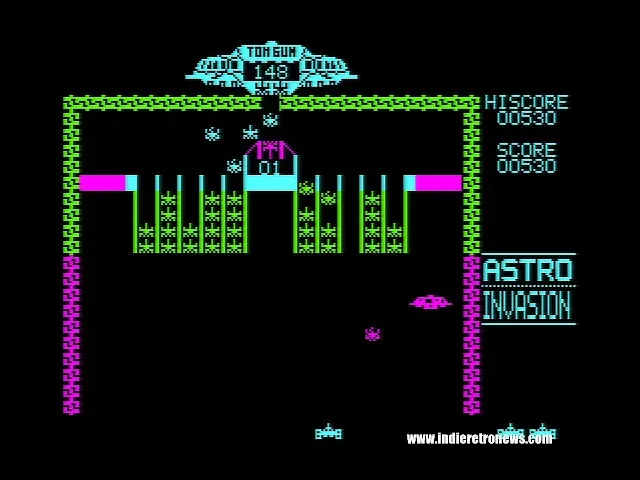
Astro Invasion is bringing a direct, high-pressure arcade shooting challenge to several classic home computers. Created by Tom Gun Software, the new release is a space shooter built around fast reactions, a lone player-controlled starfighter, and wave after wave of hostile aliens descending from an invading mothership.
The game takes clear inspiration from Astro Invader, Stern's 1979 arcade title, while being designed specifically for a broad set of vintage computer systems. Astro Invasion is available across the Amstrad CPC family, Dragon 32, Dragon 64, Dragon by Tano, and the Tandy Color Computer range. It is a notably wide release for hardware with meaningful differences in video output, input expectations, regional standards, and technical capabilities.
Rather than attempting to modernise the formula with elaborate progression systems or lengthy narrative scenes, Astro Invasion appears focused on the foundations that made early arcade shooters compelling: immediate danger, constant movement, incoming formations, and the pressure to stay alive while the screen becomes increasingly crowded. It is a game built to test reflexes, whether players choose a keyboard or a traditional joystick.
A classic arcade idea for vintage computers
The premise is deliberately easy to understand. Players take command of a solitary fighter facing an alien mothership and the seemingly unending forces it deploys. The threat comes from descending swarms, creating the familiar tension of an arcade invader game: every missed target and every lost second gives the enemy more room to take over the playfield.
For useful background on this topic, read PS5 Emulation Takes Early Steps Forward as Demon's Souls and Astro Bot Show Progress.
That stripped-back structure matters. Classic fixed-screen shooters thrive on readability. Players must be able to identify the enemy movement, judge safe spaces, fire with purpose, and react quickly when a formation closes in. Astro Invasion is positioned as a fast-paced take on that tradition, placing its emphasis on moment-to-moment survival rather than complicated rules.
Its inspiration is especially fitting for the systems involved. The Dragon and Tandy Color Computer lines have a long association with games that asked developers to get inventive within limited memory and processing budgets. The Amstrad CPC, meanwhile, remains a popular platform for new retro releases thanks to its enthusiastic development community and distinctive audiovisual possibilities. A cross-platform shooter built around strong fundamentals can make sense on all of them, but translating it effectively requires attention to each machine's strengths.
Written entirely in machine code
One of Astro Invasion's most notable technical claims is that it has been written 100% in pure machine code. For a reflex-driven action game, that choice is central to the experience rather than just a piece of technical trivia. Fast shooters depend on responsive input, clean movement, and a stable pace when enemies, projectiles, and player actions are all competing for processing time.
Machine-code development gives a programmer direct control over the hardware, which can be particularly valuable on 8-bit systems. It allows the game to be tuned for quick execution and can help reduce the overhead that might otherwise affect the speed or consistency of arcade-style action. Tom Gun Software describes Astro Invasion as delivering smooth, rapid gameplay, and that performance focus is a natural match for the game's simple but demanding concept.
The result is intended to feel equally playable with either of the control methods expected on these machines. Keyboard controls are supported, while joystick users can take a more arcade-like route. The latter is particularly welcome for a game whose identity is tied so closely to coin-op shooting, where movement and firing need to feel immediate.
For players returning to original hardware, controls are more than a convenience feature. Different computers, interfaces, and regional setups can make a supposedly universal game feel inconsistent if the input configuration has not been considered carefully. Astro Invasion addresses part of that challenge with automatic keyboard mapping on Dragon and CoCo machines, reducing setup friction for players using those versions.
Colour on CPC, monochrome elsewhere
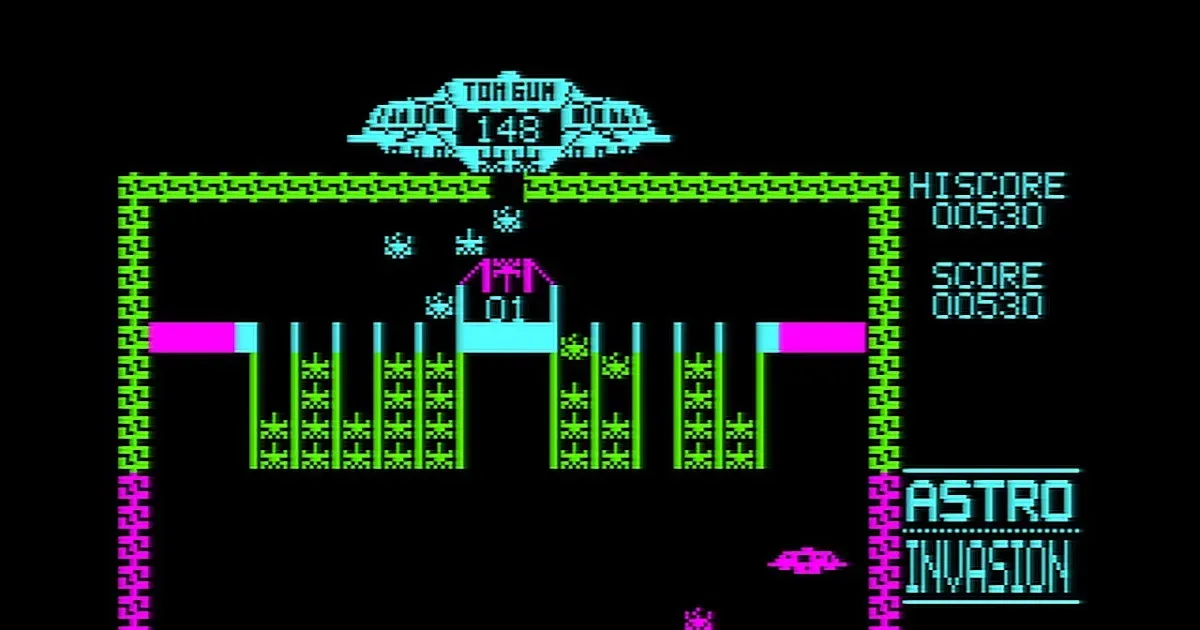
Astro Invasion also takes a different visual approach depending on the hardware. The game uses a crisp high-definition black-and-white presentation on its other supported vintage systems. On the Amstrad CPC, however, the battles are presented in full colour.
That distinction gives the CPC version a particular point of interest for collectors and players who enjoy comparing multi-platform releases. Colour can change the atmosphere of a space shooter dramatically, helping projectiles, enemy formations, and the player craft stand apart amid the action. At the same time, the monochrome approach on the Dragon and Tandy platforms is not simply a compromise in concept. High-contrast visuals can be very effective in a fast shooter, where instant recognition is arguably more valuable than visual complexity.
The choice also reflects the practical reality of developing for several older systems. A developer can preserve a consistent core game while adapting the presentation to fit the available capabilities. In Astro Invasion's case, the central action remains the same: defend against the invasion, manage the pressure created by descending enemies, and aim for the speed and clarity associated with the genre's arcade roots.
The CPC's colour-exclusive presentation gives that edition an extra differentiator without changing the game's shared identity. It is still the same invasion to repel and the same test of reactions, but owners of the Amstrad machine receive a version tailored to one of its most immediately visible strengths.
PAL and NTSC versions run at the same speed
Regional compatibility is another important part of Astro Invasion's release. Both PAL and NTSC formats are supported, and they run at identical speeds. That may sound like a small detail, but it is significant for an action game designed around timing.
PAL and NTSC systems traditionally operate at different refresh rates. Without careful handling, games can play noticeably faster or slower between regions, altering difficulty, animation pacing, and the time available to react. In an arcade-style shooter, those differences can affect the entire feel of the game. An enemy pattern that is tense but manageable at one speed may become too forgiving or too punishing at another.
By keeping the pace identical in both formats, Astro Invasion aims to ensure that its core challenge remains consistent regardless of which regional machine is being used. That is a welcome technical consideration for a title that is explicitly selling itself on quick, smooth action. Players should be facing the same intensity of alien assault rather than a version of the game shaped by television standard differences.
A universal release across several 8-bit families
The supported list is broad: Dragon 32, Dragon 64, Dragon by Tano, Tandy Color Computer, and Amstrad CPC. Calling the release universal is meaningful because it suggests an effort to make the same arcade-minded game available to communities that are often served separately.
The Dragon and Tandy Color Computer ecosystems share technical heritage, but individual models and user setups still matter. Dragon by Tano support further widens the potential audience among enthusiasts maintaining and playing these systems today. Adding the Amstrad CPC creates a release that reaches beyond one hardware family while retaining the distinctly 8-bit character of the project.
For retro gaming fans, this kind of multi-system launch has appeal beyond convenience. It invites comparison between versions, encourages discussion of each platform's output and controls, and gives players a chance to experience a new game on the hardware they already collect or emulate. It also demonstrates that there is still room for fresh releases that respect the technical and design language of the era rather than merely referencing it from a modern platform.
Reflexes first, spectacle second
Astro Invasion's appeal is likely to rest on how confidently it delivers its core loop. The game does not need an elaborate premise to create stakes: one fighter, a hostile mothership, and relentless waves are enough. The best games in this tradition make every second feel consequential, asking players to balance aggression with survival as the enemy pressure mounts.
Tom Gun Software's emphasis on fast machine-code performance, joystick and keyboard support, automatic mapping on Dragon and CoCo systems, equal PAL and NTSC speed, and platform-specific visual treatment all point toward a release designed around practical playability. Those details matter because they support the same goal: keeping attention on the screen, the incoming aliens, and the next split-second decision.
For anyone who enjoys the stripped-down urgency of late-1970s arcade shooting, Astro Invasion offers a new reason to power up an Amstrad CPC, Dragon, or Tandy Color Computer. Its foundations are familiar, but the release is built for the machines still being played decades later--an old-school invasion with a newly written response.
Community
Discussion
Start the conversation.
No comments have been posted yet.