

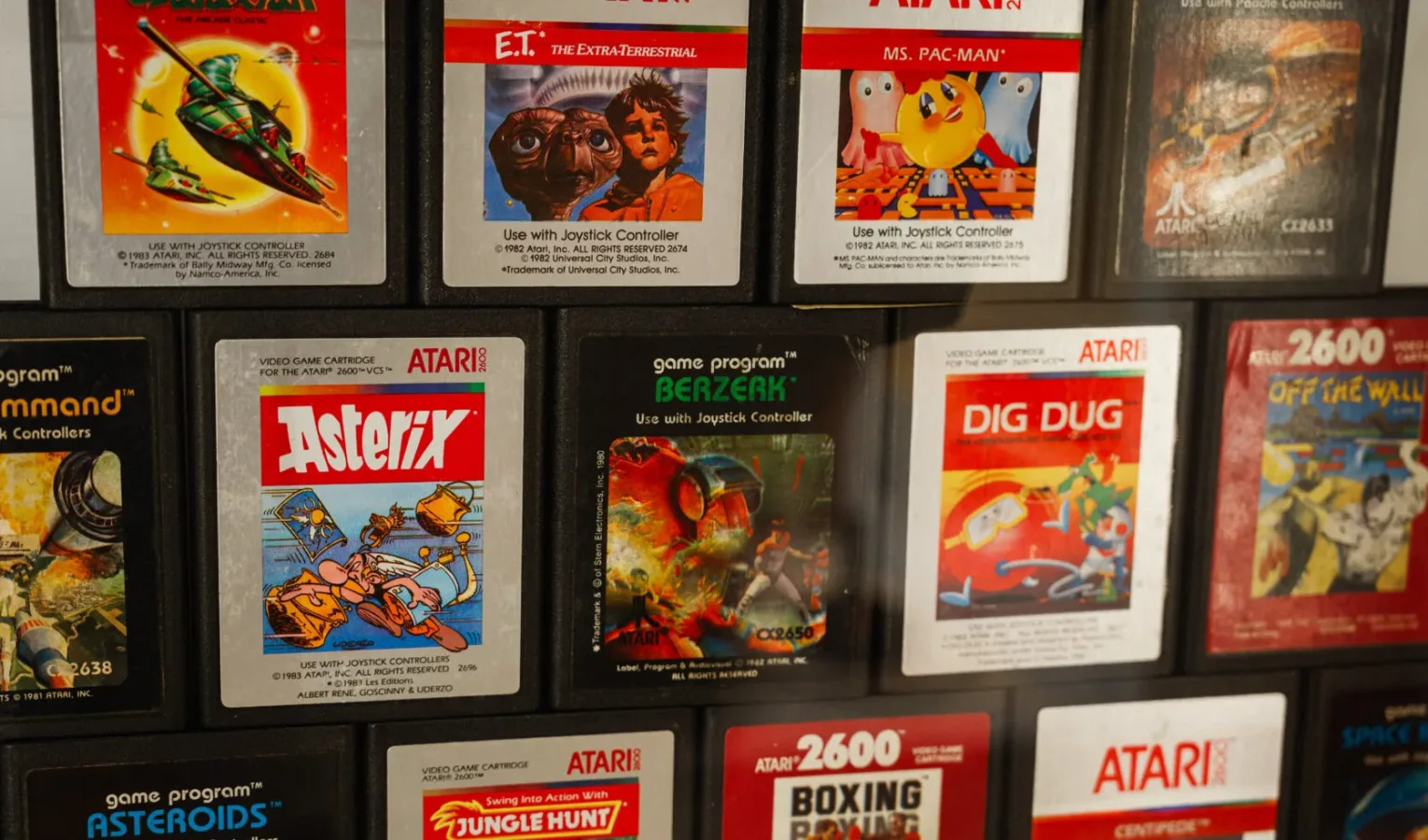
The Atari homebrew community is facing a difficult new question: how should a contest built to celebrate independent, enthusiast-made retro games handle projects created partly--or potentially almost entirely--with generative AI?
For now, the Atari Homebrew Awards will not attempt to answer it through this year's ceremony. ZeroPage Homebrew, the awards' organizer, has announced that the event has been suspended following an increasing volume of AI-assisted game releases and uncertainty over how those games could be qualified and judged fairly. The decision means what would have been the awards' ninth year will not go forward.
The announcement was made in a post on the Atari Age forums, where ZeroPage Homebrew explained that the issue had grown more challenging over the course of the year. Developers using AI tools were reportedly releasing games at a much faster pace in some cases, including multiple projects in a single week. That created more than a simple backlog of entries. It forced the organizer to reconsider what the awards are meant to recognize in the first place.
Embedded X/Twitter post
A problem larger than sorting submissions
At first glance, the answer might appear straightforward: ban AI-generated games, or create a separate category for them. But the situation is considerably less clear when looking at how modern development tools can be used. A game may use AI for a small piece of code, a music cue, an item of artwork, text, level concepts, bug fixing, or production assistance. Another project may depend on it for most of its assets and programming. Drawing a boundary between those cases is not easy.
For useful background on this topic, read How to Steal a Bravado Banshee in GTA 6 and Earn the Capital Offense Trophy.
ZeroPage Homebrew indicated that fully AI-generated games were not considered appropriate for the awards. The more difficult question was determining how much AI contribution would conflict with the event's purpose. If a developer writes a game themselves but uses an AI tool to help compose audio, does it belong? What if the AI was used for graphics but the code, design, and implementation were handled by a person? If it helped produce code that was then heavily revised, where should that entry fall?
Those questions matter especially in the homebrew scene. The term generally describes new software made for legacy hardware and platforms long after their commercial lifespans. Homebrew creators often work with severe technical limitations, old development environments, custom tools, physical cartridge production, and a great deal of self-taught expertise. The finished game can be a demonstration of programming ability, hardware knowledge, design craft, artistic expression, or all of those at once.
An awards program for that work is therefore not merely measuring whether a game runs or whether players enjoy it. It is also recognizing the creative and technical labor that brought a new experience to machines from another era. Generative AI complicates that recognition because it can alter both the pace of production and the visibility of individual contributions.
The verification dilemma
Even if the Atari Homebrew Awards adopted a detailed written policy, enforcing it would present another obstacle. There is no reliable universal method for determining exactly how much AI was used during a game's development. An organizer could require creators to disclose their use of AI, but that depends on honest and sufficiently specific reporting. A developer might also have a different understanding of what counts as AI assistance than a judge or another community member.
Attempts to investigate entries can introduce their own problems. Community scrutiny may turn into accusations aimed at developers who have not broken any stated rule. Automated detection tools, meanwhile, are widely criticized for false positives and cannot provide a complete record of a project's production process. A pixel-art asset could be challenged because it resembles generated material; code could be suspected because it has familiar structures; music could prompt debate based on style rather than evidence.
ZeroPage Homebrew described AI's arrival as a fundamental change to how retro games are being made, rather than one of the smaller organizational issues the awards had previously worked through. With no clear route to an approach that could be applied consistently, the organizer chose to suspend the event rather than proceed under rules that might be disputed by entrants and voters alike.
"We were always able to come up with a solution for small issues in previous years but the advent of AI marked a seismic shift in the way retro games were being made," ZeroPage Homebrew wrote. "I saw no path forward and made the difficult decision to suspend the Atari Homebrew Awards this year."
Why the decision hits the retro community differently
The Atari homebrew space is not a conventional games market, where enormous release schedules and studio-scale production are expected. It is a close-knit community of developers, collectors, hardware tinkerers, players, and preservation-minded fans. A new game for an Atari platform can take years of spare-time effort, and creators often share their processes, tools, technical discoveries, and prototypes publicly.
That collaborative culture makes the AI debate especially complicated. Homebrew development has always involved tools that make difficult work more manageable: assemblers, compilers, graphics editors, music trackers, emulators, flash cartridges, documentation, and code shared by fellow enthusiasts. Some community members may see AI as another tool that can help more people make games for aging platforms. Others believe the technology is fundamentally different because it can generate large amounts of content and code from prompts, potentially obscuring authorship and diminishing the accomplishment that the awards are intended to spotlight.
There is also a practical concern about volume. When a creator can use automated systems to accelerate asset production, coding, or ideation, the number of projects arriving for consideration may grow faster than a volunteer-run awards program can reasonably evaluate. Quantity does not automatically mean a game lacks merit, but a high volume of releases can strain a process designed around a smaller pool of carefully reviewed submissions.
The conversation following the suspension has reflected those competing perspectives. The forum thread accumulated hundreds of comments, with participants debating whether AI has any legitimate role in Atari homebrew, whether disclosure can solve the problem, and how a community can distinguish between ordinary software assistance and content generation that changes the nature of a work. Some responses were sharply hostile toward AI use, while others focused on the broader impact these tools can have on creators and workplaces.
No easy rulebook for AI-assisted games
The Atari Homebrew Awards situation illustrates a problem reaching far beyond one retro community. Game jams, modding contests, indie showcases, art competitions, and awards organizations are all being pushed to define policies for creative work made with generative tools. The decisions are difficult because "AI-assisted" describes an enormous range of activity.
At one end, a developer might use a chatbot to explain an unfamiliar programming concept, similar to consulting a tutorial or asking a question in a forum. At another, someone could ask a system to generate gameplay code, menus, dialogue, music, artwork, promotional copy, and design ideas, then assemble the results into a product. Between those extremes are countless mixed workflows. A single blanket rule may be easy to communicate, but it can fail to account for meaningful differences in authorship and process.
Possible approaches each carry tradeoffs:
- Complete prohibition: This is simple in principle, but difficult to verify and potentially broad enough to include limited forms of assistance that some creators consider acceptable.
- Mandatory disclosure: Entrants could document where and how AI was used, although the process relies heavily on self-reporting and may still spark disagreements over incomplete information.
- Separate categories: This could preserve a place for AI-assisted work while protecting traditional categories, but it may require more judges and could imply distinctions that remain hard to define.
- Human-authorship thresholds: Rules could attempt to set limits on AI-created material, yet measuring a percentage of contribution across art, code, audio, and design is likely to be subjective.
- Process-focused judging: Awards might ask entrants to provide development notes, source material, or demonstrations. That could increase transparency, but it also adds administrative work and may be intrusive for hobbyist creators.
None of those options offers a painless answer, particularly for an event operated within a volunteer community. The suspension is a reminder that policy design has real costs. A rule only works if organizers can explain it, apply it consistently, and give participants confidence that the same standard applies to everyone.
What comes next for Atari homebrew
The announcement suspends this year's Atari Homebrew Awards; it does not necessarily establish a permanent end to the event. However, no replacement format, revised eligibility policy, or return date was announced. Any future revival will likely require the organizers and community to decide what they want the awards to celebrate and how much evidence they need to assess a game's creation fairly.
In the meantime, Atari homebrew development itself will continue. New projects for old systems have endured because their communities value experimentation, technical challenge, and the unusual thrill of seeing contemporary ideas run on decades-old hardware. AI tools are now part of the environment surrounding that work, whether embraced, avoided, or debated.
The canceled ceremony does not resolve the argument. Instead, it makes the stakes clear. For retro game communities, the question is no longer simply whether generative AI can make a game. It is whether an awards program can preserve trust, credit human craft appropriately, and remain open to new tools without losing the identity that made the celebration meaningful in the first place.
Community
Discussion
Start the conversation.
No comments have been posted yet.