

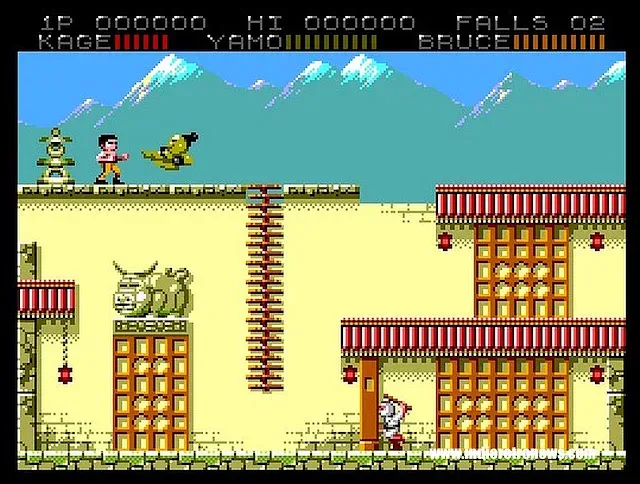
Bruce Lee has made its way to the Commodore Amiga in a new conversion by Tim Kovack, bringing the Sega Master System edition of the martial-arts action game to classic Amiga OCS hardware. The project is notable not simply because it puts a familiar 8-bit game on Commodore's 16-bit machine, but because of the technical route taken to get it there: rather than building an approximation from the ground up, the game's original Master System logic was translated from Z80 assembly into Motorola 68000 machine language.
That approach is intended to retain the feel of the console version as closely as possible. Its movement, mechanics and timing follow the Master System release's behavior, while the conversion has been built to run on an Amiga OCS system with only 512KB of RAM. It also supports both of the major video standards associated with Amiga hardware, PAL and NTSC, with the expected difference in game speed between them.
For retro enthusiasts, this is the kind of release that highlights why the Amiga homebrew and preservation scene remains so active. Ports of older games are often judged on surface-level details such as graphics or sound, but this project places considerable emphasis on the less immediately visible elements: instruction-level game behavior, sprite handling, memory limits and refresh-rate accuracy. The result is a version aimed at reproducing a particular 8-bit release on hardware with a very different architecture.
Master System behavior translated for the Amiga
The key detail behind this conversion is the decision to translate the original Sega Master System game code instead of recreating its systems through a fresh rewrite. The Master System was powered by a Z80 processor, whereas the Amiga uses the Motorola 68000 family. Those processors have very different instruction sets, so moving the game across required converting its machine-level logic for the Amiga's hardware.
For useful background on this topic, read Taki Udon Teases SuperFPGA, a Potential SNES-Focused FPGA Console.
Using that translated logic means the port is designed around the original game's internal rules rather than a modern interpretation of them. In practical terms, this should preserve the cadence of the action, the behavior of characters, and the timing that players familiar with the Master System edition would expect. It is an especially meaningful goal for a game where the rhythm of movement and reactions can matter as much as the visual presentation.
It also distinguishes the Amiga version from a broad "inspired by" recreation. The project's purpose is not to exploit the Amiga's extra capabilities to turn the game into a substantially altered edition. Instead, it uses the platform's features and compromises to bring over the established Master System experience as faithfully as the machine's constraints allow.
PAL and NTSC systems keep their regional pace
The conversion supports both NTSC and PAL Amigas, and it treats the refresh-rate split in a manner consistent with the original console release. On an NTSC machine, Bruce Lee runs at 60Hz, matching the velocity of the Master System game. This is the version players seeking the original North American and Japanese-speed experience will want to use.
PAL Amiga systems run the game at 50Hz. That produces a pace roughly 17% slower than the NTSC version, but this is not presented as an accidental performance shortfall. It mirrors the behavior of the game on European PAL Master System hardware, where the lower refresh rate likewise changed the overall speed. In other words, the port preserves not just one universal timing model, but the regional variation that came with the original hardware environment.
That distinction can be important in retro gaming. A title's speed is part of its design, affecting enemy behavior, response windows and the momentum of play. Players who grew up with a PAL release may find the 50Hz presentation immediately familiar, while those accustomed to the 60Hz version will be able to experience the faster timing on compatible NTSC Amiga systems.
Sprite techniques balance color and performance
Visually, the Amiga release uses hardware sprites in attached pairs for its characters. This permits 16-color character graphics that match the Master System version's palette. It is a smart use of the Amiga's dedicated display hardware, particularly for a project that is trying to preserve the look of an 8-bit console game rather than replace it with a wholly new art style.
However, classic hardware ports are often defined by the limits that need to be managed as much as by the capabilities that can be used. The conversion employs several practical solutions to keep the game performing reliably. Stationary elements, including the stage lanterns, are incorporated into the background graphics instead of being maintained as separate moving sprite objects. By baking those details into the scenery, the game saves sprite resources for characters and other active objects.
There is also a safeguard for crowded moments. If more than four moving sprites occupy the same horizontal screen lines, the additional objects are drawn directly into the background. This avoids screen flickering, a familiar concern in sprite-heavy games on many older systems. The technique does involve changing how those extra objects are rendered, but it prioritizes a stable on-screen image when activity becomes dense.
These details reveal the careful balancing act behind the port. The Amiga is frequently remembered as a powerful machine for its era, but its graphical capabilities still have specific rules, and a 512KB target leaves little room for waste. Making a conversion feel authentic while working within those rules requires choices about which visuals remain independent sprites and which can be treated as part of the backdrop.
Room transitions come with a brief redraw
One trade-off players will encounter occurs when moving between rooms. Each room change triggers a full screen redraw, producing a short pause of a couple of frames. It is a small interruption, but one that reflects the port's hardware-conscious design and the decision to work within a very modest memory configuration.
For many fans of original Amiga software, such behavior will be part of the expected character of an OCS release rather than a major obstacle. The project is operating on an Amiga configuration that is far more restrictive than later expanded machines, and the conversion's priorities are clear: preserve the Master System game's core behavior, maintain its color presentation, and avoid distracting sprite flicker during active scenes.
As with the PAL and NTSC differences, the redraw delay is a useful reminder that ports are not merely software copied from one format to another. They are negotiations between two sets of technical assumptions. The Master System code and design are being brought to a platform with different CPU, graphics and memory characteristics, so some platform-specific behavior is inevitable.
One important limitation for Amiga users
Amiga owners should be aware of one usability limitation before loading the game. Bruce Lee does not include an in-game route back to Amiga Workbench. When it is time to stop playing, users will need to reset the machine physically rather than quit back to the graphical desktop through the software.
That is an important practical note for anyone using original hardware, and it may also matter to users configuring an emulated Amiga environment. It does not change the game itself, but it does mean the normal end-of-session process is less convenient than it would be in software with a Workbench exit option.
A focused addition to the Amiga retro library
Bruce Lee's arrival on Amiga OCS is an interesting release because it is focused on accuracy at several levels. The translated Z80-to-68000 logic seeks to preserve the original Master System game's fundamentals. NTSC and PAL support retains the distinct 60Hz and 50Hz pacing associated with each region. Attached sprite pairs deliver 16-color characters in the expected palette, while background drawing techniques keep the game from suffering from heavy sprite flicker.
There are compromises, including the brief room-redraw moments and the lack of a Workbench exit, but they are presented openly and stem from the realities of fitting the project onto a 512KB OCS Amiga. For players who remember Bruce Lee from 8-bit home computers or Sega's console, and for Amiga collectors interested in new software tailored to classic specifications, this conversion offers a technically thoughtful way to revisit the game on Commodore hardware.
More broadly, it is another example of how much care can go into a retro conversion long after a platform's commercial lifespan. Faithful timing, low-level code translation and old-school sprite management may not be flashy marketing bullet points, yet they are precisely the details that can make a familiar game feel right when it appears on a new vintage machine.
Community
Discussion
Start the conversation.
No comments have been posted yet.