

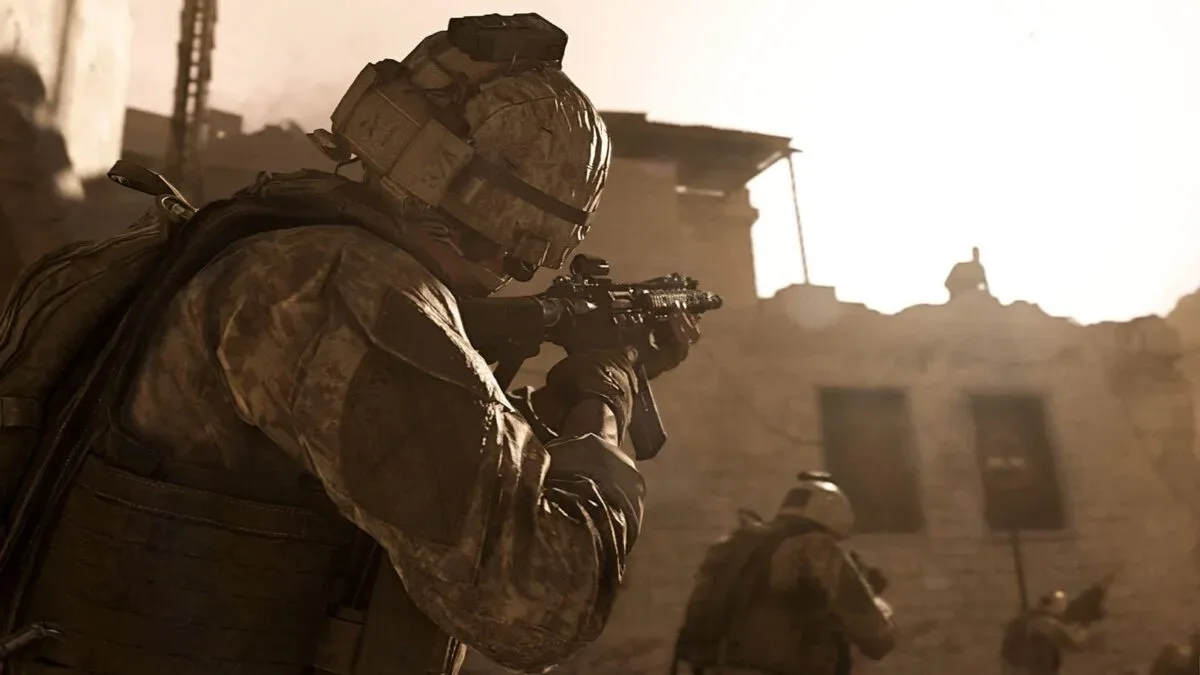
The upcoming Call of Duty movie is being positioned as more than a large-scale military action spectacle. Director Peter Berg has said the film, set within the Modern Warfare continuity, will pursue a nuanced story about the human consequences of conflict and the burdens carried by soldiers.
That is an ambitious description for a franchise most immediately associated with blockbuster firefights, military hardware, cinematic campaigns, and hugely popular competitive multiplayer modes. It is also a familiar one. Across multiple Call of Duty releases, the series has regularly presented itself as an attempt to depict the grit, trauma, ambiguity, or moral weight of warfare, even as its central commercial appeal remains fast, polished combat entertainment.
The adaptation is planned for June 2028 through Paramount Pictures. Berg is directing and co-writing the screenplay with Taylor Sheridan, the creator of Yellowstone. While the project's story details are still limited, Berg's recent comments provide a clearer sense of the creative language surrounding the film: a serious military drama built around recognizable Modern Warfare characters and themes rather than a deliberately heightened, comic-book-like action fantasy.
Berg points to Modern Warfare's characters
Discussing the project during publicity for his other military-focused film, The Mosquito Bowl, Berg highlighted the perceived depth of the Modern Warfare setting. He pointed to figures including Captain Price, Soap, Ghost, and Alex as characters he sees as complicated people rather than broad archetypes.
For useful background on this topic, read World of Warcraft Forever Adds Skyborne as Blizzard Explains Horde Elf Strategy.
His argument is that the games contain a dramatic foundation beneath their gunfire: soldiers confronting violence, danger, duty, and the lasting impact of their choices. Berg said he and Sheridan recognize that foundation and intend to bring a sense of consequence to the film. He also suggested the Call of Duty movie may be less graphically violent than The Mosquito Bowl, while still treating war with gravity.
There is an understandable practical reason for this approach. A Call of Duty adaptation will need an identity beyond recreating familiar missions, weapons, and set pieces. The brand is already capable of delivering spectacle in interactive form. A feature film has to make a case for why audiences should follow these soldiers in a non-interactive story, particularly when military action cinema is already crowded with tales of elite units, covert operations, impossible rescues, and battlefield brotherhood.
Centering Captain Price and other established characters could give the movie an immediate emotional anchor. The Modern Warfare games have long used a recurring cast to create continuity amid globe-spanning operations, and the names Berg mentioned are among the franchise's most recognizable. Yet character recognition alone will not settle the harder question: what exactly does this film want to say about the conflicts it portrays?
A promise the series has made before
Call of Duty has often moved between two public identities. In one, it is unapologetically a thrill ride: a fast-moving fantasy of tactical competence, dramatic explosions, stylish weaponry, and coordinated multiplayer victories. In the other, it is presented as a serious reflection on the realities of warfare, asking players to reckon with fear, loss, civilian harm, and morally difficult decisions.
Neither identity is inherently impossible to pursue. Games can mix entertainment with dramatic themes, and action stories can depict violence without celebrating every aspect of it. The tension comes from how Call of Duty repeatedly combines claims of seriousness with a structure that rewards combat, frames players as extraordinarily capable military operators, and turns the tools of war into objects of progression, collection, customization, and competitive mastery.
The 2019 Modern Warfare reboot is a major example of that tension. Its development messaging emphasized realism and moral uncertainty. The campaign included scenes designed to make players uncomfortable or make them pause before acting, including a moment built around uncertainty over whether a civilian is reaching for a weapon. The stated idea was that the player could make a terrible mistake and feel the consequences of acting too quickly.
But moments like that also drew scrutiny over what kind of discomfort the game was creating, what it left outside the frame, and whether isolated scenes of shock could meaningfully challenge the wider power fantasy. Other Call of Duty titles, including World War II, Vanguard, and earlier Modern Warfare entries, have likewise used promotional language about authenticity, historical weight, or the devastating costs of combat.
The movie therefore arrives with a built-in credibility problem. Saying that a Call of Duty story has "soul" and acknowledges war's costs will not, by itself, distinguish it from years of franchise marketing. For viewers who have seen the series invoke realism before, the important measure will be whose pain is explored, whose perspective is granted complexity, and whether the story is willing to challenge the assumptions beneath its own military heroism.
The politics behind a military blockbuster
Criticism of Call of Duty's handling of war has never been limited to whether its campaigns are sufficiently sad or violent. The franchise has faced longstanding objections over jingoistic framing, portrayals of Muslims and Arabs, the way it treats U.S. military power, and its relationship to the broader military-industrial culture surrounding modern warfare.
Those concerns make "the cost of war" a much larger theme than the emotional scars borne by individual soldiers. A genuinely searching war story can ask why a conflict occurred, who benefits from it, how civilians experience it, how institutions justify it, and how rhetoric around courage or sacrifice can obscure political failure. It can also examine the costs paid by people on every side of a war, rather than treating foreign locations mainly as backdrops for a Western protagonist's mission.
That does not mean a Call of Duty film must reject its action roots or portray every soldier as a villain. It does mean that a serious treatment of war requires more than emphasizing that combat is frightening and that service members carry trauma. A film can respect individuals caught in systems of violence while still interrogating those systems. It can recognize bravery without suggesting that every mission, intervention, or military objective is automatically righteous.
This is where the choice of Modern Warfare is especially significant. The sub-series has always drawn on contemporary anxieties: terrorism, covert warfare, proxy conflicts, surveillance, unstable alliances, and the blurring of conventional battle lines. Those ingredients can support a tense and thoughtful political thriller. They can also become a vehicle for simplifying complex international conflicts into a familiar story of exceptional operatives protecting the world from unambiguous threats.
Multiplayer is still the franchise's core reality
There is also a basic mismatch between the serious dramatic framing and the way many people actually engage with Call of Duty. For a substantial portion of its audience, Call of Duty is not primarily a meditation on warfare through its campaign. It is a social and competitive game: friends grouping up online, chasing unlocks, testing loadouts, and enjoying the immediacy of well-tuned shooting mechanics.
There is nothing inherently wrong with that. The franchise has earned its enormous audience in part because its multiplayer consistently delivers an accessible, responsive, high-energy experience. Its developers are skilled at making virtual combat feel dramatic and satisfying. The trouble begins when the brand asks audiences to treat the same entertainment package as an especially profound statement about war without fully confronting the contradictions involved.
In some cases, Call of Duty's most controversial campaign material has emerged precisely from its attempts to prove its seriousness. Highly provocative scenes can be framed as evidence of maturity, but they may instead feel exploitative, reductive, or detached from meaningful context. Shock does not automatically produce insight. Neither does a grim visual tone, a tragic score, or a character's anguished reaction after a mission.
Berg and Sheridan have time to establish what their version of Call of Duty will be. Their film does not need to replicate the pacing or mission structure of the games, and that could be an advantage. A movie can slow down, follow civilian and military viewpoints with more patience, and let consequences linger beyond the next objective marker. It can also choose to make its protagonists less invulnerable than the franchise's most iconic operators often appear.
What the 2028 movie needs to prove
For now, Berg's comments are a statement of intent, not proof of execution. The filmmaker clearly sees dramatic value in the Modern Warfare universe, particularly in its recurring squad of soldiers and their exposure to danger. Sheridan's involvement also signals an interest in a character-led, adult-oriented tone rather than a straightforward effects showcase.
Still, the eventual movie will be judged on more than its seriousness of presentation. Audiences will be watching to see whether its idea of consequence extends beyond noble suffering, whether it recognizes the humanity of people outside its central unit, and whether it can question the machinery of war rather than only honoring those sent to operate within it.
Call of Duty has enough cultural reach to make that conversation matter. The 2028 film has the opportunity to use one of gaming's biggest military brands for a story with genuine moral perspective. But for its promised nuance to land, it will need to do more than place familiar soldiers in grim situations and call the result a meditation on war. It will need to show what war costs, who pays that cost, and why.
Community
Discussion
Start the conversation.
No comments have been posted yet.