

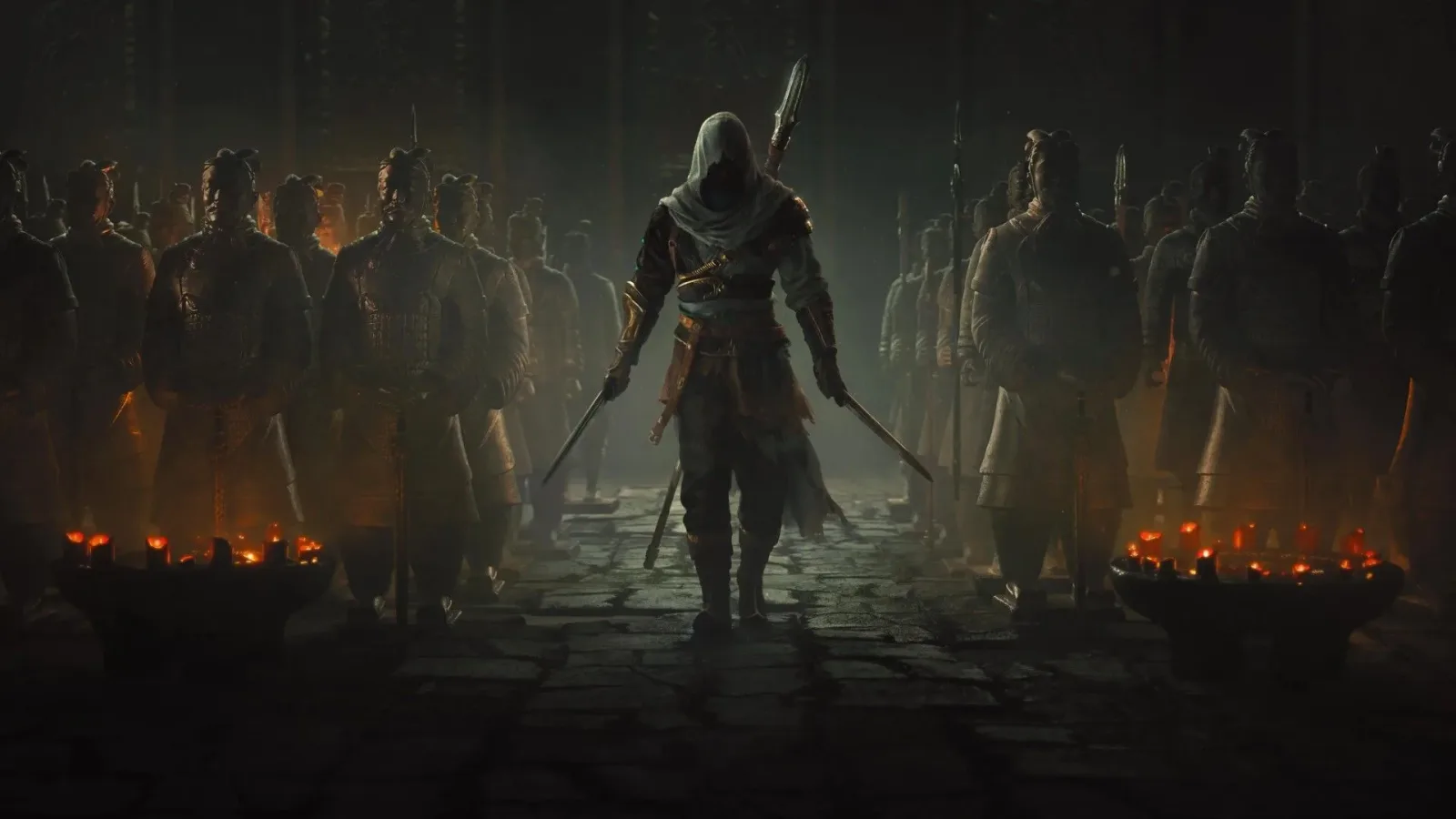
Assassin's Creed has traveled across an enormous span of history, from the Italian Renaissance and Ancient Greece to Revolutionary America, Victorian London, and feudal Japan. Yet for every location that reaches players, there are often concepts, prototypes, and entire games that never make it over the finish line. A newly surfaced collection of images and gameplay clips has now offered a rare look at one such project: Assassin's Creed Destiny, a reportedly canceled collaboration between Ubisoft and Tencent that would have brought the series back to ancient China in a full AAA-style release.
The material makes Destiny especially intriguing because this was not apparently a minor experiment or a small side project. The footage presents something that looks recognizably like a large-scale Assassin's Creed game: a character infiltrating imposing palace spaces, avoiding or eliminating guards, moving through vertically layered architecture, and fighting enemies with blades and spears. While it remains unclear how far the project progressed before cancellation, the clips suggest an ambitious game with a distinct setting and a potentially unusual set of combat tools.
Destiny was reportedly being developed by TiMi Group as part of the Ubisoft and Tencent relationship. It was canceled in 2025 amid restructuring at TiMi. That timing means the project's existence was relatively recent, even if it now joins the considerable list of Assassin's Creed ideas that players will likely never get to experience in their intended form.
A return to Chinese history on a larger scale
The Assassin's Creed franchise has visited China before, though not through one of its biggest traditional releases. Assassin's Creed Chronicles: China, released in 2015, delivered a side-scrolling stealth adventure set during the decline of the Ming dynasty. Destiny, by contrast, was reportedly envisioned as a full AAA production for modern hardware. Had it been completed, it could have represented the series' most expansive attempt to explore Chinese history.
For useful background on this topic, read Torchlight: Infinite SS14 Tartarus Launches With Netherrealm Prison Mode.
The game was said to take place around 206 BCE, during the Qin Empire period. That is also notable because it would have been closely connected, at least chronologically, to Assassin's Creed Jade, the still-unreleased mobile game announced in 2022. Destiny was reportedly set nine years after the events of Jade, placing the two projects in a similar historical era while seemingly aiming at very different production scales.
That overlap creates one of the more interesting questions surrounding the canceled game. Ubisoft and Tencent were apparently exploring ancient China through more than one Assassin's Creed project at once, suggesting a major level of interest in the setting. Jade remains positioned as the franchise's mobile entry for the period, while Destiny could have delivered a more conventional console-and-PC-style Assassin's Creed experience had its development continued.
There is no confirmation that Destiny's story, characters, systems, or assets will be reused in Jade. The two titles may have shared a broad historical backdrop without sharing much else. Still, the proximity between their settings naturally raises the possibility that some ideas from the canceled project could survive in another form. For now, that remains uncertain.
Palace infiltration, stealth kills, and a dangerous mission
The available footage appears to center on a palace infiltration during the Qin Empire. The player character moves through ornate interior and exterior areas while confronting soldiers and other hostile figures. The apparent objective involves stopping an invading army from obtaining a treasure, putting the assassin at the center of a conflict that escalates into close-quarters violence.
That premise fits comfortably within Assassin's Creed's long-running formula. Political turmoil, valuable artifacts, fortified locations, and a protagonist operating from the shadows have been foundational elements of the franchise since its earliest games. What stands out in Destiny's material is how the setting seems to shape those familiar ideas. Palace compounds, elevated walkways, courtyards, and dense architectural spaces appear designed to support both covert movement and direct confrontation.
In the clips, stealth looks central rather than incidental. The protagonist is shown stalking through guarded environments, taking out enemies discreetly, and using the layout to avoid becoming overwhelmed. The footage also indicates that combat could become considerably more chaotic when the situation breaks down. Soldiers armed with swords and spears give encounters a heavier, more period-specific feel than combat built around later firearms or more familiar European weaponry.
It is always difficult to judge an unreleased game from a limited amount of material. Gameplay footage can reflect a vertical slice, a work-in-progress build, or systems that would have changed substantially before launch. Even so, the basic ingredients visible in Destiny are easy to understand: infiltration, assassination, traversal, melee combat, and an environment structured around historical spectacle. The result looks less like a radically different spin-off and more like a lost mainline-style Assassin's Creed opportunity.
An unusual weapon could have set Destiny apart
One of the most eye-catching details in the surfaced material is a spinning bladed weapon that resembles an umbrella. Assassin's Creed games have a long history of giving their protagonists memorable tools, whether that means hidden blades, rope launchers, darts, smoke bombs, throwing knives, or specialized weapons tied to a particular era. Destiny's apparent umbrella-like blade looks like it could have been one of the project's clearest gameplay signatures.
It is not yet known precisely how the weapon would have functioned. It may have been designed for close-range attacks, defensive maneuvers, crowd control, or some mixture of those roles. Its presence nevertheless suggests the developers were considering ways to give the game a combat identity beyond standard swordplay. A weapon like that could also have suited Assassin's Creed's blend of practicality and theatricality: an object distinctive enough to be visually memorable while still fitting a stylized historical-action world.
The broader combat shown in the clips appears weighty rather than purely flashy. Swords and spears seem to have real physical presence, and the fights shown do not look detached from the dangers of a guarded palace or battlefield. That could have provided a useful contrast with the freer movement and stealth-oriented sections, creating the familiar Assassin's Creed tension between careful planning and sudden, messy escalation.
Why Destiny's cancellation matters
Cancelled projects are a normal part of game development, particularly within large franchises. Studios test concepts, change priorities, restructure teams, and respond to shifts in technology or business strategy. The loss of a project does not necessarily mean it lacked potential; often, it means the circumstances around it changed before it could be completed.
Destiny is compelling because the revealed material seems to show a game that had moved beyond an abstract pitch. There are environments, animations, mission scenarios, combat encounters, and a clear sense of place. The footage may not reveal the full scope of the planned experience, but it offers enough to make the cancellation feel tangible. This was not simply an unused historical setting on a planning document. It appears to have been a game taking recognizable shape.
The reported cancellation during TiMi restructuring also highlights the volatility that can accompany major partnerships and large internal organizations. Ubisoft and Tencent continue to have a significant relationship, and Assassin's Creed remains one of gaming's most durable series. But even a franchise with that level of recognition can have projects halted before their public debut.
For fans, the disappointment is amplified by the setting. Ancient China has obvious potential for Assassin's Creed: dramatic political shifts, elaborate cities and palaces, martial traditions, distinctive architecture, and a history filled with conflicts that could support the series' secret-war mythology. Destiny's 206 BCE timeframe would have given the game a chance to explore an era that has received far less attention in blockbuster historical action games than many of Assassin's Creed's European locations.
Jade remains the active path to ancient China
Although Destiny is no longer moving forward, Assassin's Creed Jade remains the active Assassin's Creed project associated with ancient China. The mobile game was announced in 2022 and is set in the same broad historical period, though there is still no release window. Jade is expected to offer a different kind of Assassin's Creed experience due to its mobile focus, even if it shares an interest in bringing the franchise's signature stealth, parkour, and historical tourism to the era.
Jade cannot simply be treated as a replacement for Destiny. A mobile game and a proposed AAA release have different technical ambitions, interfaces, session structures, and likely design priorities. Still, its continued development means the setting has not disappeared from Assassin's Creed entirely. Players will eventually have a route into this chapter of history, just not through the larger modern-hardware project that the newly surfaced clips seem to depict.
For now, Assassin's Creed Destiny stands as a striking glimpse at a path not taken. Its palace infiltrations, stealth encounters, sword-and-spear combat, and distinctive spinning blade all point toward an adventure that could have given the franchise a substantial new historical home. Without a clear picture of how close it was to completion, there is no way to know what the final game might have become. But the footage makes one thing clear: this was a promising Assassin's Creed project, and its cancellation leaves behind an especially intriguing what-if.
Community
Discussion
Start the conversation.
No comments have been posted yet.