


Casualties: Unknown is rapidly becoming one of Steam's most striking new survival successes--not because it offers an easy escape into an alien world, but because it appears determined to make every descent feel miserable, dangerous, and intensely personal. Released on November 9, the cave-diving survival game has accumulated more than 5,600 user reviews on Steam, with 98% of them positive. That is an extraordinary reception for a game openly built around severe difficulty, bodily trauma, permadeath, and themes that may be upsetting to some players.
Developed by Orsoniks, Casualties: Unknown places players in control of a bioengineered, animal-like humanoid created for corporate experimentation. Its purpose is not heroic exploration or scientific discovery. Instead, the character is sent into an immense cave network on a hostile alien planet to recover lost cargo for an organization that seemingly has little concern for whether its expendable asset comes back alive.
It is a bleak setup, and the game's approach to survival seems to follow through on that premise at every level. This is not simply a platformer where players avoid monsters and hazards while hunting for an exit. Casualties: Unknown frames survival as a continual struggle to keep a damaged body functioning while pushing farther into an underground environment that grows more dangerous with every layer.
An alien cave system designed to wear players down
The journey takes players through 11 increasingly hazardous cave layers. Each descent brings further environmental threats, dangerous encounters, and the persistent possibility that a manageable injury will evolve into a fatal problem. The game uses procedurally generated environments, meaning runs are not entirely predictable, while permanent death and reset-driven roguelike structure make failure a central part of the experience rather than a temporary inconvenience.
For useful background on this topic, read GTPLAYER Gaming Chair Drops to $80 in Pearl White During Black Friday Sale.
That structure may bring to mind Rain World, the famously punishing 2017 survival game in which a small creature attempts to endure a hostile ecosystem. Casualties: Unknown shares some of that oppressive vulnerability: the sensation that the world does not exist to accommodate the player, and that learning its rules can be painful. But its focus appears much more closely tied to injury treatment and physiological management than to simply navigating predators and weather.
Orsoniks describes the game as an unforgiving cave exploration survival simulator and a hardcore survival simulation. In practical terms, that means players should expect injuries rather than assume skill alone can prevent them. Keeping a run alive requires responding to the consequences of accidents, traps, illness, combat, and environmental damage after they happen.
Survival means treating more than a health bar
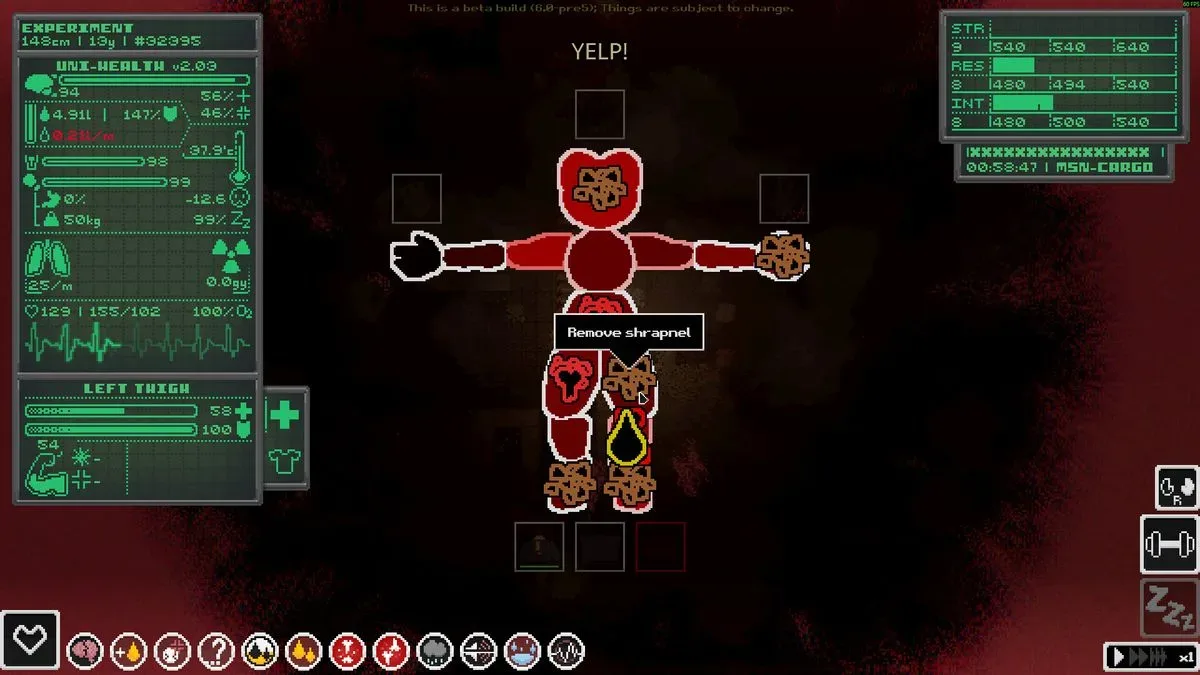
One of Casualties: Unknown's defining systems is its simulated limb and cardiovascular model. Instead of presenting damage as a single abstract health pool, the game asks players to account for bodily processes including blood flow and oxygenation. Medical care is targeted, not generic. A wounded explorer may need to bandage themselves, address infection, stabilize blood loss, and otherwise react to the specific condition threatening their survival.
This level of detail gives the game a distinctly visceral identity. A fall, a trap, or an encounter with an enemy is not necessarily an immediate game-over event, but it can begin a cascading emergency. The player may survive the initial impact only to face blood loss, a compromised limb, infection, exhaustion, or another complication while still stranded underground. The cave itself becomes a test of triage, preparation, and composure.
There is also a psychological component. The developer notes that mood can materially affect a player's odds of making it through a run. Too much despair makes survival more difficult, adding another layer to a game already concerned with physical deterioration. That mechanic fits the game's dark fiction, but it also means that Casualties: Unknown engages with heavy subject matter beyond its alien setting and graphic medical systems.
Players should be aware that the game includes or deals with themes such as drug use, depression, self-harm, and severe mental illness. Those elements are part of a broader experience that seems intentionally uncomfortable and oppressive. Anyone looking for a conventional action-adventure, or a survival game that keeps its tone light, may want to consider those themes before jumping in.
A huge range of ways for a run to end
Steam players have embraced the severity rather than treating it as a flaw. Reviews repeatedly point to the game's extreme challenge, with at least one user comparing its difficulty unfavorably--or favorably, for the right audience--to the demanding roguelike Noita. That comparison says plenty about the expected learning curve. Casualties: Unknown does not appear interested in making newcomers feel powerful quickly.
The variety of reported deaths is especially revealing. Players describe runs ending through sepsis, pulmonary embolism, fractured bones, landmines, spike traps, falls, radiation sickness, poisoning, drowning, starvation, dehydration, temperature extremes, blood loss, exhaustion, illness, overdose, and hostile enemies. Other accounts point to hazards that can cause sudden and grotesque trauma, while mental decline can also become part of the struggle.
Such a list could sound excessive, but it helps explain why the game has attracted attention. The appeal is not merely that Casualties: Unknown is difficult. Many games are difficult. Its hook is that the difficulty seems systemic: numerous individual threats can overlap, and the player must understand how to react when the run stops going according to plan. A mistake can create a problem. A poorly handled problem can create several more.
That is the kind of design that naturally divides audiences. Some players will find the constant physical maintenance, relentless setbacks, and disturbing atmosphere exhausting. Others will see those qualities as the foundation for a deeply rewarding survival loop, where a successful escape or a hard-won descent feels meaningful because catastrophe was always close.
Why the Steam response stands out
A 98% positive rating from more than 5,600 Steam reviews is particularly notable because games with intentionally abrasive systems often earn more polarized reactions. Casualties: Unknown has clearly found players who value exactly what it is attempting: a survival simulation with little interest in smoothing out discomfort or removing consequences.
The positive response also suggests that its complexity is communicating itself effectively enough for players to engage with it, even when the results are brutal. A detailed medical model, procedural cave layouts, mood management, environmental threats, and permadeath could easily become overwhelming if they lacked cohesion. The strong review score indicates that many players feel the systems support the central fantasy of being an ill-equipped, exploited creature attempting to survive an impossible corporate assignment.
There is an important distinction between a game that is punishing and one that players believe is worth enduring. Casualties: Unknown seems to be landing on the more favorable side of that divide for its audience. Failure is frequent, injuries are unavoidable, and its tone is grim, but those qualities appear to be part of the game's appeal rather than obstacles standing in the way of it.
Not a survival game for everyone--and that is the point
Casualties: Unknown is unlikely to be a universal recommendation. Its graphic premise, harsh treatment of physical and mental suffering, and demanding roguelike structure make it a poor fit for anyone seeking a relaxed exploration game. The title's very name signals its outlook: survival is uncertain, casualties are expected, and a run can unravel in more ways than players may initially anticipate.
For fans of difficult survival games, however, its early Steam reception makes it one to watch. It combines the hostile-world tension associated with games like Rain World with a more explicit bodily survival simulation, all inside a procedural cave-diving framework where every layer down can introduce another terrible problem. Players who enjoy games that turn knowledge, resilience, and careful decision-making into their most valuable resources may find that the pain is precisely what makes Casualties: Unknown memorable.
Community
Discussion
Start the conversation.
No comments have been posted yet.