

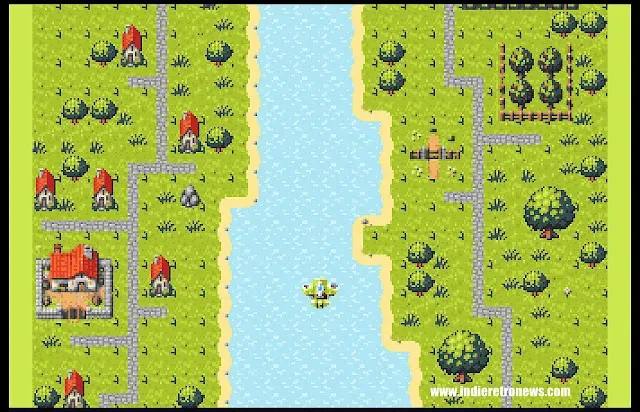
Commodore Amiga enthusiasts have another ambitious homebrew project to watch in ChromaBlast, a vertical scrolling shoot-'em-up now available in beta form from developer GuruVision. Built for classic Amiga systems using OCS/ECS and AGA chipsets, the game places players in command of the Chromacraft, a combat ship sent into a war against an alien force that has turned colour itself into a weapon.
The project is notable not only for its old-school target hardware, but also for its stated production method. Creator Michele Ferrigno describes ChromaBlast as a human-and-AI collaboration involving Claude AI, with AI assistance disclosed for code and graphics. The aim is still firmly rooted in the machine's original technical character: the game uses custom 68000 assembly and C code, and is intended to deliver OS-independent performance on stock Amiga A500+ hardware.
ChromaBlast remains a beta demo rather than a finished release, and GuruVision is continuing to publish new builds while tuning speed, compatibility, and enemy behaviour. Even in this early state, its premise and feature set suggest a shooter designed to lean into the visual strengths of the Amiga while giving its combat a distinctive colour-focused identity.
A war against the Grey Armada
At the centre of ChromaBlast is the conflict with the Grey Armada, also described as the Grayscale Armada. This hostile alien force has learned to siphon colour from the universe and transform it into fuel for its war machine. Worlds left in its wake become drained, monochrome places, stripped of their vitality and visual character.
For useful background on this topic, read Pokémon TCG 30th Celebration Early Pull Data Points to a Friendlier Set for Collectors.
The Chromacraft's mission is therefore more than simple survival through waves of enemies. Its pilot is fighting to reclaim the hues stolen from devastated environments. That setup gives the familiar vertical-shooter format a clear thematic hook: every confrontation is framed as resistance against an invasion that erases colour, rather than merely another interstellar battle for territory.
GuruVision's design also incorporates this concept into the game's presentation. The invading force can use decoloration attacks that affect the environment in real time, visually warping or draining the scenery during play. On hardware celebrated for colourful 2D visuals, using the absence of colour as an active threat is a particularly fitting idea. It turns the game's aesthetic premise into part of the action instead of leaving it as background story.
Combo-driven evolution for the Chromacraft
ChromaBlast is not positioned as a purely static shooter where a player simply finds an occasional power-up and survives until the next boss. Its central gameplay system is described as combo-driven evolution. As players battle enemy formations, the Chromacraft can evolve through its performance and sustained combat success.
The full details of how those evolution paths work have not been laid out, but the underlying promise is clear: keeping a combo going should matter beyond the score counter. This gives players an incentive to play assertively, learn formation patterns, and maintain momentum through increasingly dangerous encounters. For a genre built around route knowledge and split-second movement, a system that ties stronger development to consistent play could add another layer to each attempt.
The game sends players through multiple levels populated by relentless groups of hostile ships. Scrolling stages and large animated boss battles are among the advertised features, suggesting a structure that alternates between formation management, avoidance under pressure, and major set-piece encounters. The bosses are described as massive and animated, which should be of particular interest to Amiga fans who appreciate sprite work and arcade-style spectacle on original hardware.
As with any beta, it is sensible to treat the exact balance, behaviour, and final shape of these systems as subject to change. The developer is actively refining enemy AI patterns, so the flow of encounters may develop significantly as newer builds arrive. That iterative approach can be especially valuable for a shoot-'em-up, where the line between demanding, readable challenge and frustrating chaos often comes down to small changes in enemy timing and movement.
Designed around Amiga OCS/ECS and AGA systems
One of ChromaBlast's most important qualities is its specific hardware focus. It targets both OCS/ECS Amiga systems and later AGA hardware, rather than treating the Amiga name as a broad label. Those chipset families represent different eras of the platform, and supporting them allows the project to speak to players with a range of classic machines.
The stated objective is high-performance gameplay on a stock A500+ configuration. The Amiga 500 Plus is a meaningful target for a production that wants to feel accessible to owners of period-appropriate hardware rather than relying entirely on accelerated or heavily expanded systems. Whether every aspect of the beta performs identically across all compatible configurations will naturally be part of ongoing testing, but the intent is to make ChromaBlast run without dependence on a particular operating-system setup.
That OS-independent goal is supported by the project's technical approach. Custom 68000 assembly and C code are being used for the game, a combination that reflects both the low-level demands of fast action on vintage processors and the practical needs of producing a modern homebrew title. A vertically scrolling shooter needs to continuously handle player movement, enemy formations, bullets, collision checks, visual effects, and soundtrack playback while preserving responsive controls. Building close to the hardware is often central to making that work convincingly on older machines.
The fact that the game is designed around original Amiga capabilities is important. ChromaBlast is not simply using a retro visual filter or borrowing the broad language of the era. Its intended performance environment, chipset support, audio format, and programming choices are all connected to the real characteristics of Commodore's platform.
Music, scrolling, and colour under siege
Audio is another major piece of the intended Amiga experience. ChromaBlast includes an original Amiga MOD soundtrack, placing tracker-based music alongside the game's scrolling action. MOD music remains inseparable from the Amiga's legacy, and an original soundtrack gives the project an opportunity to establish its own tone rather than relying on familiar arcade pastiche.
Combined with scrolling environments, the soundtrack and colour-removal effects could make each stage feel more reactive than a standard backdrop. The game's universe begins from a visually expressive concept: colour is precious, threatened, and worth recovering. If the real-time decoloration effects land as intended, the player will not only be told that the Grey Armada is consuming the universe's vibrancy; they will see its influence play out while navigating attacks.
There is a useful contrast in that approach. Traditional shoot-'em-ups frequently use explosive effects, changing scenery, and escalating enemy density to communicate danger. ChromaBlast appears to add environmental desaturation to that language. A player may be fighting for survival in the usual mechanical sense, but the screen itself can also become a sign of the enemy's encroachment.
Its title also reflects that emphasis. "Chroma" points directly to colour, while "Blast" evokes the fast, destructive action expected of the genre. It is a straightforward name, but one that captures the project's goal of combining vibrant Amiga-style presentation with compact arcade combat.
AI-assisted development with a clear disclosure
GuruVision has been direct about the role of AI in ChromaBlast's creation. The project is identified as AI-assisted, specifically in its code and graphics, and its development is described as a collaboration between a human creator and Claude AI. That transparency matters because AI involvement can cover very different roles from project to project, particularly when a game is being built for unusual technical targets.
Here, the final product's technical ambition remains tied to custom programming for the Motorola 68000-based Amiga environment. Developing for legacy machines can require careful attention to memory, display behaviour, processor limits, and compatibility across differing hardware configurations. AI assistance does not remove those constraints; the game still needs to operate successfully within them.
For players, the more immediate question will be how ChromaBlast feels in motion: whether the scrolling is smooth, the formations are readable, the combo system is rewarding, and the Chromacraft's growth provides satisfying momentum. The beta period is where those questions are being tested. GuruVision's regular work on performance, patterns, and compatibility indicates that the project is still moving toward its preferred form rather than presenting the current demo as a final statement.
An early Amiga shooter worth watching
ChromaBlast arrives with a combination of familiar and unusual ingredients. The familiar side is easy to recognize: a player ship, vertical scrolling, enemy waves, power progression, bosses, and a tracker soundtrack. The unusual side is its colour-siphoning enemy faction, real-time decoloration effects, combo-linked evolution, and openly stated AI-assisted workflow.
For the Amiga homebrew scene, the project is also a reminder that new games can still be built around the original platform's constraints rather than merely inspired by its look. Support for OCS/ECS and AGA hardware, paired with the ambition of running well on a stock A500+, makes its beta worth following for players who still use original systems as well as those interested in new software for classic computers.
Because it is a beta demo, prospective players should expect continued changes as GuruVision updates ChromaBlast. Still, its foundations are already clear: the Chromacraft must push through the Grey Armada, protect a universe being rendered lifeless, and restore colour one hard-fought blast at a time.
Community
Discussion
Start the conversation.
No comments have been posted yet.