

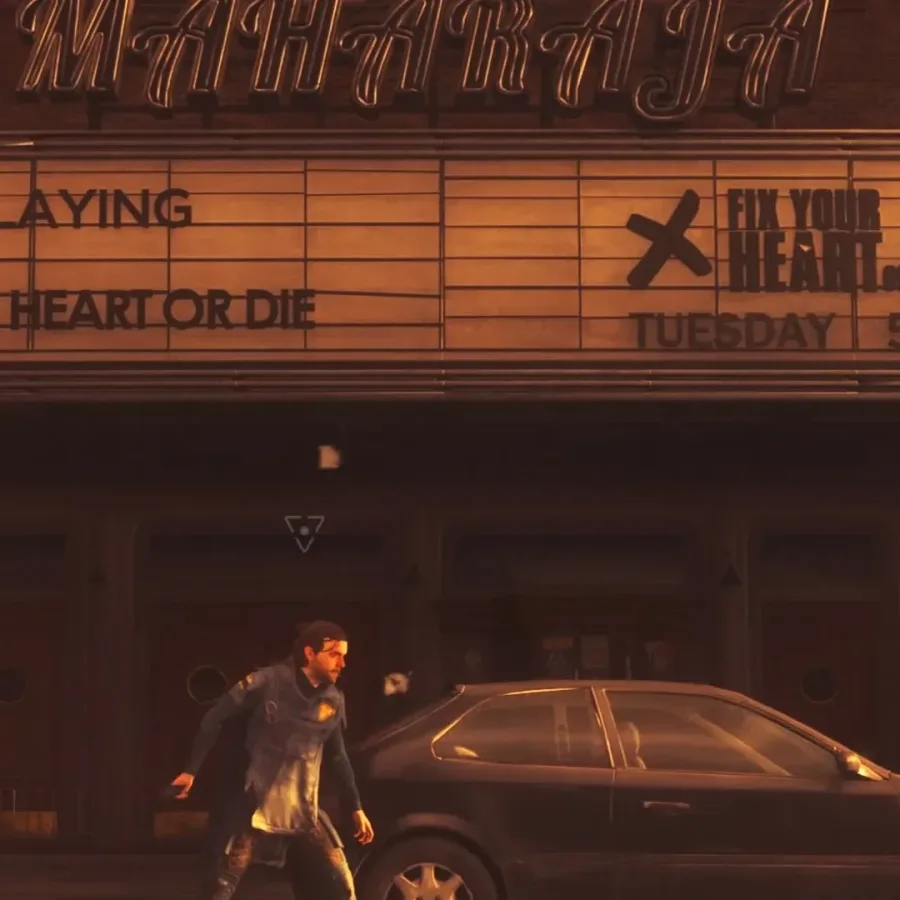
Control Resonant contains a quiet but meaningful tribute to the late filmmaker David Lynch, whose influence has long been visible in Remedy Entertainment's work. While exploring the game's open areas and its fictionalized take on New York City, players can spot a cinema marquee carrying a familiar message: "FIX YOUR HEART OR DIE."
The words are an intentional reference to Twin Peaks: The Return, the 2017 continuation of Lynch and Mark Frost's landmark mystery series. The phrase has become one of the most remembered lines associated with the show's revival, both because of the scene in which it appears and because of the compassion and conviction behind it. Its appearance in Control Resonant is therefore more than a general nod toward a director whose surreal style has helped shape Remedy's games. It also recognizes a moment that has carried particular weight for many transgender viewers.
A Lynchian thread through Remedy's worlds
David Lynch died in January 2025, leaving behind a body of work that remains enormously influential across film, television, music, and games. He was celebrated for stories that could move from mundane conversation to menace, comedy, dream logic, and emotional devastation without warning. Works including Twin Peaks and Mulholland Drive helped define a kind of uncanny storytelling in which seemingly ordinary spaces conceal something fractured, frightening, or impossible.
That creative DNA has been easy to recognize in Remedy's catalog. The studio's stories often balance procedural frameworks, noir-like mysteries, pop-cultural artifacts, supernatural intrusions, and characters trying to remain grounded when reality stops behaving normally. A strange broadcast, an ominous performance, an altered object, or an institutional document can be both a clue and an invitation to question the rules of the world.
For useful background on this topic, read Astartes II Trailer Reveals Deathwatch Terminators and Strong Space Hulk Influences.
Control, released in 2019, built much of its identity around that tension. Its Federal Bureau of Control headquarters, the Oldest House, turns bureaucracy into something cosmic and unstable. Mundane office architecture becomes labyrinthine; workplace language sits beside paranormal classification; and the player is asked to accept that ordinary objects can be vessels for forces beyond rational explanation.
The Lynch connection was arguably even more apparent in 2023's Alan Wake 2. Its layered narrative, distorted performances, television-like intrusions, unreliable shifts in perception, and mixture of horror with absurd humor all made it a natural point of comparison for players familiar with Lynch's work. Remedy has its own voice, of course, but it has never hidden its affection for creators willing to make the strange emotionally sincere rather than merely decorative.
The meaning behind the marquee
The line on the Control Resonant theater sign comes from a scene in Twin Peaks: The Return involving Gordon Cole, played by Lynch, and Denise Bryson, played by David Duchovny. Gordon speaks about Denise's service as an agent and makes clear that he refused to weaponize personal information against her. He then recounts telling hostile colleagues to "fix their hearts or die."
For another perspective on this story, read Control Resonant's 'Fix Your Heart or Die' Marquee Honors David Lynch and a Lasting Twin Peaks Moment.
In context, the statement is blunt, compassionate, and unmistakably directed at prejudice. It does not frame respect for Denise as a debate, a favor, or a complicated dilemma. Instead, it identifies the failure as belonging to those unable or unwilling to treat her with dignity. Delivered by Gordon Cole, a character portrayed by Lynch himself, the line became one of the revival's most potent declarations.
"Fix your heart or die."
Over time, those five words have taken on a life outside the series. They have been embraced as a motto and rallying cry by transgender people and in trans-rights activism, reflecting a refusal to soften the demand for basic humanity. The phrase can be read as severe, but its core is a call for people to confront cruelty within themselves and choose empathy instead.
That history is what makes the marquee more resonant than a routine Easter egg. A passing reference to a fictional coffee brand, a mysterious red room, or an enigmatic name might establish that a developer enjoys Twin Peaks. Choosing this line specifically acknowledges a scene remembered not just for its connection to Lynch, but for what it has meant to real people.
Recognition without ignoring the series' complexities
Denise Bryson's place within the full history of Twin Peaks is not without complications. Elements of the character's portrayal in the original 1990-1991 run have been criticized for falling into problematic tropes. Television's broader treatment of transgender characters during that era was often limited, sensationalized, or shaped by jokes that now deserve closer scrutiny.
At the same time, the later scene in The Return remains meaningful to many viewers because it offers an unusually direct rejection of transphobia. Gordon's defense of Denise is not evasive, and the scene's impact has endured precisely because it gives voice to the expectation that colleagues and communities should do better.
Referencing "Fix Your Heart or Die" does not erase those wider conversations around representation. Instead, it points to the part of the work that has continued to provide affirmation and strength. The tribute's setting also suits the idea: a movie theater marquee, a public-facing sign normally used to advertise entertainment, transforms the words into environmental storytelling. Players may see it while moving through the city, perhaps without immediately recognizing the origin, but those who do will understand why the phrase stands apart.
Environmental detail with a purpose
Control Resonant fills its open zones with details meant to establish the texture of its New York setting. Such details can make a game world feel lived in, but Remedy's best environmental touches usually do more than add visual noise. They hint at unseen stories, reinforce themes, or establish a dialogue with the studio's influences.
The Lynch tribute operates on several levels at once. It is a memorial gesture toward an artist who helped inspire Remedy's approach to atmosphere. It is an allusion for players who recognize the line. And it is a statement with a history beyond entertainment, placed prominently in a space where players can encounter it naturally.
That layering fits the studio's design sensibility. Remedy frequently makes meaning out of objects that might otherwise be background scenery: posters, broadcasts, signs, manuscripts, office notices, and performances often become part of the larger fabric of its connected storytelling. In this case, the words on a marquee become a bridge between a fictional city, a television moment, the legacy of a filmmaker, and the people who have carried the quote into their own lives.
Control Resonant's place in the Remedyverse
The new game arrives as another entry in Remedy's growing shared universe, often called the Remedyverse. Its story takes a comparatively more conventional structure than some of the studio's most elaborate reality-bending narratives, but the setting remains central to its appeal. The game's paranatural premise is supported by inventive world-building and a greater emphasis on the human stakes beneath the strange phenomena.
Its combat has been praised for its sharpness, even if that edge can become less fresh over time. More importantly for longtime Remedy fans, Control Resonant continues the studio's knack for creating places worth examining closely. The Lynch reference is exactly the sort of discovery that rewards attention beyond the primary path.
It also feels appropriate that the tribute is not presented with fanfare. Lynch's work often trusted viewers to sit with ambiguity, notice a detail, and decide what it meant to them. A sign encountered in the course of exploration is a fitting form for a remembrance: there if players look, charged with significance for anyone who understands the words.
For Remedy, "Fix Your Heart or Die" is a concise acknowledgment of a major artistic influence. For many players, it will be a reminder of Gordon Cole's defense of Denise Bryson and of the enduring importance of that scene. In Control Resonant, a few words on a theater marquee carry the weight of both legacies.
Community
Discussion
Start the conversation.
No comments have been posted yet.