

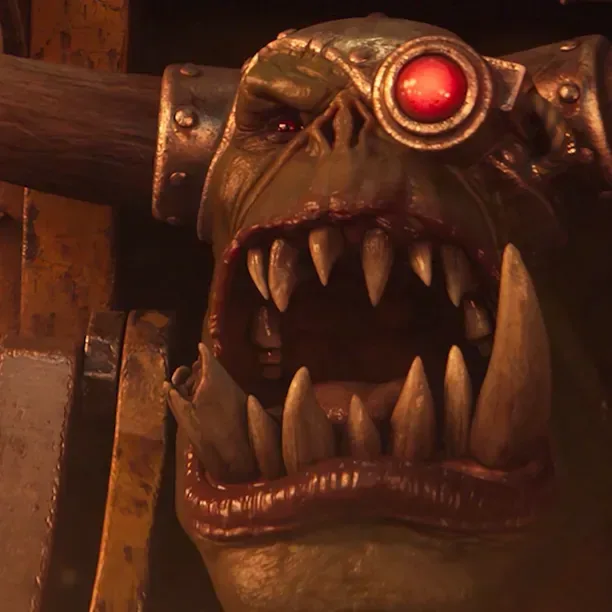
Warhammer 40,000: Dawn of War 4 has offered a particularly convincing demonstration of its Hard AI setting: two of the developers working on the real-time strategy game were decisively beaten by computer-controlled Orks while playing together as Space Marines.
Creative director Jan Theysen and senior game designer Elliott Verbiest took on a pair of Hard AI Ork opponents in a 2v2 Team Skirmish PvE match. The result was not a polished victory lap. Instead, it was a pair of escalating defeats that showed the Orks seizing objectives, keeping up relentless pressure, strangling their opponents' resource income, and eventually forcing the developers to concede.
The footage matters for more than the novelty of watching creators lose at their own game. It provides one of the clearest looks yet at how cooperative matches against AI factions may work in Dawn of War 4, while also setting expectations for players who intend to test themselves above the standard difficulty settings. The developers had previously appeared in battlefield reports centered on player-versus-player combat. This time, they were on the same side, but the AI proved to be the greater problem.
Two matches, two Ork victories
The first match is over with remarkable speed. Theysen and Verbiest are defeated a little more than four minutes after it begins, leaving little room for a comeback or lengthy tactical adjustment. They frame that opening loss as a practice attempt and decide to reset for another round, promising to approach the rematch with more focus.
For useful background on this topic, read Meta Connect 2026 Opens With AI Focus as Quest 4 Remains Unannounced.
For the second game, the pair also raises the Victory Point requirement. In objective-based RTS modes, that kind of adjustment can make a match last longer by requiring teams to accumulate more points before victory is declared. It is a sensible attempt to give their Space Marine force extra time to stabilize, build an economy, reinforce key positions, and perhaps turn back the Ork momentum.
It does not solve the underlying problem. The Orks continue to take ground and apply pressure, and the Space Marines struggle to match their pace across the map. The developers attempt to capture points and hold objectives while their units are set to automatically reinforce, but repeated enemy assaults leave them behind on Victory Points and unable to establish the resources needed for an effective response.
By the later stages of the second match, the Space Marines are not merely losing territory. They lack the means to field a force capable of stopping an Ork push toward their base. The second attempt lasts approximately 13 minutes, a substantial improvement over the first game, but it still ends in a surrender rather than a final stand.
"This might be the second loss in a row which tells you two things," Theysen says near the end. "First of all, we are not that good at our own game. And also the AI is pretty strong."
That candid conclusion captures the appeal of the showcase. Game demonstrations frequently focus on ideal outcomes: a controlled build, a prepared strategy, and a dramatic win designed to highlight a faction's best tools. Here, the loss itself becomes the feature. The match exposes the value of map control, economy management, reinforcement, and coordinated defense in a way a straightforward showcase victory might not.
Why the Orks' pressure was so difficult to answer
Dawn of War has long been associated with intense battlefield momentum, where factions contest strategic locations and the ability to replenish, reposition, and respond can matter as much as an individual unit's raw strength. The shown PvE encounter suggests that the Hard AI is designed to capitalize on those demands rather than waiting passively for players to build an unstoppable army.
Theysen and Verbiest repeatedly face the consequences of falling behind in objectives. Victory Points put a clock on the match, forcing players to make decisions about when to defend, when to attack, and when to give up a position rather than risk losing more units. Meanwhile, resources determine whether a team can replace losses and create the army needed to reverse the flow of battle.
Once the Orks establish an advantage in both areas, the Space Marines are caught in a difficult cycle. They need troops to reclaim objectives, but they need control of objectives and resources to sustain those troops. Auto-reinforcement helps prevent squads from staying depleted, yet it cannot compensate for a larger strategic deficit or for enemy waves that keep arriving before a recovering team can regroup.
The Orks are an especially suitable faction for this kind of display. Their identity in Warhammer 40,000 is inseparable from the overwhelming energy of a Waaagh!, and the battle footage leans into that image. The AI does not simply trade blows at the center of the map. It keeps forcing the Space Marine players to react, leaving them unable to build the kind of stable defensive line needed to shift onto the offensive.
There is still an important distinction between a Hard AI match and the broader balance of the finished game. Skilled RTS players will naturally study build orders, timing windows, unit counters, resource routes, and objective rotations more deeply than a casual co-op session can. Verbiest acknowledged that possibility during the defeat, suggesting players may quickly return after launch to explain how they overcame the challenge.
That is part of the usual relationship between strategy-game developers and dedicated communities. Players often discover optimizations, tactics, and niche interactions that turn seemingly punishing encounters into manageable ones. But the video makes a meaningful first impression: Hard difficulty is not being presented as a cosmetic step up. At least in this match, it demands clean coordination and punishes errors quickly.
A useful look at co-op PvE
Beyond the difficulty discussion, the match gives prospective commanders a look at a co-op format distinct from the earlier PvP-focused battlefield reports. Theysen and Verbiest are allied as Space Marines against a shared AI threat, making their performance dependent on teamwork as well as individual control.
Cooperative RTS play can create a different set of priorities from competitive multiplayer. Teammates can divide responsibilities, defend separate approaches, coordinate attacks, share battlefield information, or decide which player should spend resources on particular unit roles. Conversely, failures can compound quickly if both players commit to the same area while an objective is lost elsewhere, or if neither has the available forces to meet an unexpected attack.
The second match makes the tension of that format visible. The two Space Marine players are trying to keep pace with the battlefield's objectives while also surviving direct Ork attacks. The rising Victory Point target gives them a longer window, but not necessarily more breathing room. The AI continues to exploit the time rather than allowing the Marines to reset.
For players who prefer fighting the game rather than competing against strangers, this is a promising indication that Dawn of War 4 intends to make AI skirmishes feel consequential. A co-op match has more replay value when opponents can put up genuine resistance, and when a loss encourages teams to reconsider their approach instead of simply increasing their production speed next time.
The developers chose to leave in the defeat
Perhaps the most notable part of the presentation is that it was allowed to end badly. The developers could have chosen a lower AI setting, retried until a victory was secured, or edited the footage around a more flattering outcome. Instead, viewers see the first fast loss, the renewed attempt, the longer struggle, and the eventual surrender.
Theysen jokes at one point that he may need to speak sternly to the team responsible for the Hard mode difficulty, adding that it is meant to be hard but that "the boss is supposed to win." It is a lighthearted line, but it also acknowledges a reality of public game demonstrations: the people showing a game are normally expected to make it look effortless.
That expectation is reversed here. The defeat provides a more credible picture of a Hard AI skirmish than a carefully arranged win would have done. It also lets the factions and systems speak for themselves. The Space Marines are not portrayed as weak; they are portrayed as a force that can be overwhelmed when map control, resource flow, and defensive timing all go against them.
Community responses to the match have reflected appreciation for that openness, with viewers praising the decision to show the defeat and treating the Orks' performance as an entertaining warning about what higher difficulties may bring. The developers themselves appear to be taking it in stride, ending the second game by conceding before the final Ork blow lands.
What it means for the road to launch
Warhammer 40,000: Dawn of War 4 is scheduled to arrive on PC on December 3, 2026. There is still time for players to see more of its factions, modes, and battlefield systems, but this co-op encounter has already delivered a straightforward message: choosing Hard AI will require more than confidence in the Emperor.
For newcomers, Normal difficulty may prove the more welcoming starting point while they learn objective control, economic management, squad handling, and the strengths of the available factions. For veteran RTS players and Warhammer fans, the footage offers an invitation to figure out the answers that escaped Theysen and Verbiest: how to blunt the Ork early pressure, when to prioritize points over engagements, and how two allied Space Marine commanders can recover once the Waaagh! gets rolling.
Whether the community solves that puzzle in days, weeks, or much longer will be decided after launch. For now, the Orks have the clearest possible claim to victory. They did not merely defeat two Space Marine players. They forced the creative director and a senior game designer to hit surrender.
Community
Discussion
Start the conversation.
No comments have been posted yet.