

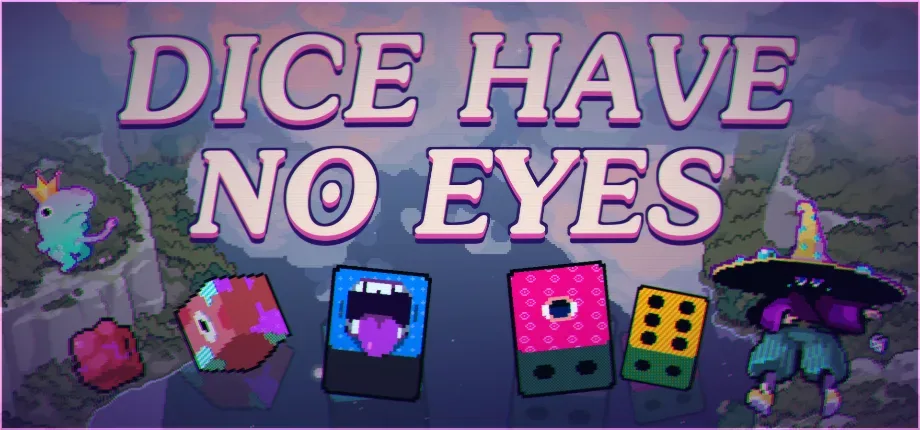
Dice Have No Eyes, the surreal dice-rolling roguelike built around luck, greed and volatile runs, will leave its pre-1.0 period on November 20, 2026. Developed by indie duo Franek and Max Cahill, the 1.0 update is positioned as a substantial expansion rather than a small version-number milestone, bringing the game's ending alongside new content, progression elements and quality-of-life improvements.
The update will arrive on Steam and is set to add new boards, playable characters, items, babies, Steam achievements and leaderboards. It will also introduce a new Rift level described as one that keeps going, suggesting an additional challenge space for players who want to push their dice-based builds beyond a conventional run structure.
For a roguelike whose identity centers on making the most of unpredictable rolls, the full launch matters because it gives its systems a definitive destination. Dice Have No Eyes has already presented itself as a strange, feverish take on dice management: players roll, modify and feed their dice while attempting to survive the consequences of chance. With 1.0, those individual rolls will now lead toward a proper finale, character-specific conclusions and more routes through the game's unusual world.
A finale for a game driven by chance
The largest addition in the 1.0 build is the game's ending, referred to as the "big finale," with the update teasing a possible meeting with God. That wording is intentionally odd, which suits a game that leans into surreal imagery and a world governed by an RNG-powered "God n' Fate" engine.
For useful background on this topic, read Wuthering Waves Version 3.8 Brings Lily, New Story Content and Major System Updates on November 12.
In roguelikes, an ending does more than close a narrative loop. It can give the entire repeatable structure a clearer sense of escalation. Early runs are often about discovering basic interactions, while later attempts become about deliberately chasing the tools needed to overcome an ultimate obstacle. Dice Have No Eyes already frames every roll as a balancing act between reward and danger, so a final encounter or destination could provide a stronger long-term target for players experimenting with the game's systems.
The update will also include character endings. That detail suggests that the game's different playable characters will have more individual context or outcomes attached to them, rather than serving solely as alternate starting kits. The precise requirements for reaching those endings have not been detailed, but their presence should offer another incentive to revisit the game through different characters and combinations.
Dice management with a strange appetite
Dice Have No Eyes belongs to the broader family of run-based strategy games where players build toward increasingly powerful combinations, but its core idea is specifically focused on dice. Its gameplay has been described as a Balatro-like fever dream of dice management, where rolls are never merely passive outcomes. Instead, players can alter the dice themselves using trinkets, spells and snacks.
For another perspective on this story, read Dice Have No Eyes rolls into 1.0 on November 20 with finale, Rift level and Steam leaderboards.
That approach gives the game a particularly tactile take on roguelike buildcraft. A die is not just a number generator; it is a part of the build that can be changed, fed and potentially turned into something much more useful--or much more dangerous. The stated emphasis on risk and reward means that manipulating a die may create opportunities for powerful results while also introducing costs, uncertainty or other complications.
This is where Dice Have No Eyes' focus on luck and greed becomes important. Randomness is a fundamental ingredient, but players are apparently meant to influence how that randomness behaves. The goal is not simply to hope for a favorable roll. It is to assemble a setup capable of making favorable outcomes more likely, more valuable or more survivable, while deciding when it is worth taking a bigger gamble.
The 1.0 update's additional items, characters and babies should expand those decision-making possibilities. No detailed list of their effects has been announced, so it is not yet clear how each new addition will interact with the game's dice systems. Still, any increase in the number of items and companions has the potential to widen the pool of possible builds, especially in a game designed around unexpected combinations.
The Rift offers another place to test a build
Among the newly announced features, the Rift stands out as a new level that "goes on and on." The description leaves room for interpretation, but it clearly marks the Rift as something structurally different from a standard self-contained stage. It may be a long-form endurance challenge, an extended route for high-performing runs, or an environment intended to keep testing the player after ordinary progression would otherwise conclude.
That sort of mode or level can be especially fitting for a build-driven roguelike. Once players find a combination that starts to work, they naturally want to see how far it can be pushed. An ongoing Rift gives those successful experiments somewhere to go, whether the result is a satisfying display of an overpowered dice setup or a dramatic collapse after one risk too many.
The update is also adding new boards. Boards are central enough to be called out separately in the 1.0 feature list, though their exact mechanical role has not been outlined. New boards could provide additional spaces, layouts or tactical contexts for dice management. Whatever form they take, they should broaden the game's run variety alongside the new characters and items.
More reasons to replay, personalize and compete
Dice Have No Eyes 1.0 will introduce Steam achievements and leaderboards, giving players both personal milestones and a way to compare performance. Achievements can help make obscure goals and unusual play patterns visible, while leaderboards create a competitive layer for those seeking the most efficient or ambitious outcomes from the game's systems.
Leaderboards are a natural match for games built around repeat attempts, but their impact will depend on the categories and scoring rules ultimately used. Dice Have No Eyes has not specified what measurements will be tracked. They could focus on progress, score, Rift performance or another metric. Regardless, their arrival formalizes a competitive element around a game where players may already be trying to squeeze one more advantage from an uncertain roll.
The update will also add new customization options. Customization is a smaller headline feature than the finale or the Rift, but it can still be valuable in a game designed for repeated play. Allowing players to shape the presentation of their experience gives long-term runs a more personal feel, particularly when paired with distinct characters and endings.
Another unusual addition is a collection of discoverable music cassettes. These cassettes can be used to create an in-game playlist, giving exploration and discovery an audiovisual reward beyond raw gameplay power. It is an especially appropriate feature for a fever-dream game: finding music in the course of a run can change not only what players are doing, but the atmosphere in which they are doing it.
Quality-of-life work and language support accompany the new content
Not every part of 1.0 is about expanding the game. Franek and Max Cahill are also including numerous quality-of-life changes and fixes. Specific adjustments have not been listed, but this type of work is often crucial when a roguelike reaches its full release. Small improvements to clarity, pacing, usability or interface behavior can make a considerable difference across dozens of runs.
Additional language support is also planned for the update. The languages themselves have not been named, but the addition should help make the game more accessible to a broader group of players as it moves into 1.0.
Taken together, the launch package suggests a full-release update concerned with both breadth and finish. There is a conclusion for players looking to see the game through, a Rift for those looking to keep going, new parts for build experimentation, and practical additions for returning players who want goals, rankings and smoother runs.
What to expect on November 20
Dice Have No Eyes 1.0 arrives on Steam on November 20, 2026. Players can expect the game's final chapter, new characters, items and babies, fresh boards, the endlessly oriented Rift level, character endings, customization options, collectible music cassettes, Steam achievements, leaderboards, more languages, and a range of fixes and usability changes.
The game's central appeal remains its willingness to make chance feel dangerous and expressive. Dice rolls can bring success, but the systems around those rolls appear to be where the real strategy lives: feeding dice, altering them with spells and trinkets, choosing companions, and deciding how much greed a run can tolerate before fate turns against you.
With a finale now in place, Dice Have No Eyes is preparing to turn that chaotic loop into a complete journey--one where every roll may still be unpredictable, but where players will have more tools, more destinations and more reasons to take another chance.
Community
Discussion
Start the conversation.
No comments have been posted yet.