

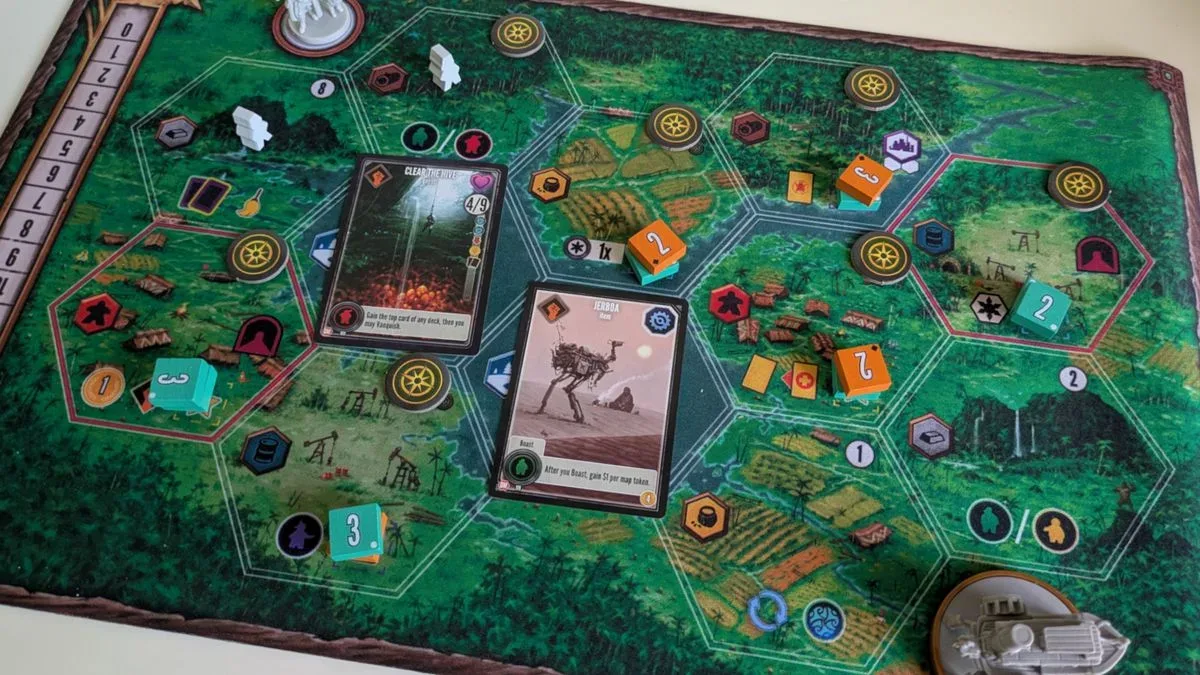
Duel of Meloch is an audacious tabletop design. Rather than adapting one established strategy game into a dedicated two-player edition, designer Jamey Stegmaier has created a stand-alone box in which one person plays using the core systems of Scythe, while their opponent uses the very different systems of Expeditions. It is a crossover set in the shared world of those games, complete with fresh factions, characters, miniatures, compact maps, and a campaign framework called the Tournament of Meloch.
On paper, it sounds like the sort of experiment that should collapse under its own complexity. Scythe is a resource-driven engine builder with territorial pressure, workers, and mechs. Expeditions emphasizes card handling, upgrades, and a single mech's journey through a mysterious Siberian landscape. Their structures are not identical, their turns are not identical, and their strategic priorities are not identical. Yet Duel of Meloch makes the pairing function surprisingly well at the table.
That achievement is real, and it makes the game compelling for a particular audience. The catch is equally clear: this is a demanding product for anyone arriving without experience of its predecessors. It may be sold as a stand-alone release, but its strongest purpose is as a companion piece for people who already own, understand, and enjoy both Scythe and Expeditions.
Two games, one battlefield
Duel of Meloch supports one or two players, is intended for ages 14 and up, and is listed at roughly 45 minutes. Its strategy and exploration label only tells part of the story. The game is also an unusual exercise in rules translation: each player is effectively operating a different game while sharing the same physical arena and pursuing the same broad objective.
For useful background on this topic, read Magic: The Gathering's Budding Insurgent Revealed for Reality Fracture.
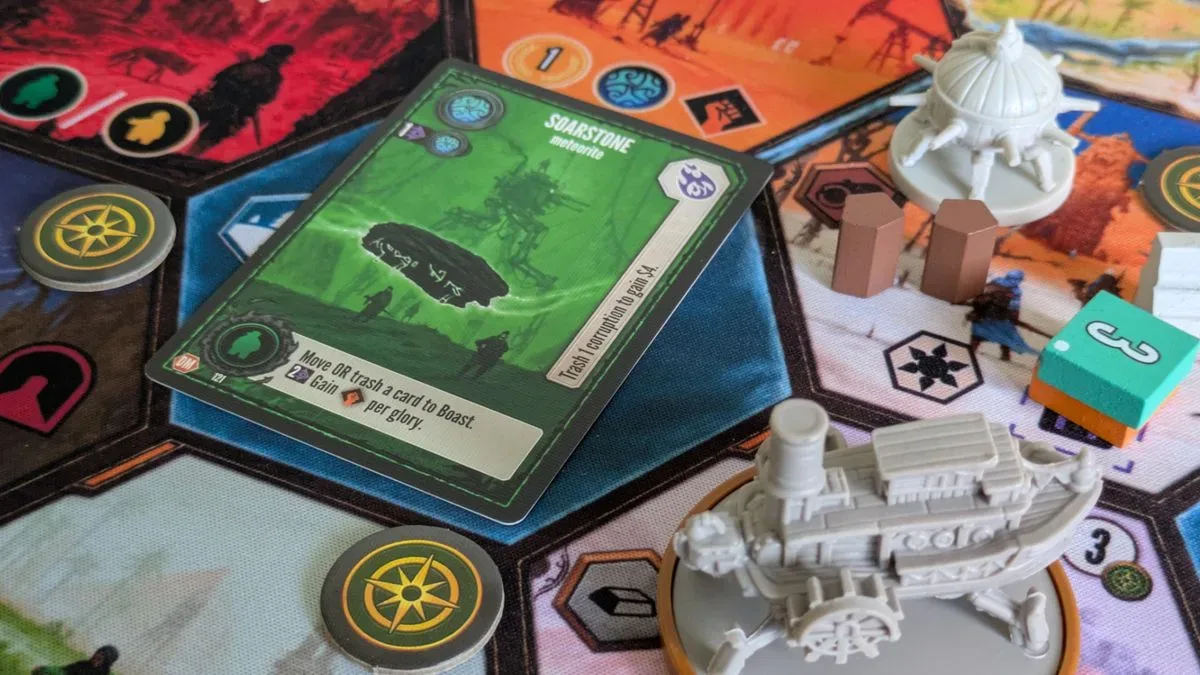
The match takes place on one of two maps printed on opposite sides of a neoprene mat. Each hex contains an unusually dense mix of symbols. Some icons matter to the Scythe side, while others are relevant to the Expeditions side. The shared geography is therefore doing double duty. A location that is valuable because a Scythe worker can produce a useful resource may have a completely separate appeal for an Expeditions mech looking to activate, play, or refresh cards.
For the Scythe player, the familiar focus remains on constructing an increasingly efficient engine. Movement, production, workers, resources, and mech deployment all feed into a broader optimization puzzle. The smaller board arguably makes that experience more approachable than the sprawling original map, where new players can sometimes be overwhelmed by the apparent number of possibilities.
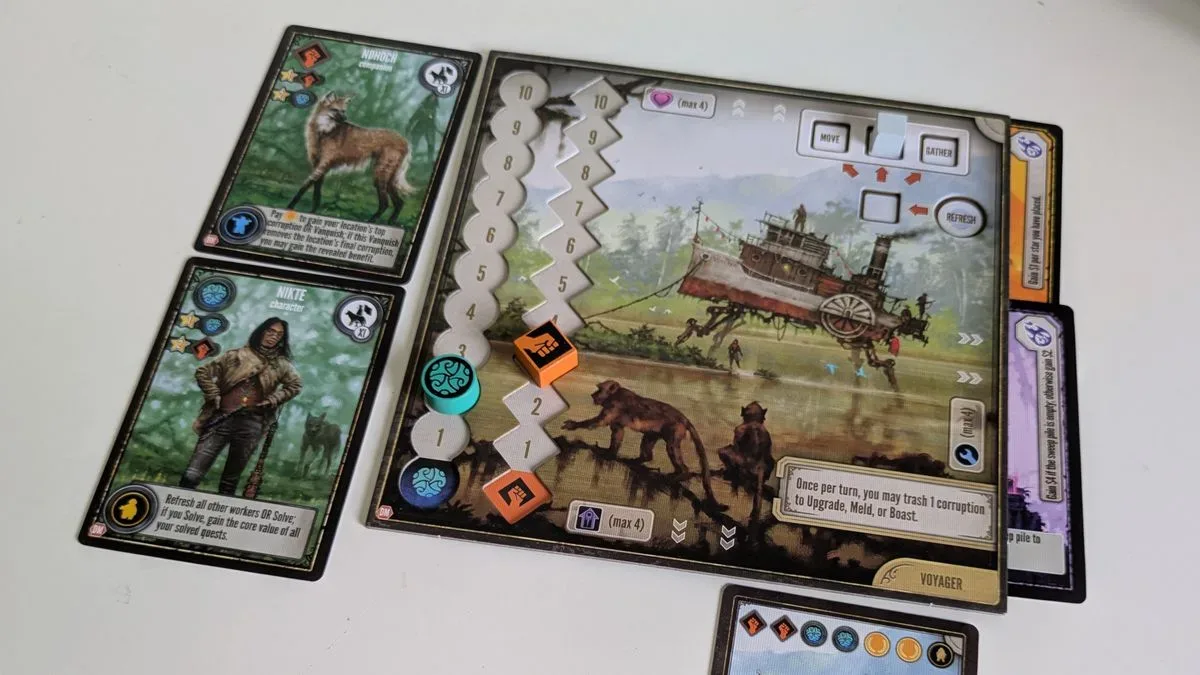
The Expeditions player retains that game's core identity as well. They manage cards and pursue upgrades while moving a mech around the board and dealing with corruption. This half loses a little of the original game's sense of discovery, because the compact Duel maps do not include the same face-down hex exploration structure. Still, the card-driven decisions and character progression that define Expeditions remain present.
A race where every prize can disappear
The central contest is a race to earn four stars. Duel of Meloch uses a shared triumph track with eight possible star spaces, each of which presents different qualification requirements for the two sides. Both games include coins, for instance, but their targets are unequal: a Scythe player can claim a relevant star at 12 coins, while the Expeditions player can do so at nine.
Other triumph conditions are even more distinct. A Scythe player might earn a star for deploying a fourth mech, whereas the Expeditions player may need to upgrade their mech three times. This structure lets the two systems keep their identities while still pointing toward a common endpoint.
The important twist is that triumph slots are exclusive. Once one player has claimed a space, the other cannot use it. That makes the track more confrontational than the achievement systems in either parent game. Players must monitor not only their own plan but also whether their rival is about to seize a reward that both might reasonably pursue.
In practice, this produces tension, though not always the direct rivalry the idea initially suggests. If one side is clearly ahead toward a given slot, the other player is often better off abandoning the contest and seeking another route. Continuing to race for a blocked-off opportunity can mean sacrificing too many actions. As a result, the mutual exclusivity creates meaningful strategic reading, but it does not guarantee a constant tug-of-war over every objective.
Combat gives the Duel its sharpest edge
The compact map also puts both sides in closer proximity than they would normally experience. Combat uses the card-based framework associated with Scythe. When the Expeditions mech enters a hex containing Scythe workers or mechs, a fight can begin. The Expeditions player can obtain combat cards from particular map icons, then both players secretly decide how much power to spend and whether to add permitted combat-card bonuses.
There is an inherent imbalance in a fight, and it is intentional. The Scythe side can bring multiple units into a battle, while Expeditions has only its single mech. That gives the Scythe player a natural advantage. Expeditions can use its position to deny production by occupying crucial hexes, which encourages disruptive movement, but it cannot casually throw itself into every confrontation.
This produces a game of threats more than repeated battles. An Expeditions player wants to exploit openings, pressure weakly defended production sites, and choose carefully when a costly fight is worthwhile. The Scythe player must protect their developing economy without losing momentum in their own engine. Actual combat can occur regularly on the reduced maps, but the larger strategic incentive is still usually efficiency rather than aggression.
That point is important for setting expectations. Duel of Meloch looks like it should turn Scythe and Expeditions into a tightly combative skirmish. It certainly increases interaction, especially compared with Expeditions, but it does not transform either game into a pure battle game. The players spend most of their time carrying out the core tasks their own system asks of them.
An impressive mechanical blend
The most remarkable accomplishment here is simply that the hybrid works. Scythe and Expeditions use related hex-map language and broadly compatible visual ideas, even though their actual gameplay loops differ substantially. Stegmaier has said that the visual overlap was not originally designed as a future crossover plan; it reflects an aesthetic he likes, one that also has echoes in the unrelated Euphoria. Whatever the origin, those shared design cues help make Duel of Meloch possible.
Neither half feels casually bolted onto the other. The Scythe player still has a recognizable, satisfying engine-building experience. The Expeditions player still has card-management decisions and a progression arc built around their mech. The triumph track and combat rules provide enough connective tissue for a legitimate head-to-head game rather than two parallel solo sessions.
It is a bold design success, but that success raises a difficult question: why choose this format instead of playing one of the original games? Both parent titles are generally stronger with more than two players, so Duel of Meloch has a useful niche for a pair seeking a quicker, smaller-map contest. Owners can also use the maps for fast two-player variants of Scythe or Expeditions, provided they own the applicable original game.
Even so, the hybrid's smoothness means it can feel more like a novel recombination than an essential replacement. Its best ideas enhance familiar systems rather than fundamentally changing why someone plays either parent title.
The rulebook barrier is hard to ignore
The biggest limitation is accessibility. To play Duel of Meloch well, a group needs to understand three rule sets: the Scythe framework, the Expeditions framework, and the Duel-specific adjustments that connect them. The crossover rules themselves are relatively manageable, but the underlying games are not lightweight. Worse for newcomers, the complete rules for those two games are not included in the box, so players without prior access will need to consult them elsewhere.
That makes the stand-alone label technically true but practically misleading for many buyers. A newcomer is being asked to learn two substantial strategy games before fully appreciating the point of the crossover. Someone who owns only one of them faces a similar issue, because the opposing side still requires knowledge of the other game's procedures.
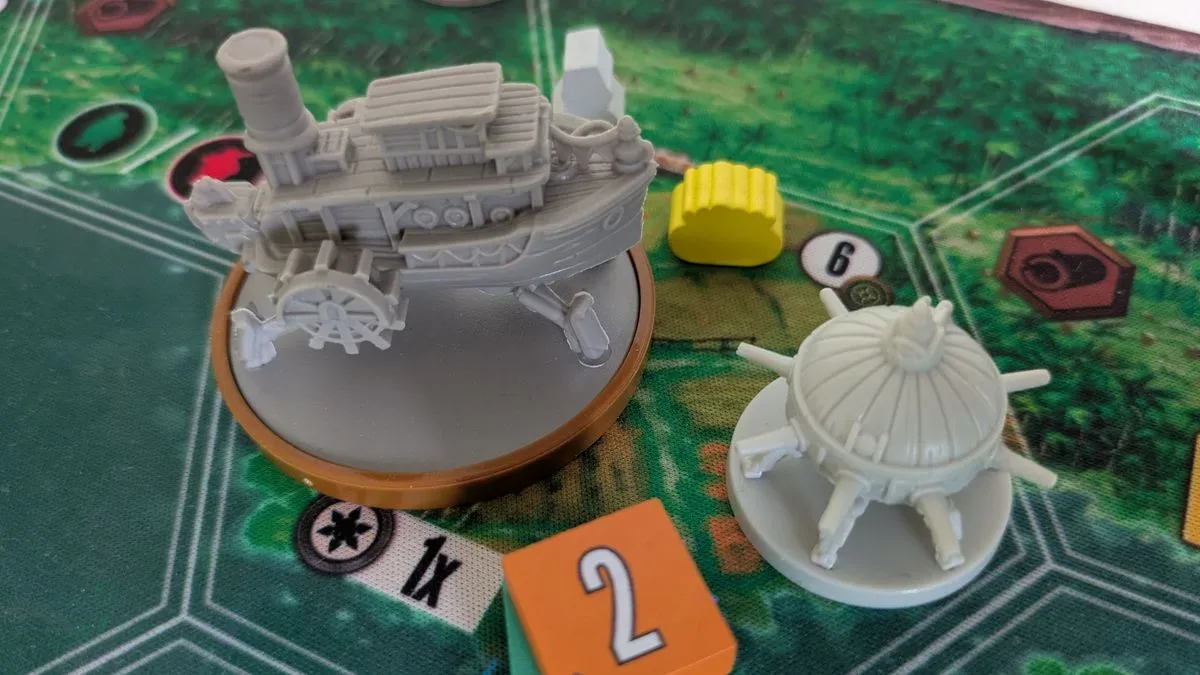
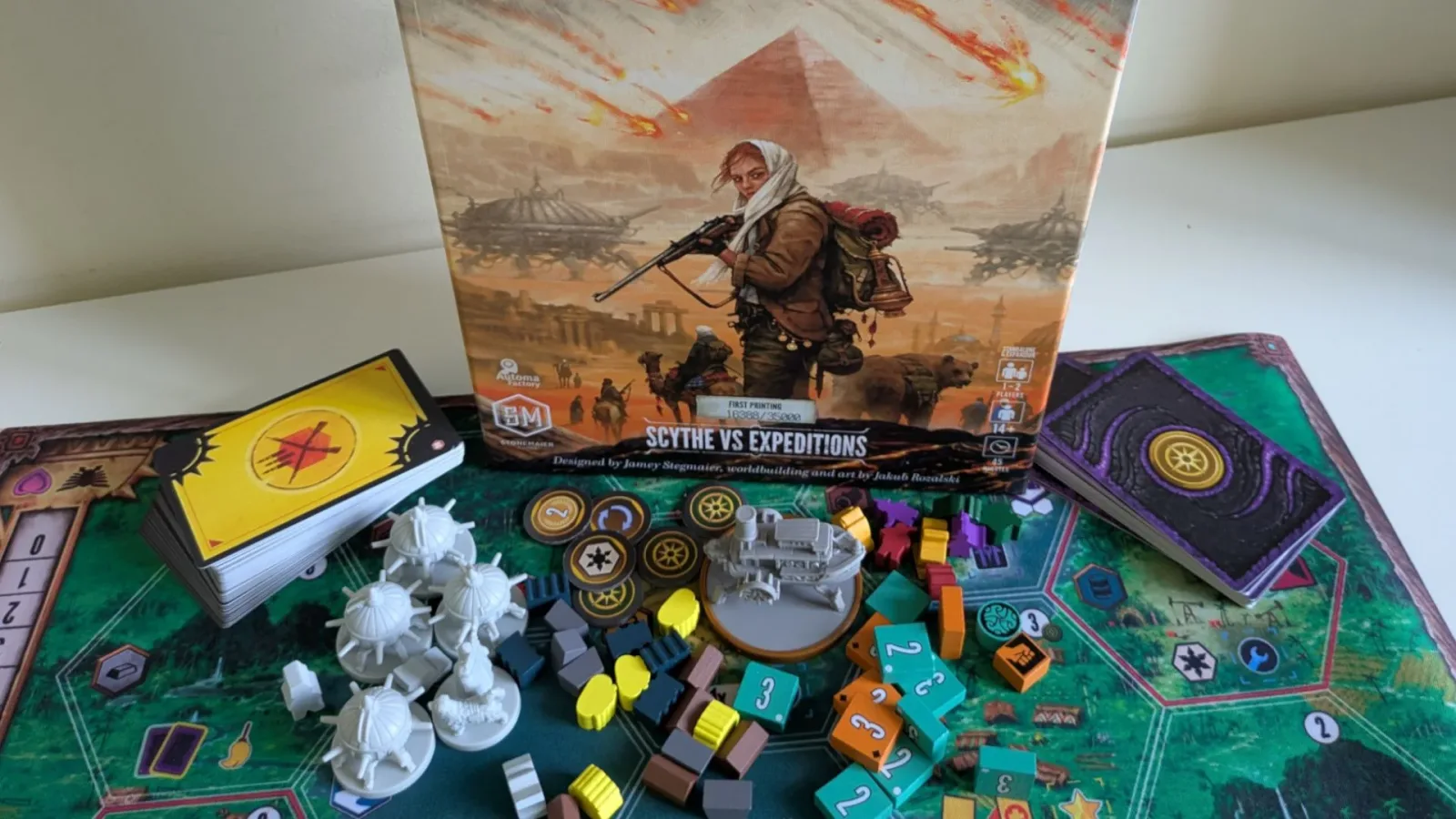
For established fans, however, the package has considerably more value. The new Scythe faction and new Expeditions character are designed to feel different from existing options, and their miniatures add strong visual appeal to the collections. Players who possess both games can also bring their existing factions and characters into Duel of Meloch, greatly expanding the number of possible matchups. The Tournament of Meloch campaign gives those combinations an additional setting in which to matter.
Verdict
Duel of Meloch is a fascinating and mostly successful crossover experiment. It demonstrates that two complex strategy designs can inhabit the same board without either losing its personality. The shared triumph race, compact maps, tactical blocking, and occasional combat offer enough interaction to make the two-player format feel purposeful, while the familiar mechanisms of Scythe and Expeditions continue to deliver their respective pleasures.
But it is not equally suited to every table. Players who do not own either predecessor, or who dislike managing extensive rules, should begin with Scythe or Expeditions instead. The learning commitment is too steep, and the final experience too dependent on appreciation of those original designs, for Duel of Meloch to be the ideal gateway.
Buy Duel of Meloch if:
- You already own and enjoy both Scythe and Expeditions.
- You want more factions, characters, miniatures, and matchup variety for those games.
- You are looking for a quicker, more interactive two-player format.
Consider skipping it if:
- You own neither Scythe nor Expeditions.
- You only know one of the two games and do not want to learn another large rules system.
- You want a direct-combat game rather than a strategic optimization contest with selective conflict.
For the right audience, Duel of Meloch is a generous expansion of two beloved tabletop worlds disguised as a stand-alone duel. For everyone else, it is an ingenious curiosity whose cleverness does not quite overcome its formidable barrier to entry.
Community
Discussion
Start the conversation.
No comments have been posted yet.