


Dune: Awakening has expanded beyond PC, arriving on PlayStation 5 and Xbox Series X alongside a substantial update for the original version. Funcom's ambitious survival MMO remains one of the more striking attempts to turn Frank Herbert's Arrakis into a playable open world: hostile, sun-scorched, visually dramatic, and constantly threatening to swallow careless players whole. Its move to consoles has not fundamentally changed that identity. It is still an evocative Dune game with an enormous number of ideas, but it remains a game whose individual systems do not always reach the same standard as its world-building.
More than a year after its PC debut, Dune: Awakening continues to inspire sharply divided reactions. For some players, its mixture of survival mechanics, crafting, exploration, factional sci-fi, and MMO progression delivers a uniquely convincing life on Arrakis. For others, the long stretches of gathering, navigating, and managing systems can feel laborious rather than immersive. The console release preserves both sides of that argument. The desert is spectacular, the setting has immense potential, and the broader progression loop can become rewarding. Yet combat, enemy behavior, climbing, and the interface still create regular friction.
Arrakis remains the game's greatest achievement
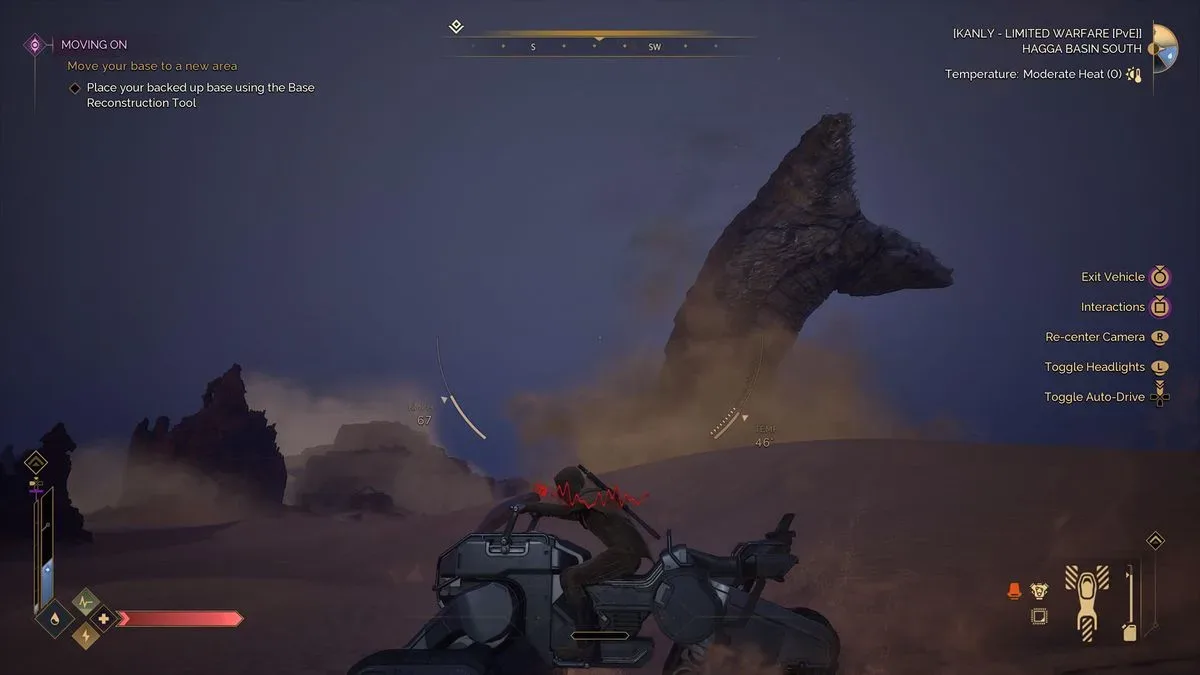
From its earliest hours, Dune: Awakening understands the appeal of placing a player on Arrakis. The premise begins with a crash that leaves the protagonist stranded in a world defined by lethal conditions. Heat, dehydration, exposure, hostile scavengers, and the ever-present danger of sandworms combine to make basic travel feel risky. It is a strong foundation for a survival game, especially because Dune's setting naturally supports the genre's staples. Water matters. Shelter matters. Equipment matters. Walking in the wrong place at the wrong time can matter more than a firefight.
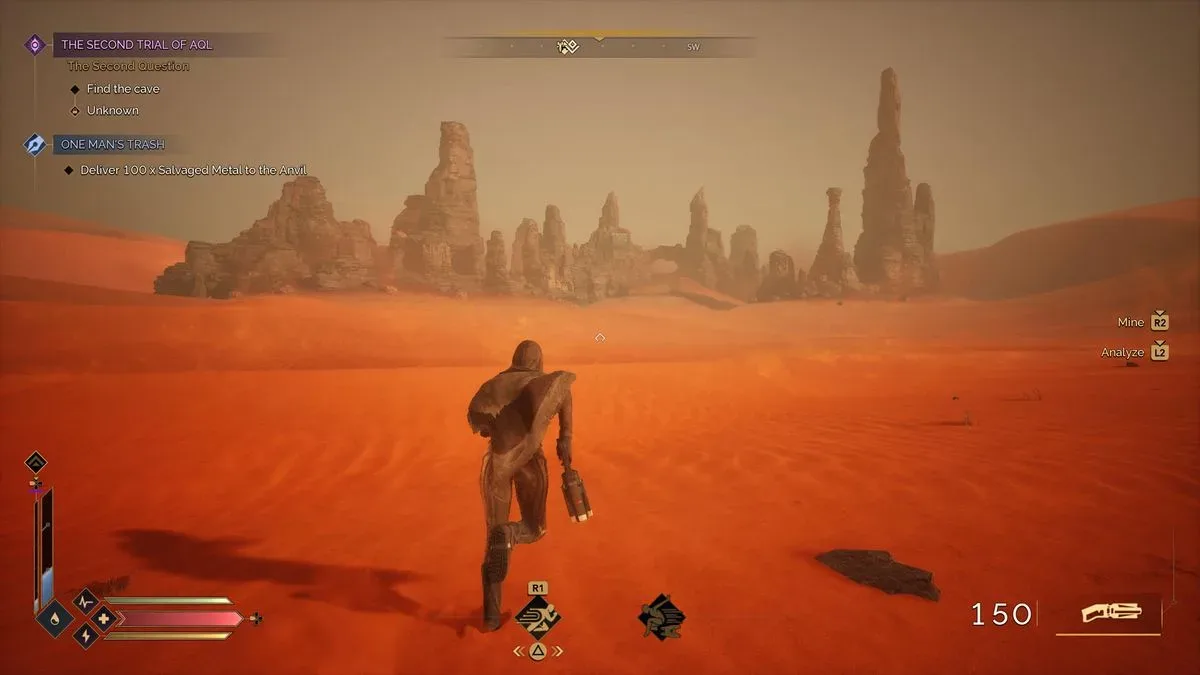
That pressure gives the game an immediate sense of place. Arrakis is not simply a desert map with Dune imagery painted over it. The environmental hazards are central to how players move, prepare, and make decisions. Open sand is frightening because of what may be beneath it. The sun is not merely decorative ambience. The need to secure hydration is connected to both personal survival and broader crafting and base-building goals.
For useful background on this topic, read Golden Joystick Awards 2026 Set for November 11 With New Visual Identity.
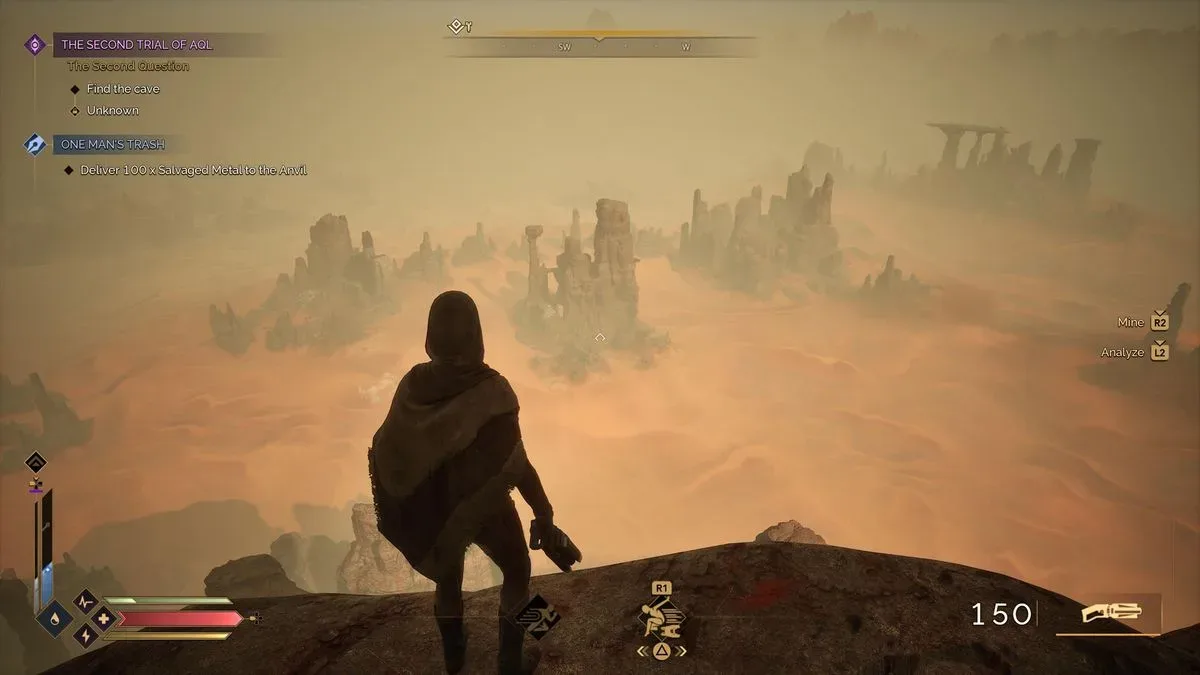
The visual side remains particularly successful on PS5. Players can choose between a 60 frames-per-second performance option and a 30fps setting that emphasizes visual detail and can reduce some environmental pop-in. The performance mode is an appealing fit for a game that involves frequent traversal, shooting, evasive movement, and quick responses to danger. It still presents Arrakis handsomely, while the reduced input and camera friction of smoother performance helps moment-to-moment play.
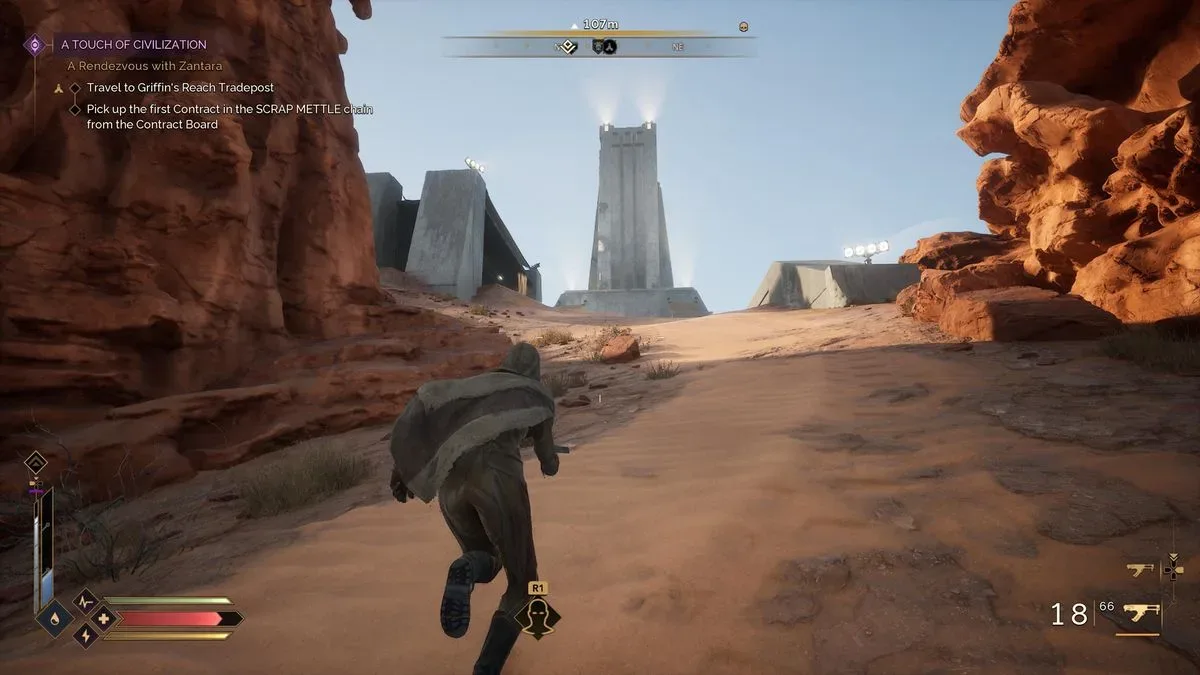
There are compromises, as expected in an open-world game of this scale, but pop-in in the 60fps mode is not severe enough to erase its benefits. Meanwhile, the higher-detail option is available for players who prioritize the richest possible desert vistas. Whichever mode players select, the art direction does much of the heavy lifting. Rock formations, wide dunes, distant structures, stillsuits, and the oppressive brightness of the landscape all help sell the fantasy.
Survival systems have a compellingly harsh premise
Water is perhaps the clearest example of Dune: Awakening getting the big idea right. It is more than a conventional thirst meter. Water supports the player's body, base, technology, and abilities, making it a central part of the economy of survival. Early options are limited, including collecting moisture from flower patches, but the game encourages a more unsettling answer: extracting water from defeated people.
That is an appropriately grim concept for Arrakis. The process turns combat encounters into a resource opportunity, reinforcing the sense that no one survives here without compromise. In theory, every skirmish can carry a little extra weight because a fallen enemy is not just loot; they represent hydration and continued access to the tools that keep a player alive.
In practice, the intended scarcity is weakened by enemy behavior. Many early scavengers are surprisingly easy to defeat. Ranged opponents may fire from a safer distance, but they often fail to make convincing use of cover or react intelligently to incoming attacks. Melee-focused enemies can be even more problematic, sometimes charging directly into gunfire without demonstrating much self-preservation. When a nearby camp repeatedly produces easily defeated enemies carrying valuable water, a resource meant to feel precious can become routine.
Solo players can adjust difficulty, which can make encounters more demanding. However, higher numbers or harder-hitting foes do not necessarily solve the underlying issue when their decisions remain simplistic. The result is a strange imbalance: a game set on one of science fiction's most dangerous planets can make obtaining a key survival resource feel too reliable once a player understands where to farm it.
Combat is stronger when Dune's rules take over
The unevenness of the action is most visible in the contrast between gunfights and encounters involving shields. In Dune lore, personal shields complicate ranged warfare, encouraging close-range combat because conventional gunfire is ineffective against protected targets. Dune: Awakening uses that idea to create some of its more memorable confrontations. A shielded enemy advancing through a firefight carries genuine tension, since players must prepare for a more personal and dangerous fight.
Melee combat is not perfectly elegant. It can feel awkward and weighty, with the rough edges that might frustrate players looking for clean, responsive action-game duels. But that quality can also suit the setting. Knife fighting in the middle of a brutal desert should feel frantic, desperate, and uncomfortable. The game's close-quarters encounters have more character than its standard shooting, which can come across as serviceable rather than exciting.
The issue is that too many unshielded opponents also behave as though charging toward an armed player is their only possible tactic. That diminishes the distinction between the frightening shielded foes and ordinary enemies who should know better. Dune: Awakening has the ingredients for more varied combat scenarios, but its AI frequently prevents them from fully coming together.
Mobility tools and progression offer reasons to persist
There are brighter spots in the game's growing collection of systems. The skill tree contains meaningful upgrades that can alter how players approach the world. A dash ability is particularly useful for escaping sandworm danger, giving movement across exposed terrain a welcome burst of energy. A hookshot also helps address some of the limitations of basic traversal, providing a more controlled way to negotiate vertical spaces.
Climbing is clearly inspired by the broad, stamina-based freedom of games such as The Legend of Zelda: Breath of the Wild. Players can scale many surfaces if they manage their endurance carefully. Going up is generally functional, but descending cliffs is less dependable. Characters can push away from rock faces too aggressively, turning what should be a cautious climb down into a dangerous fall. Early in the game, when survivability is limited, a single mistake can be punishing.
Later equipment can soften that problem. Progression eventually includes wearables that eliminate fall damage, making exploration less hazardous. This is representative of Dune: Awakening's broader power curve: it can be slow and at times overly restrictive, yet it does provide useful milestones. Players willing to endure the early inconvenience can unlock tools that make Arrakis more manageable and movement more expressive.
Base construction is another major pillar, allowing players to establish their own foothold in the desert. The appeal is obvious. Building a fortified desert home fits the fantasy, supports crafting progression, and gives survival-minded players a tangible record of their advancement. Unfortunately, creating and managing that base is where the console adaptation has its greatest usability problems.
The PS5 interface remains a major obstacle
Adapting a dense PC survival MMO to a controller is a difficult task, particularly when the game needs to handle crafting, research, construction, inventory, objectives, abilities, and MMO-style progression. Dune: Awakening's PS5 version makes a serious attempt to place all of those functions on a DualSense, but the underlying interface remains cumbersome.
Important information and basic functions are too often buried under multiple layers of menus. Finding a particular project, technology-tree entry, placeable, or crafting station can require navigating a chain of tabs and submenus. The pause menu creates another annoyance by failing to display objectives directly, forcing players to leave one part of the interface and hunt through another simply to remind themselves what they were trying to accomplish.
This is not merely an aesthetic complaint. In a survival game, players routinely need to make quick practical checks: what materials are missing, where an objective is located, what needs to be crafted, or which structure must be placed next. When those answers are obscured by menu navigation, the game interrupts its own momentum. It is especially unfortunate because the physical act of surviving on Arrakis is often less mentally taxing than identifying where the interface has hidden a needed option.
The controller experience also makes lengthy construction sessions feel more exhausting than they should. Console players can certainly build and progress, but the process lacks the convenience that a more streamlined radial menu system, stronger objective visibility, or clearer categorization could provide.
A compelling Dune game that still needs sharper systems
Dune: Awakening on PS5 and Xbox Series X is not a clean reinvention of the PC experience. It is the same expansive, ambitious game, complete with its dazzling atmosphere and unresolved frustrations. Funcom has created an Arrakis worth exploring, and the game's best moments emerge when its setting, survival pressures, mobility options, and Dune-specific threats align. Fleeing a sandworm, securing precious supplies, preparing a base, or confronting a shielded enemy can deliver exactly the kind of desert tension the premise promises.
But the game still tries to carry a very broad assortment of mechanics: survival, MMO systems, shooting, stealth, melee combat, climbing, vehicles, flying, construction, and now a dedicated single-player mode. The breadth is impressive, yet several pieces feel under-refined. Enemy AI blunts the resource economy, gunplay lacks impact, climbing can be clumsy, and interface design makes routine tasks unnecessarily difficult.
Players with a deep investment in Dune's world may find enough atmosphere and long-term progression to push through those issues. Those looking for a more immediately polished survival experience, however, should approach with patience. Dune: Awakening is a remarkable visit to Arrakis, and its console performance is often slick, but surviving its design decisions can sometimes be almost as demanding as surviving the desert itself.


Community
Discussion
Start the conversation.
No comments have been posted yet.