

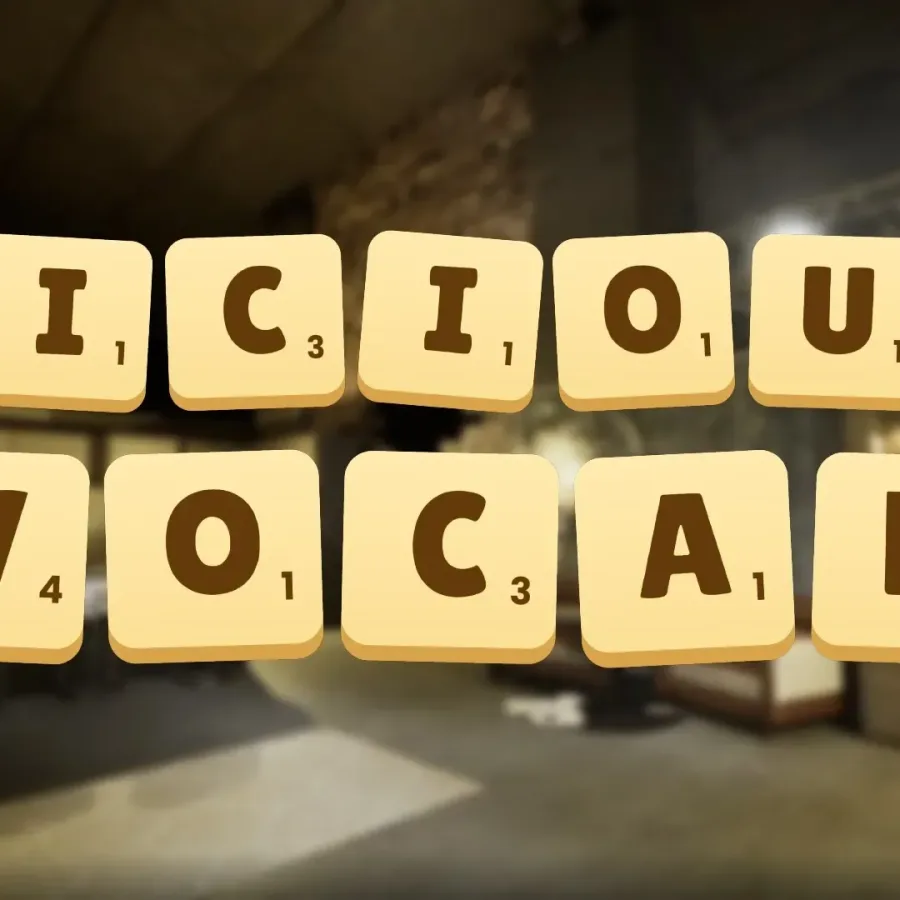
Vicious Vocab is an upcoming PC game that wants to make spelling feel dangerous. Announced by former Call of Duty creative strategist Robert Bowling and comedian Dane Cook, the project begins with familiar word-game DNA but heads somewhere far stranger: words do not simply score points, clear tiles, or fill a board. They carry consequences, trigger effects, counter threats, and can apparently push the experience into entirely different kinds of games.
Created by a five-person team operating under the name funcool games, Vicious Vocab is being described as a collision between classic letter-based games and the escalating, combo-driven energy associated with roguelike deckbuilders. The team's own shorthand is "Scrabble meets Balatro in a backroom casino," though even that only captures part of the pitch. There is a word board, a vocabulary challenge, and room for endless traditional play, but the larger single-player game is built around surprises, branching narrative material, and more than 20 endings.
It is an unusual premise on paper, particularly because it comes from a partnership that joins a veteran shooter developer with a stand-up comic whose career has been closely tied to the careful use of language. Yet the concept seems specifically designed around that intersection: Bowling brings systemic game design and a history in blockbuster multiplayer games, while Cook's enthusiasm centers on the texture, rhythm, and impact of choosing exactly the right word.
Words Can Cause Damage--and Solve It
At its foundation, Vicious Vocab asks players to assemble words from available letters. The important difference is that a completed word can reshape the state of play. Rather than treating language as a route to a higher score alone, the game assigns words meanings that become mechanics.
For useful background on this topic, read ENDIX virtual gaming expo Opens With 50-Plus Games, Demos and Publisher Spaces.
The reveal material illustrates the idea with elemental effects. Creating words such as torch or fire can result in fire damage. That danger is not necessarily permanent, however. If the player has the letters to create water or ice, they can put out the flames and halt additional damage. The result is a chain of reactions in which vocabulary, letter management, and immediate survival become connected.
This is why the developers have used terms including "word brawler" and, in Cook's phrasing, "first-person speller." The language is deliberately playful, but it conveys a central goal: Vicious Vocab is intended to have more tension and motion than a conventional casual word game. Players may need to react to threats with a relevant word, manage the letters they retain, and recognize how one effect can create another.
Bowling has emphasized the appeal of building interacting systems that continue to layer over one another. A player may still be making words from letters, but a multi-step chain of consequences is meant to make that familiar act feel increasingly detached from the expected boundaries of the genre. In other words, the team is not just adding combat flavor to a spelling game. It is using words as the underlying verbs for a broader mechanical playground.
A Game That May Leave Its Own Board Behind
The most intriguing part of Vicious Vocab is the promise that the board itself is not always the destination. The game can reportedly take an unexpected turn if players find and play the appropriate words, moving beyond the initially cozy-looking word-game setup into something with a more surreal, self-aware character.
Bowling has pointed to the kind of disorienting experience associated with The Stanley Parable as a useful creative reference point, while Cook has said that the team wants to deliver memorable "holy s**t" moments. That does not mean Vicious Vocab has been fully explained. On the contrary, Bowling and Cook are intentionally holding back details about the major twist and the places the game can go. The trailer is meant to signal the tonal shift without spelling out every surprise.
That restraint makes sense for a project based on discovery. If the premise is that a player can enter an entirely unanticipated experience through language, revealing all of those pivots in advance would undermine the effect. What is known is that funcool games does not want the word board to be a rigid limit. The team has been exploring just how far seven letters and a strong vocabulary can carry an experience when every word has the potential to produce a bespoke outcome.
The designers recognize that this approach naturally requires limits. Vicious Vocab is handcrafted, so it cannot literally account for every imaginable word or transform into every conceivable genre. Still, the group's development philosophy appears to be focused on testing where the boundaries are rather than immediately enforcing them. That willingness to follow an unusual idea beyond its safest form may be the project's defining trait.
Single-Player Narrative First, Multiplayer Later
Vicious Vocab is currently positioned as a single-player, narrative-driven game. Players who simply want a repeatable word-game experience will be able to remain in that familiar loop indefinitely. But those who pursue the wider structure will find a deeper authored campaign with achievements and over 20 narrative endings.
Bowling describes the single-player side and the planned multiplayer component as two branches growing from the same stem. Both are expected to become weird in their own ways, but their priorities will differ. The solo experience is focused on narrative routes, endings, and the strange directions the concept can take. Multiplayer, meanwhile, is intended to lean more heavily into replayability.
Multiplayer is a future plan rather than a confirmed launch feature, so players should not assume it will arrive alongside the PC release. The announcement also does not establish details about modes, player counts, online requirements, or how the reactive vocabulary systems might function competitively. For now, the clearer picture is of a single-player game that can be replayed both for narrative outcomes and for the more open-ended pleasure of a word system with many possible interactions.
A Long Friendship Behind an Unexpected Collaboration
Bowling and Cook's collaboration may look surprising at first, but their friendship goes back roughly two decades. They met when Bowling was beginning his career as a community manager at Infinity Ward. Their early connection included playing Call of Duty 2 together, where Bowling was impressed that Cook contributed to the objective during Capture the Flag rather than treating the match as a simple hunt for eliminations.
That relationship later reached the games themselves. Cook provided battle chatter--spoken commands and callouts for in-game characters--in the Modern Warfare titles. Over the years, he also brought various game concepts to Bowling. Vicious Vocab is the idea that finally developed into a full project, with the serious work beginning around a year before the announcement.
The earliest version was comparatively straightforward: a word game where words visibly affect the board. Writing bomb, for example, could cause other words to explode. From there, each new discussion about effects opened more possibilities, including the idea that gameplay could eventually travel beyond the board altogether. In many productions, that scope expansion might be treated as a warning sign. Here, it became the catalyst for the game's identity.
Cook's Love of Vocabulary Is Central to the Premise
Cook's involvement is more than a celebrity attachment to a game concept. His interest in language has personal roots. As a child, he watched his father read the dictionary to improve his vocabulary for work as a local hockey color commentator. Cook did not appreciate the habit at the time, but later came to understand it through his own work in comedy.
For a stand-up performer, word choice affects pacing, imagery, sound, and the precise emotional response a line can create. Cook has described his comedy in terms of painting verbal pictures, where repeating the same language can blur the result while varied phrasing gives the performance musicality. He has used tools such as word-of-the-day prompts and has long looked for terms that better fit the feeling he wants a joke or story to convey.
That perspective maps naturally onto Vicious Vocab. The game asks players to think not only about whether they can make a word, but what that word means and what it might do. A more expressive vocabulary could become a practical advantage, a route to a narrative discovery, or simply a way to uncover a surprising interaction. It is a clever extension of Cook's professional relationship with language into interactive form.
PC Release Planned, Details Still to Come
Vicious Vocab is planned for release on PC at an unspecified date described as being in the not-too-distant future. No price has been decided, and no additional platforms have been announced. The small team still has ample mystery to preserve, including the full nature of the game's genre shifts and how its future multiplayer ambitions will take shape.
Bowling is also separately working on a larger first-person shooter through the new studio //18.bravo. That project is planned to include a single-player story and PvP multiplayer while pushing against current live-service conventions. Cook, meanwhile, has the documentary Funny Money available on Netflix.
For Vicious Vocab, though, the immediate appeal is its refusal to settle for an easy label. It starts with letters, boards, and the recognizable pleasure of finding a good word. Then it adds damage, counters, combinations, narrative consequences, and a stated interest in taking players somewhere they do not expect. Whether funcool games can successfully unite all of those ideas remains to be seen, but the central hook is memorable: in this game, vocabulary is not just knowledge. It is power.
Community
Discussion
Start the conversation.
No comments have been posted yet.