

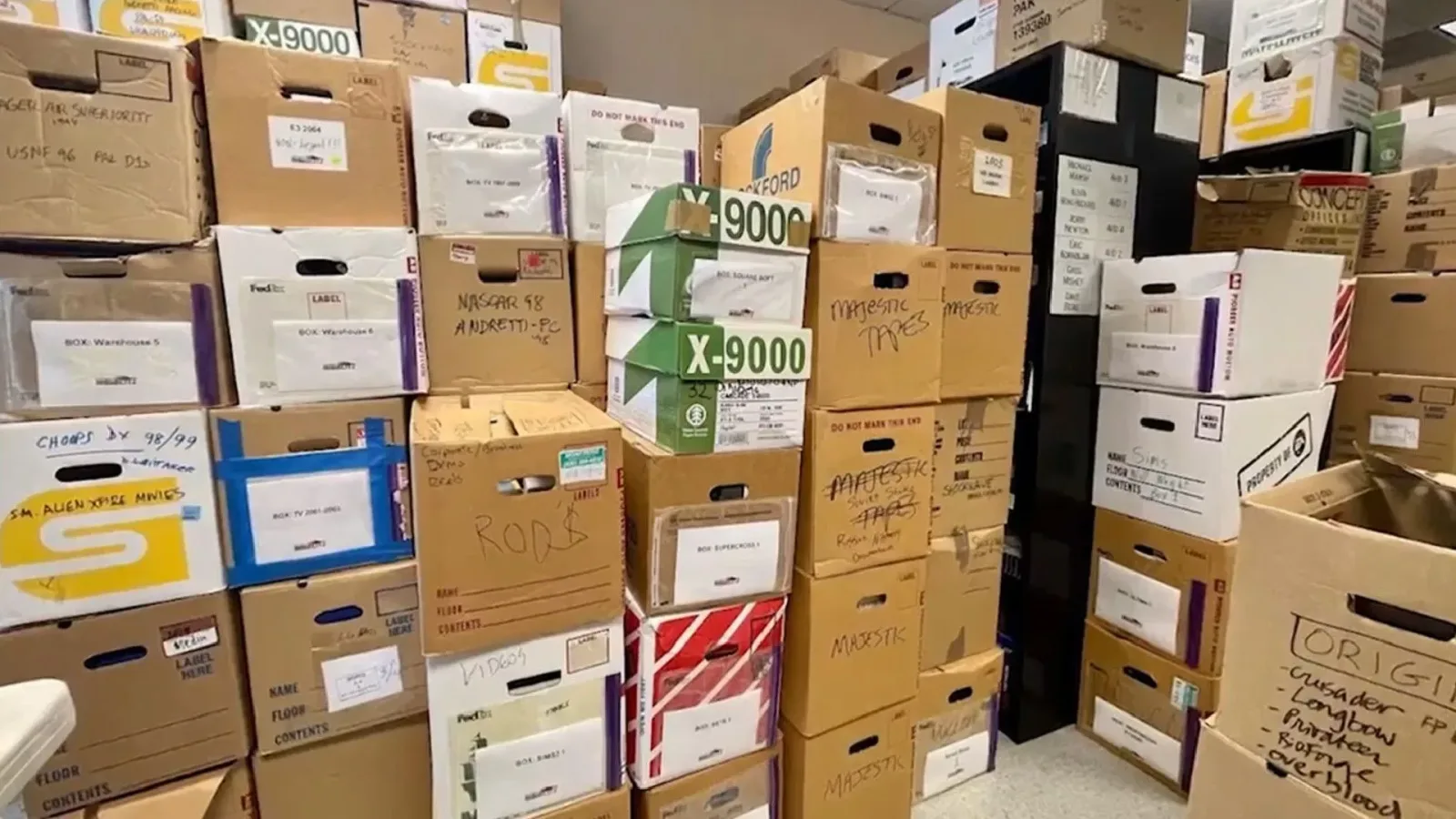
Some game preservation stories begin with a carefully funded archival plan. This one began with a shelf full of old tapes and a producer trying to find somewhere else to put them.
EA has released seven newly restored classics through Steam and GOG: Wing Commander, Wing Commander II, Wing Commander III, Wing Commander IV, Wing Commander Prophecy, Privateer 2, and Road Rash. The six space-combat titles are being presented as Anniversary Editions, while the 1994 3DO version of Road Rash returns in a 30th Anniversary Edition. Their path back to modern PC storefronts was enabled by the rediscovery of a huge collection of physical materials that had been sitting in an EA storage room.
The find was not a small cache of discs or a few old backup drives. It was a room containing close to 20,000 historical assets across formats including Betacam tapes, VHS, D1 tapes, film reels, CD-ROMs, and other media. The archive eventually yielded thousands of digitized items, including master materials for Road Rash and substantial material from the Wing Commander series.
A preservation project born from Command & Conquer
Producer Jim Vessella had previously worked on Command & Conquer Remastered, a project that required restoration of Betacam tapes containing the strategy game's original live-action video sequences. Those tapes remained in storage during the pandemic. When office work resumed in spring 2022, Vessella was left with roughly 200 Betacam tapes on a large shelf in his cubicle and needed a more suitable place to keep them.
For useful background on this topic, read WoW: Forever Gives Tauren a Fast New Reason to Roam Mulgore.
A facilities employee pointed him toward a room in another building where similar material might be stored. Opening that room revealed an unexpectedly deep archive. What began as a practical storage problem quickly became a much larger preservation undertaking.
Vessella and other EA staff began unpacking boxes, sorting materials, and identifying what could be saved. The scale meant that casual handling would not be enough. Many of the tapes and formats required aging playback hardware, specialist knowledge, and careful cataloguing before the original contents could be transferred into digital form.
Work accelerated in early 2024. A small contracted team was brought in, along with four Betacam players and a VCR. Over eight weeks, the equipment ran in shifts for around 17 hours per day as the team fed tapes through the machines. Vessella also personally catalogued and transported another 500 items in less common formats, including D1, D2, Umatic, and film reels, to a professional digitization vendor in San Francisco.
By the end of the effort, the team had digitized around 6,000 media assets and preserved an estimated 2,500 hours of historical footage. That figure captures why the story matters beyond these seven releases. Old games are not just executable files. Their history may be scattered across video masters, audio recordings, development discs, packaging materials, source elements, and hardware-dependent formats that can become inaccessible as equipment deteriorates.
Community modders became restoration partners
The recovered materials created an opportunity, but turning them into playable modern releases still required technical work. For the Wing Commander games, Vessella contacted members of the long-running fan community. The franchise has retained an active modding scene for years, with enthusiasts building patches and improvements long after the original releases.
One collaborator was Matt Wells, a modder who had already made an Enhancement Patch for Wing Commander III. The restoration process became an ongoing exchange: Wells would prepare a new build, Vessella would play it and return feedback, and the group would discuss bugs, technical behavior, and potential design refinements through Slack.
The work was not limited to broad visual or compatibility changes. It also involved the familiar, painstaking troubleshooting that accompanies old PC games. Vessella recalled a Saturday night in 2025 spent repeatedly replaying a mission under different conditions while reviewing logs in an effort to isolate a crash. That kind of testing can sound mundane, but it is essential when adapting decades-old software for current systems and configurations.
The resulting releases are especially notable because they join official stewardship with volunteer community expertise. The modders contributed their time to improve games they care about, while EA could provide access to archival materials and support the effort toward formal distribution. It is a useful model for legacy games whose audiences have often kept them alive with unofficial fixes long before publishers revisit them.
Not every title had the same existing community foundation. Wing Commander Prophecy, in particular, did not have comparable support already in place. GOG worked with EA on that restoration, spending months assembling the available elements, resolving smaller technical issues, and adding its own improvements. Those additions include enhanced controller support and a dedicated launcher for configuration setup.
The seven games included in the initiative
The newly released collection spans multiple eras of the Wing Commander universe as well as one of EA's more unusual motorcycle combat racers. The games involved are:
- Wing Commander
- Wing Commander II
- Wing Commander III
- Wing Commander IV
- Wing Commander Prophecy
- Privateer 2
- Road Rash (the 1994 3DO game)
The six Wing Commander and related releases are available as Anniversary Editions on both Steam and GOG. Their arrival brings a major chunk of a historically important PC space-combat lineage into a newly supported form, with preservation work addressing the practical obstacles of making older releases usable for present-day players.
Wing Commander is particularly significant in that legacy. The series helped define cinematic PC game presentation, flight-oriented space combat, branching campaign ideas, and elaborate production values in its era. Later entries leaned heavily into filmed sequences and an expansive fictional universe, making recovery of high-quality original footage especially valuable. Preserving source tapes can make a meaningful difference over relying on degraded copies that have circulated for years.
Road Rash faced a very different obstacle
While the space games depended on technical restoration and collaboration with fans, Road Rash brought a separate problem: music rights.
The 1994 3DO edition includes a licensed soundtrack featuring Soundgarden, Paw, Hammerbox, Monster Magnet, Therapy?, and Swervedriver. The game had never previously received a digital-platform release, and bringing it back intact meant more than making the code run. EA had to negotiate rights again for music licensed decades earlier.
The legal work was complicated by the ownership structure around the 14 tracks. Completing the agreements required reaching the relevant label and every band member who controlled a side of the necessary rights. By summer 2026, agreements had been completed with six of the seven bands, including the best-known act in the soundtrack lineup. But one required person connected to another band could not be located despite months of searching.
That created a serious risk that the associated music would have to be removed from the 30th Anniversary Edition. By September 2026, the project was close to the point where the team would need to begin extracting those tracks. A final lead eventually connected the rights holders, however, and the final license was completed in mid-September. The full soundtrack was therefore retained for the release.
That outcome is important for more than nostalgia. Licensed music is often among the first things lost when older games return, because agreements expire, ownership changes, and locating everyone with approval rights can be difficult or impossible. In Road Rash, the music is tightly connected to the identity of the 3DO version, so preserving it protects a significant part of the game's original character rather than delivering a compromised reissue.
Why the archive matters
The release of these seven games is a concrete result of a far wider archival recovery. Thousands of digitized assets and roughly 2,500 hours of saved footage may have implications that extend well beyond the initial set of Anniversary Editions. The collection could contain material tied to other EA projects, promotional history, cinematics, recordings, and development-era artifacts that might otherwise have remained inaccessible or degraded beyond recovery.
There is no guarantee that every preserved item will become part of a future game release. Digitization is only one stage in a process that can also involve technical feasibility, rights clearance, resources, and decisions about what can be made available. Still, the effort demonstrates why physical-media archives remain so important. A forgotten room, functioning playback hardware, patient cataloguing, and cooperation between a publisher, specialists, and fans have collectively brought seven classics back to PC players.
For anyone interested in game history, that is the larger victory. These are not simply old titles returning to sale. They are games supported by recovered original materials, renewed technical attention, and--in the case of Road Rash--a soundtrack that narrowly avoided being separated from the game that made it memorable.
Community
Discussion
Start the conversation.
No comments have been posted yet.