

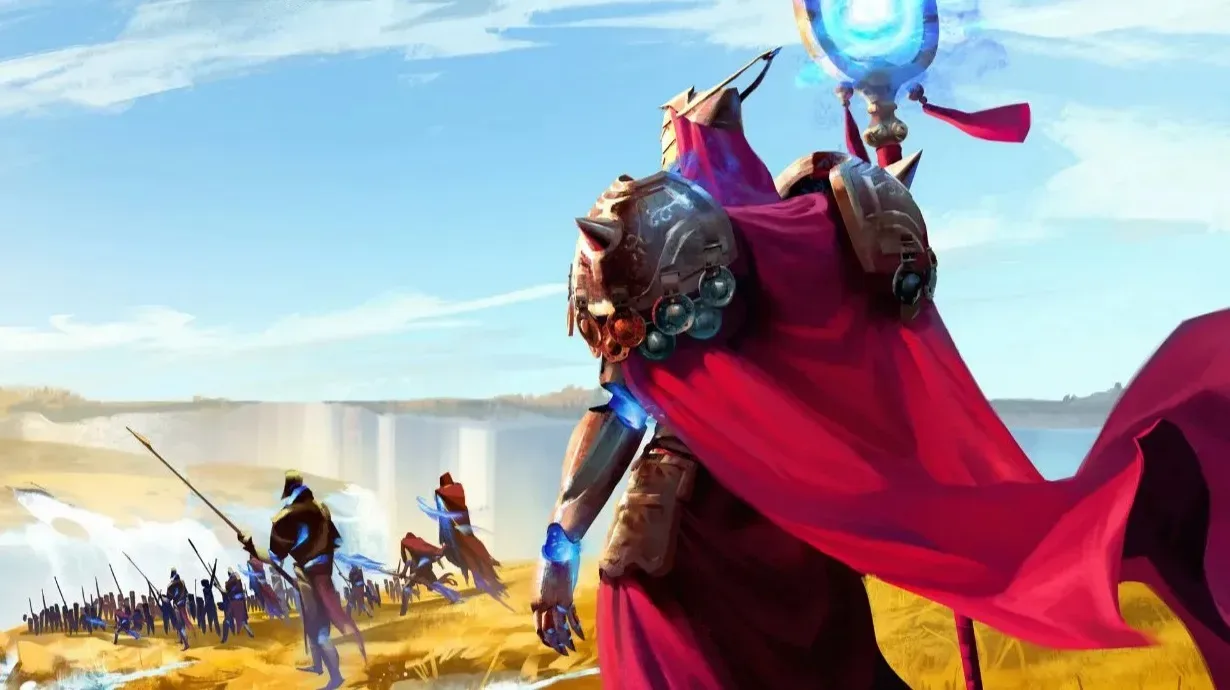
Endless Legend 2 is preparing to leave Steam Early Access on September 17, roughly a year after its development began in public. For Amplitude Studios, the milestone is more than a version-number change. It arrives at a time when the studio believes the meaning of Early Access has changed sharply, especially for strategy games that need extensive player feedback, balancing work, and long-term refinement.
The fantasy 4X sequel follows Endless Legend, the game that established Amplitude as a major name in the genre more than a decade ago. But while the studio has considerable experience building games alongside its community, CEO and cofounder Romain de Waubert de Genlis has described a much tougher environment for teams releasing incomplete games today. The central challenge is no longer merely communicating that a game remains in production. It is meeting an audience that increasingly treats an Early Access debut as a full commercial launch.
That shift has consequences for both players and developers. A public build can still provide crucial information about interface design, pacing, balance, systems, and content priorities. At the same time, a rough first impression can follow a game for its entire development cycle. With Endless Legend 2 about to reach 1.0, discussion around the game illustrates the uneasy balance between the traditional promise of Early Access and modern expectations for a polished product from day one.
From development space to launch-day spotlight
Amplitude's history with Early Access stretches back to Endless Space, its debut science-fiction 4X game. The model offered the studio an opportunity to work closely with players while the game was still being shaped. In those earlier days, de Waubert de Genlis said, players and the press often gave unfinished titles a wider berth. Early Access was more plainly understood as a place where games were still becoming what they would eventually be.
For useful background on this topic, read Bungie Denies Rumor That Destiny and Marathon Will Be Combined.
Nearly 15 years later, that understanding is far less straightforward. Early Access remains a process built around games in active development, but it has also become a highly visible retail event. Players can buy in immediately, streamers can broadcast their first hours, community discussion can form within days, and reviews can establish a public record that persists through every subsequent patch.
De Waubert de Genlis said the studio sees a major difference between the expectations attached to an unfinished game in the past and those attached to one now. In his view, players who pay a premium price can be much less willing to accept visible incompleteness, even when the game is sold under the Early Access label. A developer may view a launch build as the beginning of a collaborative process; a portion of the audience may see it as the product they have already purchased.
That creates an unusual inversion. The Early Access release can become the largest moment of attention in a game's lifecycle, while the formal 1.0 launch may be treated more like another major update. For studios, that means a project must make a strong first impression long before every feature, interface element, faction, mode, or balance pass has been finalized.
For another perspective on this story, read Endless Legend 2 Faces a Tougher Early Access Audience Ahead of 1.0.
A difficult path for a complex 4X sequel
4X strategy games are especially suited to ongoing feedback, but they are also especially exposed to the risks of public development. Their core appeal comes from interlocking systems: exploration, expansion, resource management, diplomacy, conflict, technology, faction identity, and the countless decisions that emerge over long campaigns. Small changes can have consequences far beyond the immediate feature being adjusted.
Endless Legend 2 began its Early Access journey with a strong worldbuilding foundation and a distinct identity, but player discussion has also highlighted concerns that the overall package needed more work. Some feedback has focused on a UI that can feel clunky, while other players have questioned whether the game contains enough content for its stage of development. Those concerns have not disappeared simply because the 1.0 date is approaching; some Steam users remain skeptical of what September 17 will represent for the game.
That skepticism is understandable within the contemporary Early Access landscape. A version 1.0 label carries substantial weight. It suggests that a game has reached a stable, complete form, even if developers plan to continue supporting it with patches and further updates. For players who stayed away during Early Access, the question is whether the launch build delivers the breadth, polish, and usability they were waiting for. For those who have played through the past year, the question is whether the accumulated changes have addressed the frustrations they experienced along the way.
Amplitude's experience also points to a broader reality: every change made in public is judged not only by its final destination, but by its immediate condition. A new feature that is promising but imperfect may be viewed as evidence of momentum by one player and as a failure by another. The room to experiment is narrower when each iteration is consumed as part of a live, paid release.
The tension between experimentation and responsiveness
De Waubert de Genlis framed the situation as a creative dilemma. For a game to develop a strong personality, developers need the freedom to try ideas that may not work exactly as intended. Some experiments will succeed, while others will need to be revised or discarded. That is not a flaw in game development; it is often how a team finds the mechanics and combinations that make a strategy game memorable rather than merely functional.
However, he also acknowledged that the journey can become rocky. A development process that takes risks may produce temporary rough edges, balance problems, or systems that require rethinking. Avoiding those risks entirely might create a smoother short-term experience, but it can also leave a game feeling flatter and less adventurous.
The modern pressure surrounding Early Access can push teams toward immediate response rather than larger experimentation. In the case of Endless Legend 2, the studio's time and energy across numerous patches and major updates appears to have been directed heavily toward responding to player complaints. That work is vital, particularly when feedback identifies practical problems with usability or missing content. Yet it can also reduce the time available for broader creative tests that might reshape what the game can become.
The CEO said players can be unforgiving when an update is not perfect. From a development perspective, that response can be frustrating because a live update may be an attempt to test, improve, and refine a system rather than a declaration that the system is finished forever. From a player perspective, though, a patch that makes the experience worse, introduces inconvenience, or fails to solve a known issue is immediately felt in the game they own and play.
Neither side of that relationship is difficult to understand. Players want confidence that their money and time are being respected. Developers need room to learn from feedback and make changes without every imperfect step being treated as a final verdict. The question for studios is how to keep those two needs aligned once Early Access becomes a full-scale public showcase.
What version 1.0 means for Endless Legend 2
The September 17 launch will be an important test of whether Endless Legend 2 can convert its year of public development into a convincing full release. The game already has the advantage of an established series identity and the kind of setting and strategic ambition that can help differentiate it within a crowded genre. Its remaining challenge is ensuring that the experience feels sufficiently complete and approachable for players who judge it as a finished game rather than an evolving project.
For returning players, 1.0 may offer a chance to assess the totality of Amplitude's work rather than a single patch or isolated point in the Early Access timeline. For newcomers, it may be the first time they consider entering the game at all. This is why version 1.0 still matters even in an era where Early Access can command the biggest launch-day attention: it is a statement of readiness, and audiences will evaluate it accordingly.
Amplitude's reflections reveal a changing contract between developers and audiences. Early Access still promises dialogue, iteration, and transparency, but it no longer guarantees patience for unfinished elements. Studios must now launch early builds with a degree of polish that once might have been reserved for a later stage, while still preserving enough flexibility to react to feedback and make meaningful improvements.
Endless Legend 2 reaches that moment on September 17. Whether players view the transition as the culmination of a successful year of refinement or as a point that demands further proof will depend on how the finished package addresses the concerns that have followed its Early Access run. What is already clear is that Amplitude sees the road to 1.0 as very different from the one it traveled with its earliest strategy games.
Community
Discussion
Start the conversation.
No comments have been posted yet.