

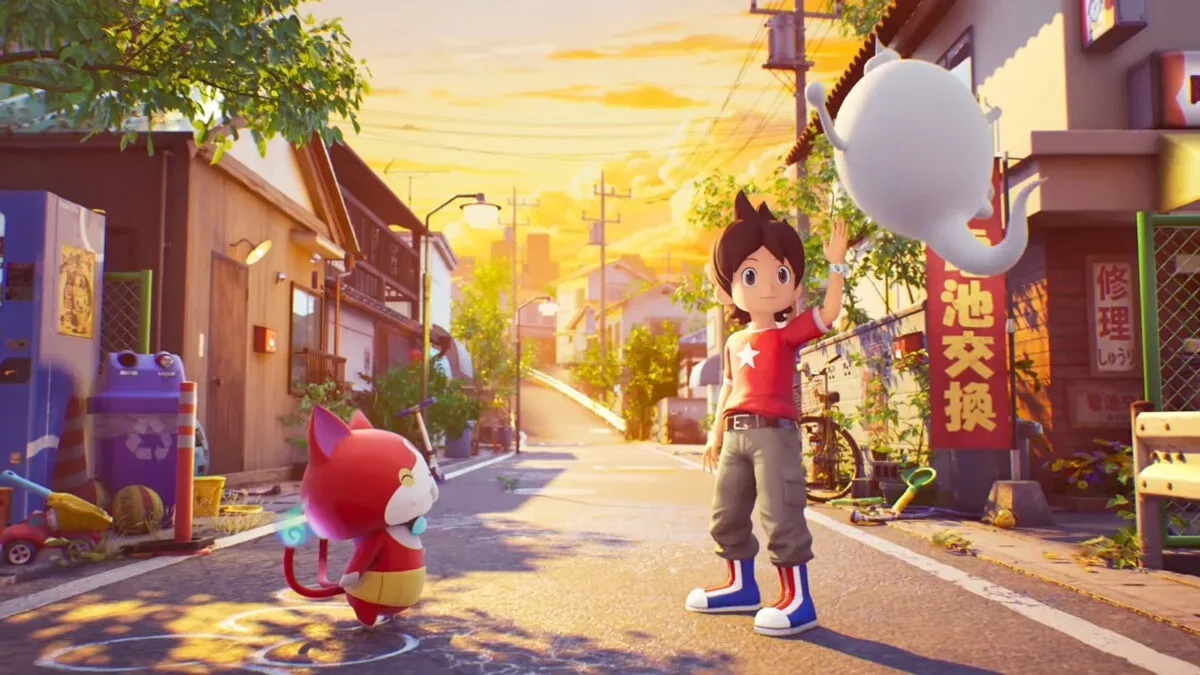
Level-5 has responded to fan criticism surrounding its recent VISION 2026 II: Dreams presentation, acknowledging that parts of the showcase created understandable concerns while insisting that several of the most conspicuous visual problems were not generated by AI. The company says some of the unusual artwork seen in the first trailer for Yo-Kai Watch 2: Haunted Domain came down to rushed production and ordinary human mistakes rather than generative tools.
The clarification arrives after the September 9 Nintendo Direct and Level-5's subsequent VISION 2026 II: Dreams event put the developer under intense scrutiny online. Viewers shared screenshots and clips of strange-looking environmental details, with particular attention paid to background objects that appeared inconsistent or poorly constructed. For a studio already discussing AI use in development, those images quickly fueled accusations that generative AI had found its way directly into promotional footage.
Level-5 is not now claiming that AI has played no role whatsoever in its work. President and CEO Akihiro Hino had already addressed the subject in a September 12 post on X, and the company's newer statement maintains that distinction. Its message is narrower: a number of the details viewers identified as supposed AI artifacts were, Level-5 says, either based on real-world references or were simply errors made by people during the creation of the presentation material.
Embedded X/Twitter post
Embedded X/Twitter post
Why the Yo-Kai Watch 2 backgrounds attracted so much attention
The original trailer for Yo-Kai Watch 2: Haunted Domain included background imagery that many fans found distracting. Electrical wires and telephone poles looked oddly tangled, while objects including vending machines and rain gutters appeared to have visual irregularities. In the current climate, those traits are often treated as immediate warning signs of generated imagery: objects that look plausible from a distance but become confusing when examined closely.
For useful background on this topic, read RGB Mew Cards Become Pokémon TCG's Early 30th Anniversary Chase.
Level-5 says the power-line imagery had a more mundane explanation. The company used photographs of actual Japanese electrical infrastructure as reference, and it argued that the dense arrangements of cables and equipment can look surprising even when they are faithfully based on reality. Japan's utility poles are often packed with wires, transformers, junction boxes, and overlapping lines, meaning a real reference can still produce a composition that viewers initially read as artificial or impossible.
That explanation does not extend to every criticized feature. Level-5 also conceded that some of the troublesome environmental assets were not up to the required standard. Rather than calling those particular issues AI-generated, the company described them as shortcomings in human-created art. The distinction matters to Level-5's broader response, but it also means the developer accepts that fans were right to notice that the material did not look polished.
In other words, the company's defense is not that the first trailer was flawless. It is that visible flaws should not automatically be treated as proof of generative AI. For players, that may be an important technical clarification, yet the larger reaction shows why presentation quality has become inseparable from debates over AI. Once an audience believes a publisher may be relying on generated material, rushed or inconsistent work can be interpreted through that lens almost immediately.
For another perspective on this story, read Level-5 Says Yo-Kai Watch 2 Trailer Art Errors Were Human, Not AI--But Will Update Its Presentation.
Updated trailers are planned for Tokyo Game Show
Level-5 says revised versions of the relevant trailers will be shown at Tokyo Game Show. That includes material connected to Yo-Kai Watch 2: Haunted Domain, and the company has also said it will address the presentation surrounding Professor Layton. The update is intended to replace footage that contained the disputed or poorly finished visual elements.
The timing behind the mismatch between versions is central to Level-5's explanation. The Nintendo Direct was scheduled before VISION 2026 II: Dreams, requiring the studio to submit its materials in advance to meet Nintendo's deadline. As a result, the Direct used an earlier version of the Yo-Kai Watch 2 trailer. A later version had already received background-art changes, but that was not the version shown during the Direct.
That production timeline helps explain why viewers may have encountered conflicting footage around the announcements. It also illustrates a familiar issue with major publisher showcases: marketing assets are frequently locked weeks ahead of broadcast, even as teams continue revising trailers and games. Normally, minor differences between cuts are barely noticed. In this case, the heightened attention around AI turned those inconsistencies into the center of conversation.
Tokyo Game Show will therefore be more than another opportunity for Level-5 to market its lineup. It will be a chance to demonstrate that the revisions are real and that the studio has responded to the concerns raised after the September presentations. The company has not provided a full breakdown of every shot or asset being altered, so audiences will need to compare the updated footage when it is shown.
Level-5 is not backing away from AI entirely
Although the company disputes that many criticized images were generated, it has not denied using AI tools during game development. Hino previously made clear that Level-5 sees AI as part of its workflow, and the studio's recent message instead focuses on boundaries. It says it will seek to limit AI use toward improving efficiency rather than creating visual work that is presented directly to fans in videos.
That approach reflects a distinction increasingly made by game companies: using AI-assisted processes behind the scenes is not the same as using generated images, voices, writing, or other finished creative assets in public-facing game material. In practice, however, players may still ask for more detail about what "efficiency" means in a particular project. The term can cover a broad range of uses, from technical support and data handling to creative iteration.
For Level-5, the challenge is especially visible because its games have long been associated with strongly authored visual identities. Series such as Yo-Kai Watch and Professor Layton depend on stylized worlds, distinctive characters, and carefully composed environments. Fans who value that handcrafted appeal are likely to be more sensitive to anything that feels generic, unfinished, or inconsistent with the studio's established art direction.
Hino has been outspoken in favor of treating AI as a creative tool rather than an automatic threat. Last year, he warned that allowing the belief that using AI is inherently wrong to take hold could obstruct the progress of digital technology. He also expressed hope that creators and audiences could recognize AI as something people use in making their work, with technological progress benefiting the games industry.
The reaction to VISION 2026 II: Dreams demonstrates the difficult balance in that position. Even players who accept technical experimentation may draw a firm line when they think generated output is replacing artists or appearing in final advertising. And for companies, transparency can create a paradox: openly acknowledging any use of AI may lead audiences to inspect every unusual image for evidence of it, whether or not the image actually came from such a system.
A quality-control issue as much as an AI debate
Level-5's statement ultimately turns much of the controversy into a question of quality control. If a trailer includes assets that are confusing enough to be mistaken for generated imagery, the underlying issue remains meaningful even if a human artist made them. The company appears to recognize this by revising the footage rather than merely issuing a denial.
That is likely the most constructive part of the response. Fans did not only object to the possibility of AI; they objected to promotional material that looked careless. Replacing the flawed scenes is a practical acknowledgment that high-profile reveals need to meet a higher visual bar, especially for returning series with dedicated audiences.
There is also a wider lesson for game marketing. AI discourse has changed how trailers are watched. Background props, signage, architecture, anatomy, and environmental clutter now receive a level of forensic attention that would have been unusual only a few years ago. Any error can become evidence in a larger argument, particularly when a developer has publicly discussed using AI in some capacity.
Level-5's forthcoming Tokyo Game Show material will not settle the industry's larger debate over generative AI, labor, authorship, or creative standards. It can, however, show whether the studio has corrected the specific issues that triggered this backlash. For Yo-Kai Watch 2: Haunted Domain and the Professor Layton material, the updated presentation will be judged on the clarity and craft of what appears on screen--not only on explanations offered after the fact.
For now, Level-5's position is clear: it acknowledges AI use within development, says it intends to keep that use focused on efficiency, and maintains that many of the visual details fans labeled as AI output were either real-world-inspired or the result of human error. The next trailers will determine whether that clarification is enough to restore confidence among viewers who felt the original showcase fell short.
Community
Discussion
Start the conversation.
No comments have been posted yet.