


The fast-growing retro handheld market could face greater scrutiny in the United States after the Entertainment Software Association, or ESA, asked the Office of the United States Trade Representative to examine companies it characterizes as sellers of piracy devices. ANBERNIC, one of the most recognizable names in the Chinese-made emulation handheld space, is among the companies identified for review.
The request concerns the USTR's annual Notorious Markets process, which spotlights physical and online marketplaces that are alleged to facilitate significant copyright infringement or trademark counterfeiting. It is not a ruling, a ban, or an announced seizure action. But the filing raises the prospect of more aggressive attention toward a portion of the retro-device business that has long occupied a legally uncomfortable space: hardware that can run legitimate emulators and homebrew software, but may also be shipped or sold with storage cards full of unlicensed games.
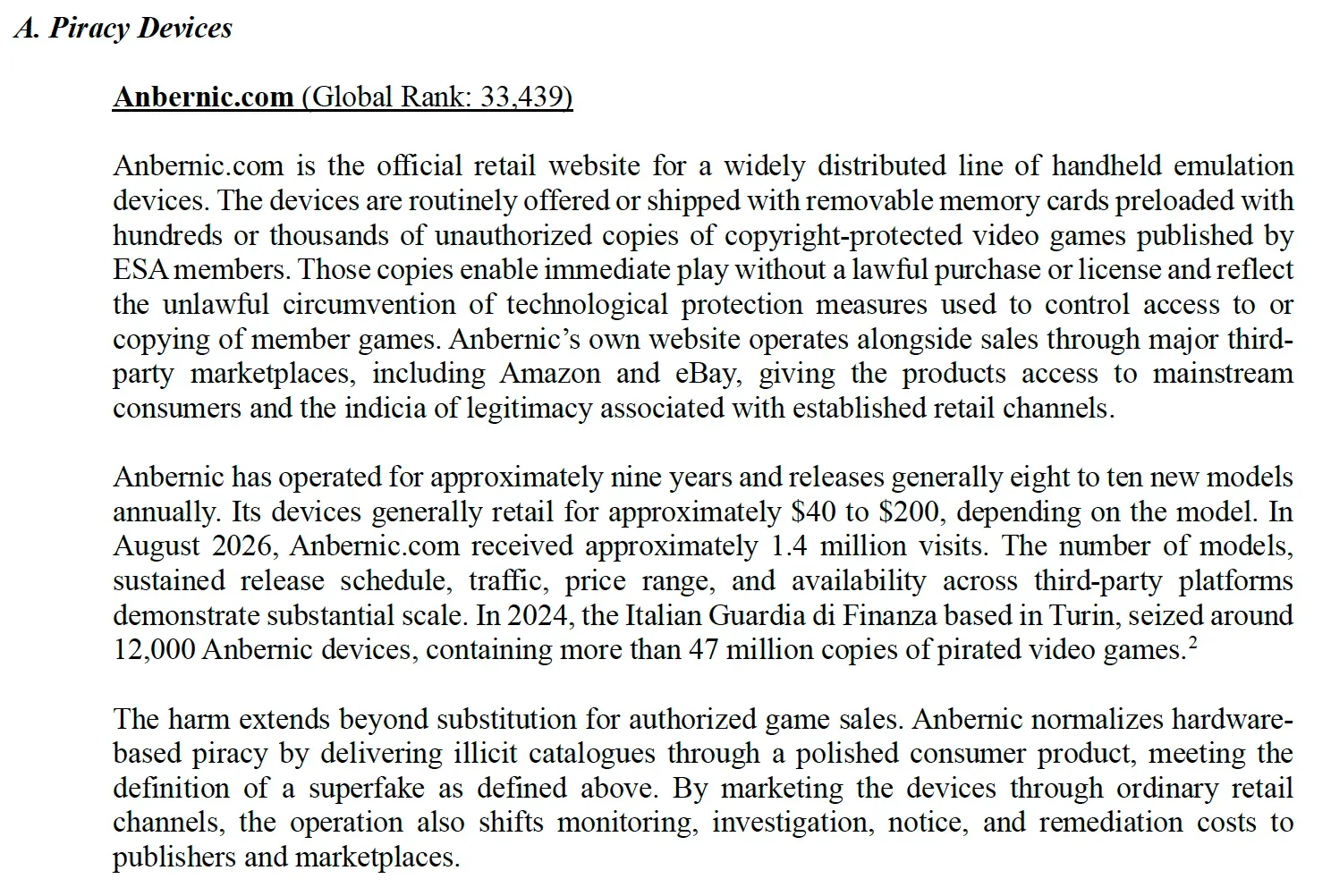
The ESA's concerns extend to what it calls "super fake" products and commercial-scale infringement. Its submission reportedly points to an enormous volume of allegedly pirated game copies associated with the devices and sellers it wants examined, putting the figure at more than 47 million games. That number reflects an allegation in a trade-policy submission rather than a court-established finding against ANBERNIC or the other named businesses.
What the ESA is asking the USTR to do
The ESA is a nonprofit U.S. trade association representing companies involved in video game hardware, software, and related interactive entertainment. A central part of its work is advocacy around intellectual-property protection, digital commerce, regulation, and worldwide market access for game publishers and platform holders.
For useful background on this topic, read Crash Bandicoot Running on a Classic iPod Shows Off Sprout's Ambitious Modern Board.
In this case, the association has asked the USTR to consider certain Chinese sellers and manufacturers as part of its Notorious Markets review, placing ANBERNIC in a category described as piracy devices. The Notorious Markets list is intended to identify operations that allegedly enable large-scale copyright piracy or counterfeit trade, draw attention to the revenue streams around those operations, and encourage governments, platforms, intermediaries, and market operators to act.
Being named in a submission or ultimately appearing in the report does not automatically create a criminal penalty or stop a product from entering the United States. The list itself is principally a trade-policy and public-pressure mechanism. Still, inclusion can be consequential. It can elevate a company's profile with customs authorities, rights holders, retailers, payment services, shipping partners, and policymakers. The practical result could be increased pressure to change how products are packaged, marketed, imported, or sold.
The strongest potential flashpoint is not the existence of an emulation-capable handheld on its own. Emulation software and multipurpose computing devices have legitimate uses, while many classic games can be played legally through licensed collections, official digital releases, homebrew projects, personal backups where lawful, and independently produced software. The more direct concern is hardware marketed with thousands of recognizable commercial games already installed, especially when those titles are not licensed for redistribution.
Preloaded SD cards remain the key issue
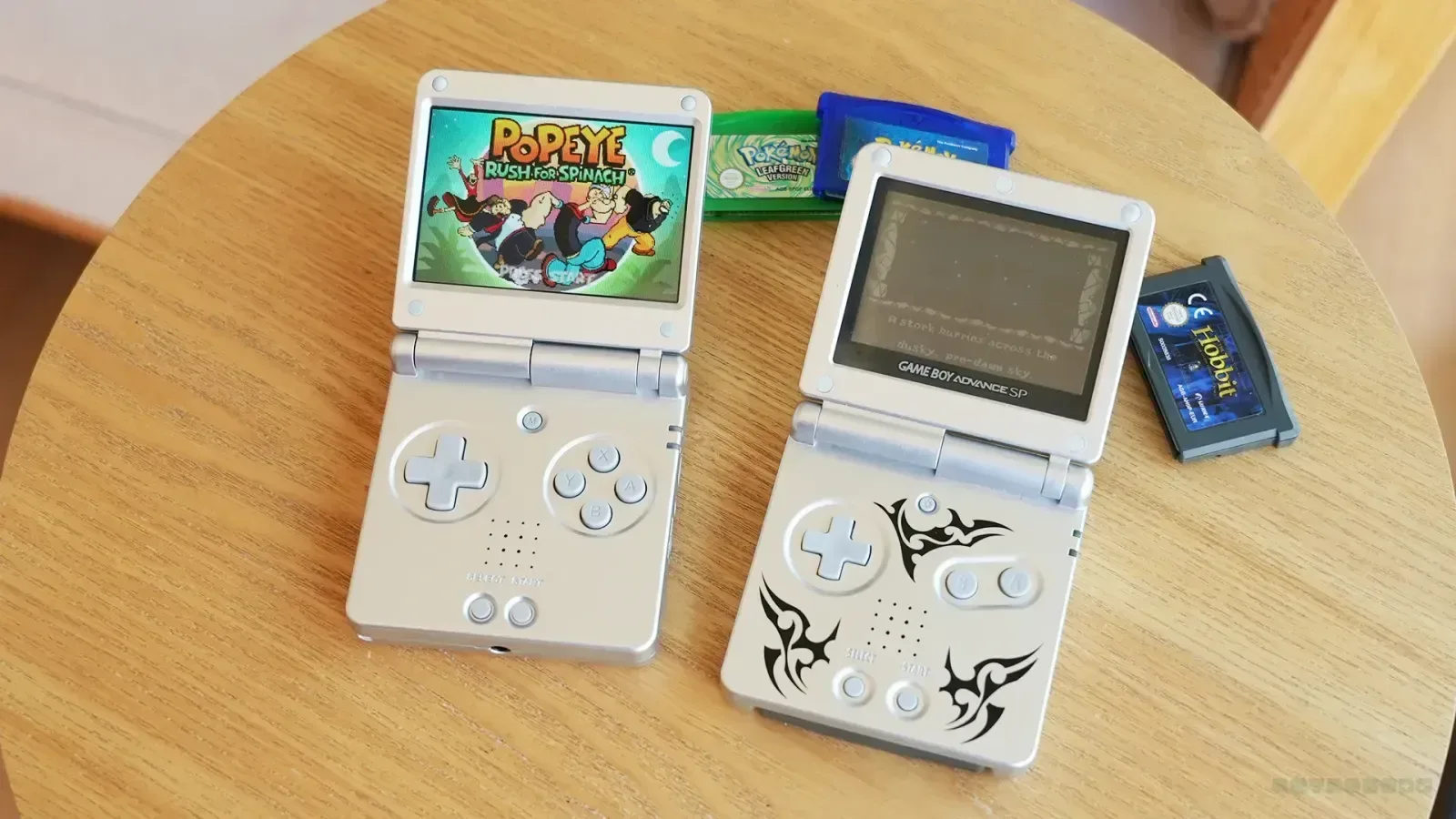
Retro handheld buyers have become accustomed to seeing product listings promise enormous libraries: hundreds, thousands, or even tens of thousands of games on an included microSD card. Such claims can be attractive to newcomers who want an all-in-one device. They also create an obvious copyright problem when the card contains games, firmware assets, artwork, or BIOS files distributed without authorization.
There is an important distinction between a handheld being capable of playing old games and a seller providing copyrighted games as part of the transaction. A device configured for users to supply their own legal files is materially different from one whose advertised value is a bundled library of commercial titles. In practice, however, the marketplace can blur that line. Listings may vary by storefront, reseller, territory, or even individual shipment, and a buyer may receive a different card or software setup than the one shown in promotional material.
The ESA's action appears aimed at that commercial ecosystem rather than solely at individual users. Its argument is that vendors and marketplaces can support infringement at scale when game-filled cards are included as a normal part of a hardware sale. That approach also explains why a prominent manufacturer such as ANBERNIC may draw attention even if the company's current official offerings do not consistently include loaded cards.
Many larger brands in the handheld scene have increasingly moved away from routinely supplying major copyrighted libraries with their devices. Buyers often receive a bare handheld, a basic card, or a card containing only menu software and open-source components. Yet game-packed products remain widely visible through marketplace listings, smaller resellers, and lower-cost devices whose advertising directly emphasizes the number of games included.
That inconsistency makes enforcement difficult. A manufacturer may sell hardware through its own store under one set of conditions while independent vendors offer altered bundles elsewhere. At the same time, rights holders may argue that a company benefiting from a distribution network has a responsibility to prevent infringing configurations from becoming a routine commercial product.
Why ANBERNIC is in focus
ANBERNIC has become one of the best-known makers of retro-focused handhelds, releasing devices in numerous shapes, performance tiers, and price ranges. Its broad reach in the United States makes it a conspicuous name in any discussion of imports. A large import footprint does not itself establish wrongdoing, but it can make a business more visible when trade groups seek examples of a wider market trend.
The submission does not mean ANBERNIC has been found liable for copyright infringement, nor does it establish that every one of its devices is sold with unauthorized games. Those questions would depend on particular products, listings, sellers, jurisdictions, and evidence. For now, the development is a recommendation to the USTR, not an announced action against the manufacturer.
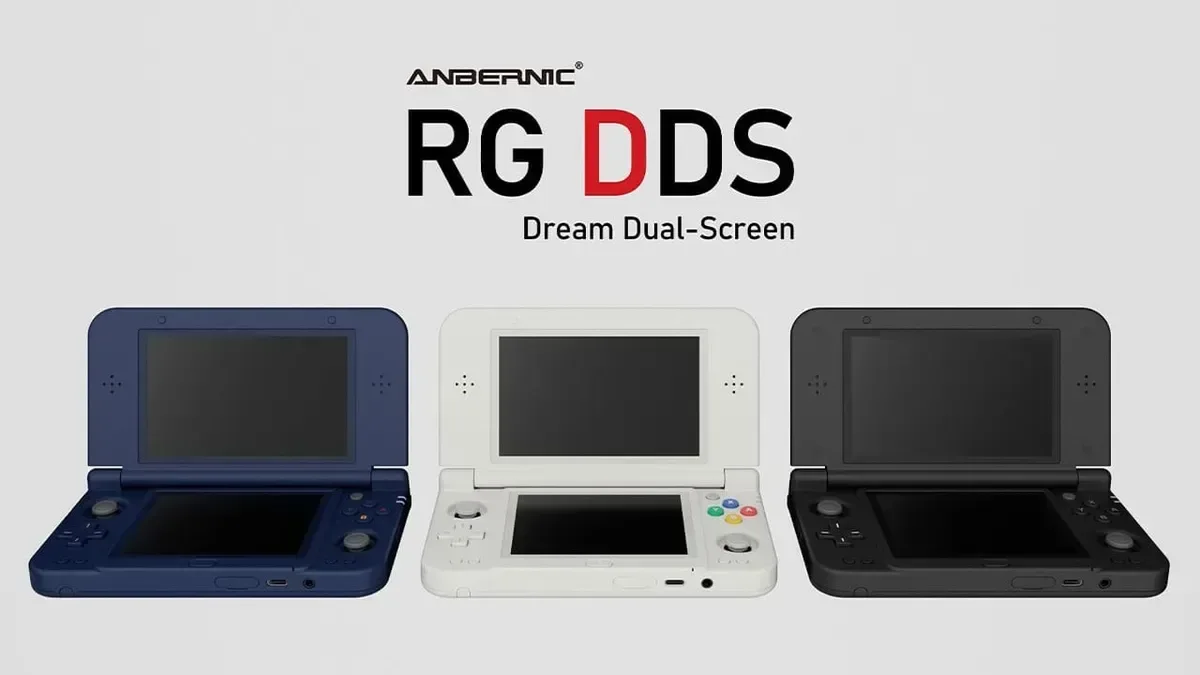
The issue also arrives while handheld makers continue to experiment with familiar industrial designs. ANBERNIC recently announced the RG DDS, a device whose appearance has drawn comparisons to Nintendo's 3DS family. Design resemblance and copyright piracy are separate legal questions. Any potential dispute over product design, trade dress, trademarks, or patents would involve different rights and would likely require action from the relevant rights holder. The ESA's current trade submission is centered on alleged piracy devices and unlicensed content, rather than serving as a determination on the RG DDS design.
What could happen next
There is no indication that U.S. authorities have ordered an import prohibition, blacklist, recall, or seizure campaign connected to the ESA's request. The USTR will review submissions as part of the Notorious Markets process, and any ultimate report could choose to mention specific entities, broader market patterns, or neither. The agency's assessment may take time, and a listing would still not automatically dictate a single enforcement outcome.
Even without a formal ban, the filing may encourage sellers to reassess their bundles. Marketplace operators could tighten listings that advertise copyrighted game libraries. Importers may decide that including generic, empty, or user-configured storage is less risky than selling a card preloaded with commercial software. Manufacturers could also face stronger demands to control how distributors use their branding and products.
For consumers, the safest interpretation is straightforward: the hardware and the game library should be treated as separate purchases and separate legal questions. A retro handheld can be a versatile platform for homebrew, independently developed games, public-domain software, legally acquired ports, and titles a player is authorized to use. A giant bundled library containing recognizable commercial releases is a much more obvious warning sign, regardless of whether it comes from a major brand, a marketplace reseller, or an obscure listing.
A pivotal moment for the retro handheld market
The U.S. trade submission reflects a larger change in how the retro handheld business is being viewed. These devices are no longer a tiny niche limited to enthusiasts willing to tinker with firmware and configure emulators. Better screens, stronger chips, recognizable form factors, widespread online retail availability, and highly visible social-media promotion have made them a substantial consumer category.
As the audience expands, so does scrutiny of the practices used to sell the hardware. The convenience of opening a box and immediately browsing thousands of games has helped fuel demand, but it also puts sellers in direct conflict with the owners of those games. The ESA's request suggests the industry's largest rights holders want that conflict addressed not only through individual takedowns, but through trade and import policy.
Other countries have already taken action against retro handheld shipments. Italy, for example, has previously seized 12,000 ANBERNIC products. That history does not predict what the United States will do, and it does not establish the outcome of the USTR review. It does show, however, that retro gaming hardware can attract enforcement attention when authorities believe it is tied to unlawful content distribution.
For ANBERNIC, competing handheld makers, resellers, and buyers, the immediate situation remains one of uncertainty rather than confirmed punishment. The ESA has made its position clear, but the next meaningful step belongs to U.S. trade officials. Whether that leads to a named entry in the Notorious Markets report, more cautious retail practices, or broader import action, the debate over preloaded retro game libraries is unlikely to fade soon.
Community
Discussion
Start the conversation.
No comments have been posted yet.