

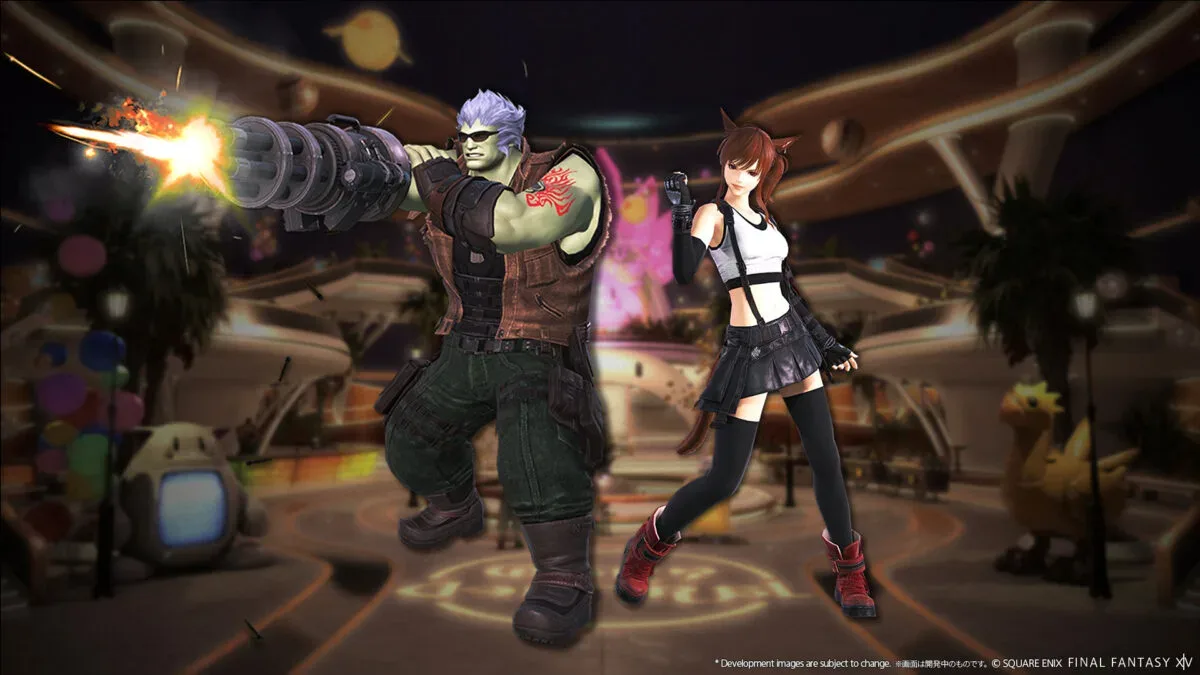
Final Fantasy XIV is preparing to bring another Final Fantasy VII Remake-inspired activity to Eorzea, but one upcoming Gold Saucer attraction is already meeting resistance from parts of the MMO's community. Keybound Brawler, a typing-focused minigame planned as part of the game's broader crossover material, has become a point of contention well ahead of its arrival.
The complaints center on two connected but distinct issues. First, the activity requires a keyboard, creating an extra hardware hurdle for players who have spent years playing Final Fantasy XIV exclusively with a controller. Second, its initial cosmetic rewards are gender-locked: a Barret-inspired outfit is limited to male player characters, while a Tifa-inspired outfit is limited to female player characters.
Either decision might have prompted discussion on its own. Together, they have landed poorly with a community that treats character fashion--better known in-game as glamour--as one of Final Fantasy XIV's most important long-term pursuits.
Embedded X/Twitter post
Embedded X/Twitter post
Embedded X/Twitter post
A Final Fantasy VII-inspired game within the Gold Saucer
Keybound Brawler is tied to Final Fantasy XIV's larger collaboration with Square Enix's Final Fantasy VII remake project. The crossover plans include a raid series drawing on the remake trilogy, while Keybound Brawler brings a more playful piece of that connection to the Gold Saucer.
For useful background on this topic, read EA Shelves Project Lotus as Rumored Sims 4 Follow-Up Takes Priority.
The Gold Saucer has long served as Final Fantasy XIV's theme-park-like diversion from dungeon runs, raids, crafting, gathering, and world-ending story stakes. Players visit it to spend gil, take part in minigames, earn prizes, and pursue a wide variety of optional activities. A typing challenge is an unusual fit for an MMO space usually designed around a broad array of control preferences, but the concept itself has clear roots in arcade-like typing games such as The Typing of the Dead.
In Keybound Brawler, typing is not merely an alternative input option. A keyboard is required to play. That stipulation has drawn a particularly sharp response from players on consoles, many of whom use controllers as their primary and sometimes only way to interact with the game.
Final Fantasy XIV has supported controller play for a very long time, and its cross hotbar interface has become a defining part of the experience for many PlayStation and Xbox users. The game has also now launched on Switch 2, adding another potential audience accustomed to console-first play. For those players, being told that a new activity requires separate hardware can feel at odds with the accessibility and flexibility they expect from the rest of the MMO.
The cost is small, but the principle is bigger
A basic USB or wireless keyboard is not necessarily an expensive purchase, and some console players may already own one for chatting, account management, or other games. But the player frustration is less about the difficulty of finding a keyboard than it is about the precedent created by the requirement.
Final Fantasy XIV has generally allowed its audience to choose how it wants to play. Keyboard-and-mouse users have one set of advantages and habits, while controller users have another, yet both groups can participate in the game's central content. Major battles, crafting systems, gathering, housing, social features, and Gold Saucer activities have all been accessible without demanding that console players abandon their established setup.
Keybound Brawler changes that equation for a piece of optional content. It is not a question of whether the minigame is technically possible on a keyboard--it plainly is designed around typing--but whether it needed to exclude controller-only participants entirely. Players discussing the issue have raised the possibility of alternative implementations, such as controller-friendly prompts, an on-screen keyboard approach, button-based equivalents, or separate input modes that preserve the central idea without making a physical keyboard mandatory.
There is no indication that such alternatives will be included in the first version of the attraction. As things stand, the minigame's design appears to make a keyboard part of the entry price for anyone who wants to participate directly.
That matters even more because Gold Saucer content is meant to be a communal, repeatable part of the game. Optional does not always mean unimportant in an MMO. Players can spend enormous amounts of time chasing collectibles, achievements, event rewards, and cosmetics that have no effect on combat power but have major value to the people who want them.
Glamour concerns have intensified the response
The larger flashpoint, for many players, is the reward structure. Keybound Brawler's first set of prizes includes costumes based on Final Fantasy VII characters Barret and Tifa. Yet the Barret gear can only be equipped by male characters, and the Tifa gear can only be equipped by female characters.
That distinction has struck many fans as a step backward. Final Fantasy XIV players have long used glamour to build outfits that range from lore-friendly adventuring gear to elaborate formalwear, casual clothing, comedic costumes, and cross-series tributes. The phrase "glamour is the endgame" has endured because it captures how much effort players put into personal style after completing, or alongside, combat progression.
When a high-profile crossover reward is restricted by character gender, it limits one of the biggest reasons players pursue it. A player with a male character may want the Tifa-inspired look. A player with a female character may want to dress as Barret. Others may simply want the freedom to combine individual pieces with existing glamour collections. The restrictions prevent all of those possibilities before players have even earned the items.
The decision is especially notable because Final Fantasy XIV has moved away from a number of comparable limitations over the years. In 2020, director Naoki Yoshida announced that gender restrictions on the game's wedding outfits would be removed. The game later lifted restrictions on maid outfits ahead of the Endwalker expansion, a change that arrived alongside the introduction of male Viera as a playable character option.
Those updates helped establish an expectation that cosmetic gear would gradually become more broadly wearable. They also reflected a simple practical reality: glamour systems are more compelling when the player has more creative control. Reintroducing a male-only and female-only split for costumes tied to two of the most recognizable characters in Final Fantasy feels inconsistent with that direction to many in the community.
Why crossover outfits make the restriction more visible
Not every item in Final Fantasy XIV produces the same level of scrutiny. These rewards are drawing attention because Barret and Tifa are iconic, and because the Final Fantasy VII remake collaboration has naturally created high expectations. Fans are not looking at generic themed clothing; they are looking at outfits that invite role-play, homage, screenshots, social events, and mix-and-match glamour experimentation.
Barret's visual identity and Tifa's visual identity are both immediately recognizable. Locking either set to one character gender can make the collection feel less like a celebration of those characters and more like a narrowly prescribed costume choice. In a game where players have repeatedly asked for broader glamour compatibility, that is a difficult message to sell.
There may be technical, animation, modeling, or policy considerations behind the current implementation, but none have been detailed here. Without further clarification or a stated plan to expand eligibility later, players are left judging the feature as it has been presented: keyboard-only participation paired with restricted cosmetic rewards.
An opportunity for Final Fantasy XIV to respond
The reaction does not mean players are opposed to Keybound Brawler as a concept. A Final Fantasy VII-flavored typing attraction in the Gold Saucer could be a memorable novelty, particularly for keyboard players who enjoy score-chasing minigames. The criticism instead reflects a desire to see the activity fit Final Fantasy XIV's wider strengths: flexible play styles, a shared community space, and highly customizable character expression.
There are two clear areas where adjustments could change the conversation. Supporting controller-oriented alternatives would let more players access the minigame without buying additional equipment. Removing the gender locks from the Barret and Tifa costumes would bring the rewards closer to the direction Final Fantasy XIV has taken with other glamour pieces.
For now, Keybound Brawler remains unreleased, meaning there is still time for feedback to shape its future. Even if the initial version launches as announced, the history of Final Fantasy XIV shows that systems and item restrictions can change after player response. The debate surrounding this minigame is therefore about more than a keyboard and two costumes. It is about whether a new crossover attraction will be open to the many different ways people have chosen to play--and dress--in Eorzea.
Community
Discussion
Start the conversation.
No comments have been posted yet.