

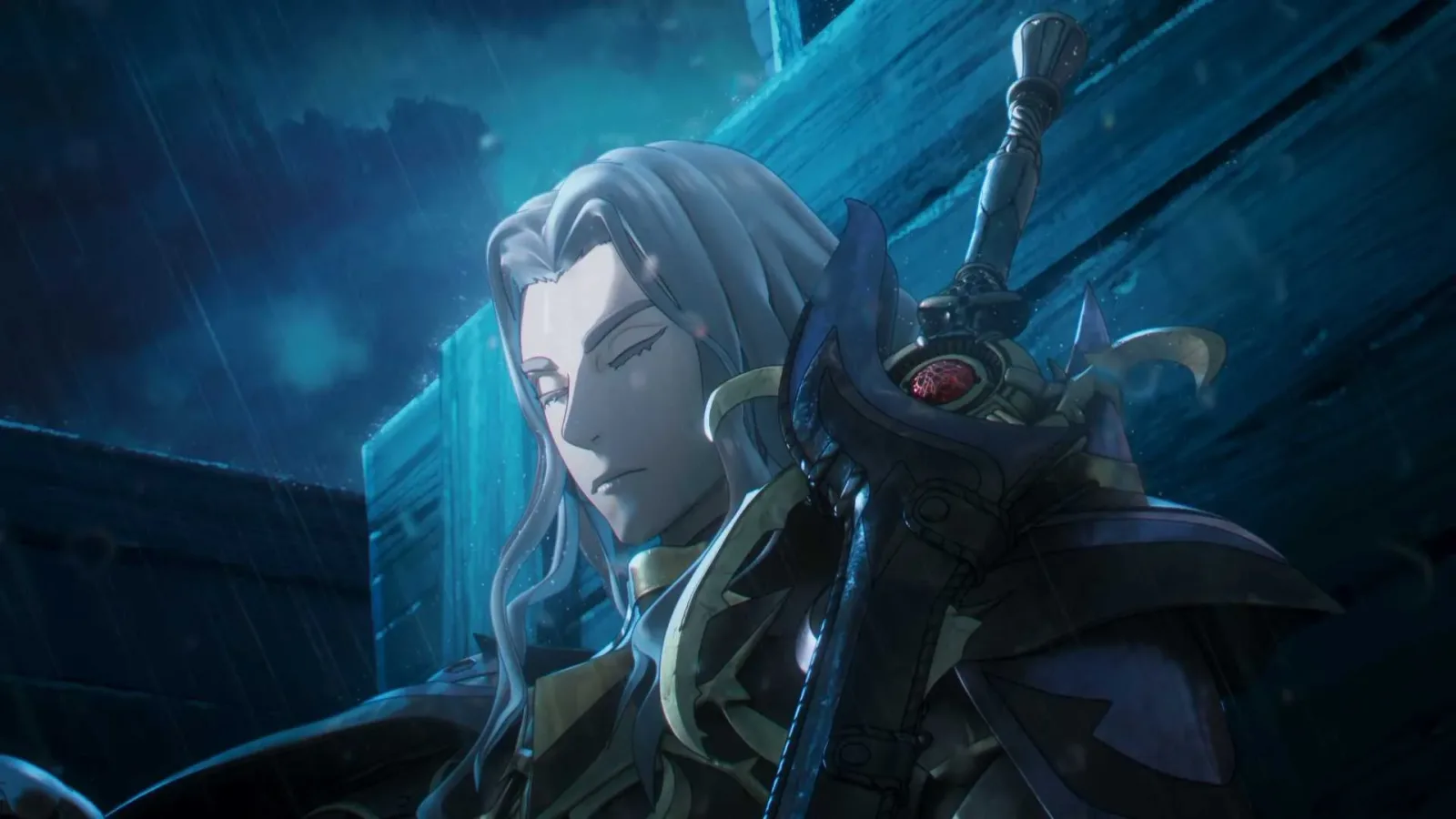
Fire Emblem: Fortune's Weave appears to be presenting players with an ensemble of equally important heroes, but its early narrative structure may be pointing somewhere more specific. Among the game's Flame Lords, Dietrich increasingly looks like the character whose path carries the greatest weight for the central mystery--at least during the opening 10-plus hours of the adventure.
That does not necessarily mean Dietrich is officially the sole protagonist. Fortune's Weave has several characters positioned as major leads, including the customizable avatar Eshmel and Flame Lords Dietrich, Theodora, Leda, and Cai. Anatolia, a gun-wielding nun who appears to have her own unusual role in the story, complicates the hierarchy even further. Still, an early read on the campaign suggests that Dietrich's storyline is the one most directly engaged with the questions surrounding the game's setting, its apparently impossible technology, and the broader forces moving behind the scenes.
For a series long associated with kingdoms, cavalry, crests, dragons, and continent-spanning wars, Fortune's Weave makes an especially startling first impression. Its fantasy world is not simply embellished with a few magical devices or ancient ruins. The game begins with imagery that seems far closer to science fiction: glowing monitors, cables, advanced machinery, lasers, and even giant starships are part of its framing.
Eshmel awakens as a disembodied spirit in a containment chamber surrounded by futuristic equipment, evoking a high-tech medical or reconstruction facility rather than a traditional Fire Emblem opening. Before that setup can be fully explained, however, the story sends Eshmel back in time. The striking technology and anachronistic imagery then fade from immediate view for a while, allowing the game's more familiar fantasy-facing plot to take over.
For useful background on this topic, read The Witcher 3 Remastered's Path Tracing Can Push an RTX 5080 Down to 30 FPS at 4K.
That decision makes the early focus of Dietrich's route particularly notable. While other stories appear to establish their own character stakes and conflicts, Dietrich's path reportedly brings Fortune's Weave back into contact with the material most likely to explain that strange opening. His story is also said to cross paths with Anatolia earlier than the other routes, placing two potentially plot-critical figures in the same narrative orbit.
Dietrich's Route Has the Strongest Connection to the Unknown
The key difference is not necessarily that Dietrich is the most sympathetic Flame Lord. In fact, the early response to Fortune's Weave suggests almost the opposite: the appeal of his route may rest less on affection for Dietrich himself and more on the unsettling questions his chapters raise.
Dietrich is initially framed through a comparatively straightforward ambition: he wants to become stronger. That is familiar territory for a tactical role-playing game hero, and it could easily become the least distinctive premise in a cast full of competing ideals and personal histories. Theodora, Leda, and Cai all seem to possess motivations that may provide more immediately compelling emotional hooks. Yet Dietrich's apparent simplicity could be intentional.
For another perspective on this story, read Dietrich's Route May Hold Fire Emblem: Fortune's Weave Together.
A character who seems focused on battle, monsters, and personal strength may be an effective entry point into a much bigger plot. His route reportedly offers the earliest and clearest intersections with the setting's unanswered questions, including the game's blend of medieval fantasy and future technology. Rather than resolving the oddity of Fortune's Weave's opening, it seems to sharpen it.
That makes Dietrich valuable to the story even if he is not the most naturally charismatic member of the ensemble. A route can be carried by momentum, mystery, and revelations as much as by a player's attachment to its central character. If the goal is to learn why Eshmel began as a spirit in a high-tech chamber, how the time displacement occurred, and why a Fire Emblem world has lasers and starships in its past or future, Dietrich may be the route currently offering the most clues.
The distinction matters because Fortune's Weave has apparently built its structure around multiple protagonists rather than one unquestioned lord. Fire Emblem has experimented with divided perspectives before, whether through separate armies, branching campaigns, or avatar-led stories. A multi-route setup naturally invites comparison: players will ask which character has the most complete arc, which path has the best battles, and which one contains the indispensable lore.
At this early stage, Dietrich may be winning the final category.
The Avatar's Opening Changes Expectations
Eshmel's role makes the situation more intriguing. Customizable avatar characters in Fire Emblem often occupy a privileged narrative position, functioning as the player's point of view and a major catalyst for the wider conflict. Byleth in Fire Emblem: Three Houses and the player avatar in Fire Emblem Engage are natural comparisons because both games ask players to see an unfamiliar world through a protagonist with unusual origins or powers.
Fortune's Weave seems to begin in a way that would normally establish Eshmel as the narrative center. A spirit awakening amid unfamiliar, advanced technology is a premise built around mystery. Who is Eshmel? Why are they in this facility? Who created or operates the technology? What does their return to the past mean for the world in which the Flame Lords live?
But instead of immediately pursuing those questions, the game reportedly shifts its attention away from them. That can be a deliberate pacing choice. Holding back the answers allows the world to feel stranger over time, especially if the fantasy setting begins to show cracks through which the futuristic framework becomes visible again.
Dietrich's route may be where those cracks first widen. If so, that does not reduce Eshmel's importance. It could instead establish Eshmel as the overarching mystery while positioning Dietrich as the route that most aggressively investigates it. The avatar may be the key, but Dietrich could be the character whose campaign gives players the clearest reason to turn that key.
Anatolia Could Be the Other Half of the Puzzle
Anatolia is another major reason to watch Dietrich's story. The nun with a gun already stands apart from the conventional expectations of Fire Emblem's fantasy setting, and the presence of firearms is especially meaningful in a game that has openly introduced other advanced technology into its premise.
Guns alone do not prove a direct connection to Fortune's Weave's starships, computer displays, or time-related events. Fire Emblem has always made room for unusual weapons, magical artifacts, and eccentric units. Nevertheless, Anatolia's visual and mechanical distinctiveness makes her difficult to dismiss as a simple side character. If Dietrich encounters her early, the route may be deliberately directing players toward the game's least easily explained elements.
There is also a useful contrast between Dietrich and Anatolia. Dietrich's stated drive toward strength is grounded in a classic warrior archetype. Anatolia's gun, religious identity, and apparent narrative significance are much harder to categorize. Putting them together could create a route that begins with a recognizable Fire Emblem-style conflict before moving into the story's more disruptive science-fiction ideas.
That combination may explain why Dietrich's campaign is generating particular curiosity. The question is not merely whether he can become stronger or defeat the monsters in front of him. It is whether the threats he faces are connected to the larger machinery of Fortune's Weave's world.
Equal Leads Can Still Have Unequal Narrative Jobs
Even if Fortune's Weave ultimately treats all of its Flame Lords as co-leads, equal billing does not require every route to perform the same narrative function. Theodora and Leda may offer the most effective character-driven stories. Cai may reveal a different political or emotional side of the conflict. Eshmel may remain the personal lens through which the player experiences the entire campaign.
Dietrich, meanwhile, could be the lore route: the path most tied to the hidden architecture beneath the game's visible war. That would be a legitimate and potentially smart division of labor. Ensemble stories often work best when each major character owns a distinct piece of the larger picture rather than repeating the same kind of conflict from four angles.
Of course, this is still an early interpretation based on the opening stretch of the game. Fortune's Weave may later shift its emphasis, reveal that another Flame Lord has deeper ties to the future-tech opening, or make Anatolia's role central across every route. The apparent importance of Dietrich's story is not proof that the other characters will receive less meaningful conclusions.
But early momentum matters. When a game introduces an avatar trapped between eras, machinery that does not belong in its surface-level fantasy setting, and a cast of leaders with competing priorities, players will naturally gravitate toward the path offering the most immediate answers. At present, Dietrich seems to be that path.
Fire Emblem: Fortune's Weave may have four Flame Lords, an enigmatic avatar, and a conspicuously armed nun competing for attention. Yet Dietrich's route appears to have the clearest line into the mystery that makes this entry feel so unlike a conventional Fire Emblem story.
Community
Discussion
Start the conversation.
No comments have been posted yet.