

Flashback: 25th Anniversary Edition is heading back to the platform where Conrad B. Hart's celebrated sci-fi adventure began. AmiKit has announced a substantial Amiga conversion built around the modern anniversary release, allowing owners of compatible hardware to create versions tailored to AGA and RTG-equipped machines.
The project is more than a straightforward attempt to run a later version of Flashback on old hardware. It is designed as a visual and audio overhaul that uses assets from a player's own copy of Flashback: 25th Anniversary Edition. Depending on the target configuration, the resulting Amiga release can use smoother artwork or fully repainted high-definition backgrounds and character animation, alongside upgraded music and stereo effects.
For a series with unusually deep Amiga roots, the conversion gives the 1992 classic a particularly fitting homecoming. Flashback first arrived on Commodore Amiga before spreading to PC and console formats, becoming one of the best-known cinematic platformers of its era. Its rotoscoped movement, deliberate pacing, puzzle-solving and dystopian future setting helped establish Conrad's adventure as a landmark of the 16-bit period.
A conversion built for several Amiga setups
AmiKit's release is available in three versions intended for different classes of hardware. At the lower end, an Amiga 1200 can run an AGA configuration at 640x256. More capable systems can move beyond that baseline, with RTG, or ReTargetable Graphics, support reaching as high as 1024x896 on Amigas equipped with an appropriate graphics card.
For useful background on this topic, read GTA 6's Tiny Beer Hiccup Shows Where Even a Huge Open World Can Draw the Line.
That split is central to what makes this project unusual. Rather than treating every Amiga as if it has the same display capabilities, the conversion scales its presentation around the machine available. AGA users can access a version suited to a comparatively standard Amiga 1200 environment, while RTG owners are offered a more ambitious presentation that makes greater use of higher resolutions and enhanced image processing.
The underlying game is still Flashback, with its familiar mix of exploration, combat, stealthy positioning and carefully timed jumps. Conrad is still navigating a hostile future after escaping from danger and trying to piece together his past. The point of the conversion is not to replace the game's identity, but to reinterpret the anniversary-edition material within the Amiga ecosystem.
From dithered pixels to painted backgrounds
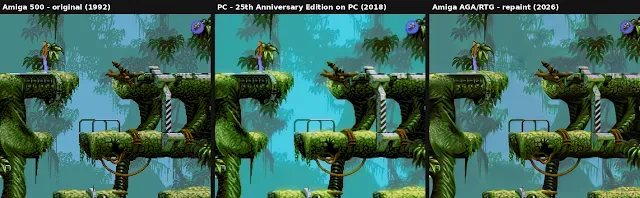
One of the most notable parts of the conversion is its approach to background art. Older versions of Flashback were built around the visual constraints of their day, including low-resolution imagery and extensive dithering. Dithering was an effective technique for suggesting additional colour and texture, but it can look coarse or blurred when enlarged without careful treatment.
AmiKit's custom conversion process addresses that problem by processing backgrounds through the ArtStation neural model. The stated aim is to turn the original dithered visual material into sharper, painted-looking HD textures instead of simply enlarging the legacy artwork. This distinction matters because a conventional scale-up can preserve the underlying pixel grid while making its flaws more obvious. A repainting process, by contrast, attempts to reconstruct surfaces and scenery with a cleaner appearance at higher resolutions.
The result is positioned as a major step beyond a basic stretch-and-smooth treatment. The conversion specifically avoids relying on the 256x224 artwork associated with the 1993 release as a source to be blurred across larger displays. For players who appreciate Flashback's original art direction but would like a less visibly dithered image, the project offers an alternate way to revisit its alien cities, industrial spaces and futuristic environments.
Character animation receives similar attention on RTG systems. Conrad and enemy sprites are processed with the BigFArt model, producing cleaner, more contemporary-looking figures than the rigid pixel art of the original presentation. Flashback's animation has always been one of its signature traits, so any revision to its characters has the potential to be particularly noticeable. The new treatment is intended to preserve the game's expressive movement while making it sit more naturally against the repainted scenery.
Higher-resolution cutscenes and smoother moving elements
The RTG editions also enhance the game's cinematic material. Cutscenes can run at up to four times the original resolution, providing extra clarity for the narrative sequences that frame Conrad's journey. Flashback's storytelling has long depended on brief but memorable scenes, from its opening crisis to revelations about the larger world, and higher-resolution playback should give these moments more visual presence on suitable displays.
Moving objects are also smoothed in real time in the RTG versions. That feature is particularly relevant to a game whose design places constant attention on motion: Conrad's running, climbing, weapon handling and cautious progression all contribute to its cinematic-platformer feel. The original animation language remains the foundation, but the conversion seeks to make it appear less harsh on modern-sized screens and high-resolution Amiga displays.
There is an interesting preservation angle here as well. Retro projects are often discussed as though players must choose between untouched originals and total remakes. This conversion occupies a middle ground. It retains the established game structure and relies on legally obtained anniversary-edition assets, yet it provides hardware-specific options that would have been impossible on a typical early-1990s Amiga configuration.
Audio upgrades are a major part of the package
Visual changes may be the easiest element to spot in screenshots, but AmiKit's conversion also places significant emphasis on sound. The Amiga files generated by the tool include remastered music along with panoramic stereo sound effects. That is a meaningful addition for a game driven by atmosphere, where tense environmental audio and moody music reinforce the isolation of its science-fiction setting.
The stereo treatment is described as an enhancement not included in the 2018 PC remaster. While the exact listening experience will naturally depend on a player's Amiga configuration and audio setup, the inclusion gives the conversion an identity beyond being an alternate graphics package. It aims to deliver a more enveloping version of Flashback for those able to use the expanded audio assets.
For long-time Amiga enthusiasts, that focus is fitting. The platform remains closely associated with distinctive game audio, and projects that take advantage of its sound capabilities can be as compelling as those chasing higher pixel counts. Here, the remastered soundtrack and broader stereo effects are intended to complement the rebuilt backgrounds rather than merely accompany them.
Players need their own anniversary-edition copy
This is not presented as a standalone commercial release containing Flashback itself. To make the Amiga version, players need to own Flashback: 25th Anniversary Edition on Steam. AmiKit's Convert2Amiga utility, available for Windows or Mac, then takes the necessary material from that copy and produces the Amiga files, including the enhanced backgrounds, remastered music and sound effects.
That requirement is important both practically and legally. The converter is the means by which users prepare files for Amiga use; it does not remove the need to acquire the anniversary edition. Prospective users should therefore make sure they have the required game version and a compatible Amiga setup before beginning the process.
- Required game: Flashback: 25th Anniversary Edition on Steam
- Conversion utility: Convert2Amiga
- Computer support for conversion: Windows or Mac
- Amiga options: AGA at 640x256, plus higher-resolution RTG configurations up to 1024x896
- Enhanced content: repainted or smoothed visuals, improved cutscenes, remastered music and panoramic stereo effects
A new way to revisit a 16-bit classic
The conversion will not replace the importance of Flashback's original Amiga release, whose visual design and technical compromises are part of the game's historical character. Instead, it offers another path through the same adventure: one shaped by later assets, neural-model-assisted visual reconstruction and the expanded display possibilities of upgraded Amiga hardware.
That makes it especially appealing to players who still use an Amiga 1200 or an RTG-equipped system and want an excuse to return to Conrad's world. The release also highlights how active the Amiga scene remains decades after the platform's commercial peak. Enthusiasts are not only keeping older games running; they are finding ways to adapt later editions, improve presentation and tailor software to a broad range of classic hardware.
With three hardware-oriented versions, high-resolution RTG support and a conversion process based on an owned copy of the anniversary edition, AmiKit's project is an ambitious revisiting of Flashback rather than a simple port. Conrad B. Hart's adventure has travelled across many systems since 1992. This time, it is returning to Amiga with a distinctly modern coat of paint.
Community
Discussion
Start the conversation.
No comments have been posted yet.