

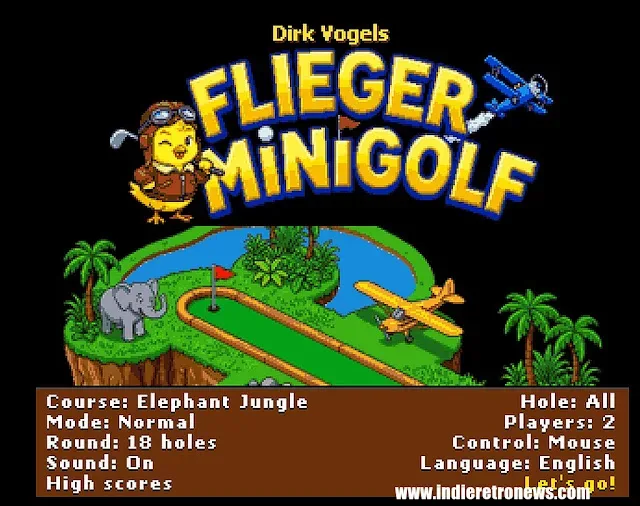
Classic Amiga owners have two new projects to watch from Fliegeralarm Games: Flieger Minigolf, a miniature-golf game built for OCS and ECS machines including the Amiga 500, and Fliegeralarms Wintergames AGA, an in-development multi-event winter sports title being made for AmiGameJam 9. Both games lean into the social, joystick-passing traditions of the platform, with hot-seat multiplayer for as many as four participants.
The projects also arrive with a clear disclosure from their creator about the use of AI-assisted assets. Flieger Minigolf features three AI-crafted courses, while the artwork for Wintergames was made using the Higgsfield AI image service alongside Blender, with sound effects created using ElevenLabs. Wintergames is being produced with the ACE engine.
While the pair share an Amiga focus and a fondness for accessible competitive play, they target different generations of Commodore hardware. Flieger Minigolf is designed around the earlier OCS/ECS graphics standards. Wintergames, as its name indicates, requires AGA-capable hardware and is aimed at the higher-spec Amiga 1200 class of systems or compatible machines.
Flieger Minigolf brings scrolling island courses to OCS and ECS
Flieger Minigolf turns miniature golf into an isometric Amiga challenge. Players choose a bird character, line up a shot, account for the intended direction and obstacles, then try to putt their way around a series of compact but elaborate courses. Rather than treating each hole as a static, single-screen puzzle, the game presents holes as larger floating islands that scroll beyond the visible play area.
For useful background on this topic, read Gun.Smoke Is Riding Toward Amiga AGA in a New Retro Port.
That scrolling design could give the courses a greater sense of scale than their immediate screen space suggests. It also means success is not simply about tapping the ball toward a cup. Players need to consider the route ahead and manage the hazards positioned around every fairway.
The announced obstacle selection includes wooden barriers, sand traps, water, steep gradients and wind gusts. Several hazards also use moving components, adding an element of timing to the usual angle-and-power calculation. Miniature golf games can quickly become deceptively demanding when a player must judge a shot's path around terrain changes or wait for a moving obstruction to clear, and Flieger Minigolf appears designed around that familiar balance between a cheerful presentation and frustratingly precise course design.
Three courses have been created for the game. The AI-crafted nature of those environments has been disclosed directly, but the playable structure remains firmly rooted in traditional arcade sports design: survey the hole, pick a line, take the shot, and attempt to finish in as few strokes as possible.
Hot-seat competition remains central
Like many games built for computers that were once gathered around in bedrooms and living rooms, Flieger Minigolf supports hot-seat multiplayer for up to four people. One player takes a turn, then hands the joystick to the next competitor. It is a straightforward format, but particularly well suited to a game where every missed putt, bad bounce and ill-timed encounter with water can become part of the group's conversation.
A solo mode is also included. Players who are not assembling a local group can work through the courses alone, chase stronger scores and learn the best way to approach each hole. The game's mix of slopes, gusts and dynamic obstacles should make repeated runs useful, as a safe route may not always be the fastest route.
Flieger Minigolf's OCS/ECS compatibility is significant for owners of earlier Amiga hardware. Those chipsets cover machines such as the Amiga 500, allowing the game to target a substantial segment of the classic Amiga community without requiring the later AGA graphics hardware. The focus on an isometric viewpoint, scrolling terrain and shared joystick play makes it feel purpose-built for that audience.
Wintergames heads to AGA hardware with five snowy events
Fliegeralarms Wintergames AGA takes a more ambitious sports-compilation approach. The project remains in development as part of the AmiGameJam 9 competition, but its planned event list already spans several distinct styles of winter competition: ski jumping, bobsleigh, biathlon, downhill skiing and slalom.
The game is intended to use a 256-colour palette, painted backdrops and Copper-driven graphical effects. The Amiga's Copper coprocessor was famously used to help deliver colourful displays and display tricks beyond what might be expected from its era, and Wintergames is looking to use that heritage as part of its visual identity. English and German language options are planned.
As with Flieger Minigolf, up to four players can participate through hot-seat multiplayer using a single shared joystick. The stated objective is to rise through the national medal standings, giving the different events a broader tournament context rather than presenting them only as isolated score challenges.
In ski jumping, competitors must handle the in-run, judge their takeoff with the wind in mind, and land with a proper telemark. Three style judges will assess the result, making the event about more than raw distance. A jump that travels far but ends poorly may not produce the desired result, so players will need to balance commitment at the ramp with control during the landing.
Bobsleigh shifts to a first-person view for a rapid run through an ice channel. The event asks players to steer aggressively through corners, but excessive risk can carry a serious consequence: crashing over the track's edge. It is a natural fit for a fast reaction-based mode, contrasting sharply with the planned timing and technique of ski jumping.
Biathlon, downhill and slalom broaden the challenge
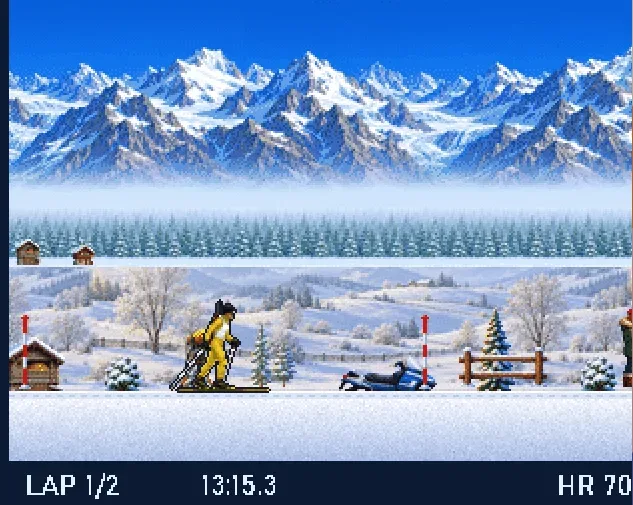
Biathlon introduces a different kind of pressure. Players navigate a snowy landscape with shifting parallax before reaching the shooting range, where accuracy must be managed alongside an elevated heart rate. That combination reflects the sport's defining tension: physical exertion makes the precision phase more difficult, so racing speed and controlled shooting cannot be treated as entirely separate concerns.
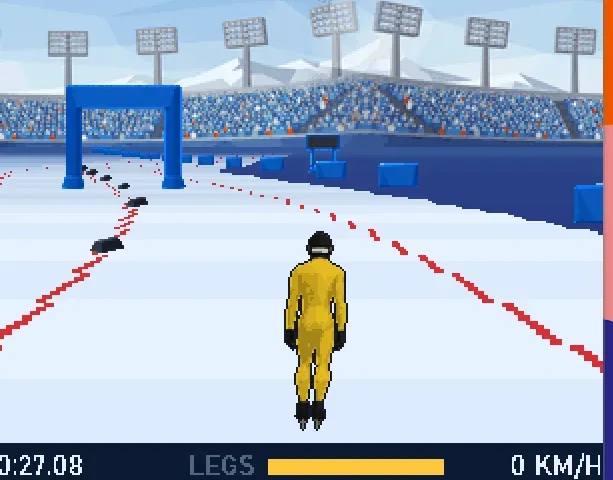
The downhill and slalom disciplines use pseudo-3D presentation. Players will race through gates at high speed, with a penalty clock making errors costly. Downhill is likely to reward confident, direct lines, while slalom's tighter gate work should demand more disciplined steering. Together, the events give Wintergames a range of pacing, from the brief technical focus of a ski jump to extended reflex-driven runs on ice and snow.
Audio is another notable part of the project's stated feature set. Custom sampled effects are planned for the Amiga's Paula sound chip, including crowd reactions, cowbells and skis moving through powder. Paula remains one of the defining parts of the Amiga's audiovisual legacy, so using sampled effects for a winter-sports atmosphere is a fitting choice for a game designed specifically for the platform.
Hardware requirements for Wintergames
Fliegeralarms Wintergames AGA is planned for an Amiga 1200 or compatible system with the AGA chipset and a 68020 processor or better. It requires 2 MB of Chip RAM plus 2 MB of Fast RAM, as well as a hard disk. Controls are set for a joystick in port 2, though cursor keys can be used with Space or Return acting as the fire button.
Those requirements distinguish it clearly from Flieger Minigolf's OCS/ECS focus. Players interested in both titles should therefore check which Amiga configuration they own before assuming the games share the same compatibility profile. The earlier-compatible golf game and the more demanding AGA sports compilation represent two different technical targets within the wider Amiga scene.
For retro enthusiasts, the appeal of both projects is easy to understand. Flieger Minigolf offers a compact, social contest built around a simple sport made more complicated by inventive hazards. Wintergames aims for the variety of a classic multi-event sports package, using AGA colour, parallax, pseudo-3D sequences and sampled sound to support its snowy competition. Their AI-assisted asset disclosure will be of interest to players following how contemporary homebrew creators approach production tools, while their gameplay ideas remain closely tied to the strengths of the original hardware: local competition, immediate controls and memorable audiovisual character.
Flieger Minigolf is the project for players with an OCS/ECS setup looking for a bird-filled putting contest, while Fliegeralarms Wintergames AGA is the larger work-in-progress for AGA owners who want to compete for medals across several winter disciplines. Both continue the long-running tradition of new software being made for Commodore's classic machines.
Community
Discussion
Start the conversation.
No comments have been posted yet.