

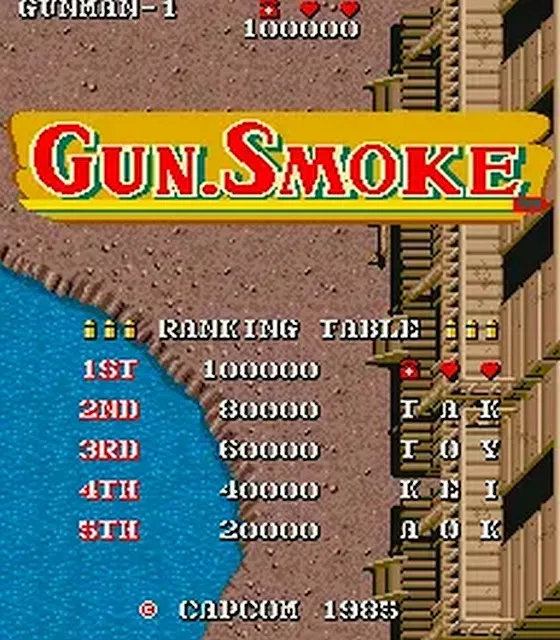
Capcom's arcade western Gun.Smoke is headed for AGA-equipped Amiga computers through a new fan-made conversion from Modern Vintage Gamer. The project follows the developer's recent Amiga adaptation of Zippy Race and takes on a substantially more demanding game: a fast, vertically scrolling 1985 coin-op filled with enemies, weapon pickups, bosses, and a famously unusual shooting system.
Early work on the port is already in progress, with the aim of retaining the arcade game's hectic pace while operating within the limits of classic Amiga hardware. Modern Vintage Gamer is targeting smooth performance at either 50 or 60 frames per second, though getting that result on an original Amiga 1200 presents an increasingly difficult memory challenge. The eventual version may require additional Fast RAM even if the project's central ambition remains compatibility with an otherwise stock machine.
A western arcade classic with a distinctive control idea
Released in arcades in 1985, Gun.Smoke places players in control of bounty hunter Billy Bob. His mission is to travel through the Old West, confront gangs of dangerous criminals, collect bounties, and defeat major outlaw leaders. It is a simple premise, but its execution helped make the game one of Capcom's memorable early arcade hits.
Rather than using a conventional single fire button paired with movement, Gun.Smoke built its combat around three directional shooting buttons. Billy Bob can fire diagonally left, straight ahead, or diagonally right, while the joystick controls his movement around the screen. That setup asks players to manage positioning and aim separately, especially as enemy fire, riders, wagons, and other hazards begin to fill the playfield.
For useful background on this topic, read Persona 4 Revival Makes Aika Nakamura a Social Link, Raising Questions About New Arcana.
The game's scrolling action also demands constant forward momentum. Stages move upward as Billy Bob advances across desert routes, settlements, and other western environments, turning every encounter into a test of route planning as well as reflexes. Better weapons can make a major difference, yet the player remains vulnerable to ambushes and the dense enemy patterns that define the coin-op's later stretches.
Gun.Smoke was more than a cult curiosity in its original arcade form. By the first half of 1986, it had ranked as Japan's sixth highest-grossing table arcade game. Its mixture of western presentation, memorable music, mechanical identity, and escalating stage design has kept it in the conversation among Capcom's notable arcade releases from the period.
Reverse-engineering the arcade code for a practical conversion
Instead of attempting to recreate every system manually from the ground up, Modern Vintage Gamer is using a reverse-engineering process that converts the original arcade ROM into C source code. This transcode-style technique is intended to provide a more efficient route to preserving the original game's behavior while rebuilding it for a very different hardware platform.
That is particularly relevant for a game of Gun.Smoke's scope. The complete arcade experience includes ten separate levels, collectible weapons, boss encounters, enemy logic, scrolling scenes, sound, and a considerable amount of moving action on screen at once. Writing a new Amiga version system by system without a foundation from the original program would be a major undertaking and could take a very long time.
The approach is reminiscent of work associated with JOTD, a developer well known in the Amiga community for technically ambitious conversions and reverse-engineering-led projects. In practical terms, translating the original logic into C can make it easier to study, adapt, optimize, and connect that code to Amiga-specific graphics, audio, controls, and memory handling.
It does not remove the hard work. An arcade board and an AGA Amiga have different processors, graphics architectures, memory arrangements, display expectations, and performance bottlenecks. A direct understanding of the arcade program can help preserve the game's structure, but the conversion still needs to render its action efficiently enough for the target hardware.
Why the Amiga 1200 target is demanding
The Amiga 1200 is the natural baseline for an AGA-focused release, but Gun.Smoke is not an especially gentle test for the system. The arcade game can flood the screen with enemies and projectiles while the background scrolls and the player fires in multiple directions. Preserving the sensation of relentless action without sacrificing responsiveness is a demanding objective on period hardware.
Modern Vintage Gamer has indicated that the port is already looking promising in early form, but the available Chip RAM is proving extremely tight. Chip RAM is important on Amiga systems because it is shared by the custom chips responsible for graphics and audio tasks. It is therefore not merely a matter of fitting program data somewhere in memory; the available pool can directly affect what the system can display and play smoothly.
A stock Amiga 1200 has limited Chip RAM, and a conversion attempting to reproduce a busy arcade game must carefully account for graphics data, screens, animation frames, sound resources, buffers, and other necessities. Every byte saved can matter. Depending on how final optimization develops, users may need Fast RAM to receive the intended full experience.
Fast RAM, when present, gives the main processor a separate memory area that is generally quicker to access and does not compete with the chipset in the same way. It can ease the pressure placed on a machine by code and data, though it cannot magically eliminate every graphical limitation. The question for this project will be how much of Gun.Smoke's original intensity can be maintained on baseline equipment and where additional memory becomes necessary.
Faithfulness will be measured in motion, not just appearance
For retro conversions, visual similarity is only one part of the challenge. Gun.Smoke needs to feel correct in motion. Its difficulty comes from the relationship between scrolling speed, enemy placement, projectile timing, player movement, weapon behavior, and the split-direction shooting system. Small changes to any of those components can alter the balance of entire stages.
A conversion that runs smoothly at 50 or 60 frames per second would be especially important for that reason. The original game's intensity depends on readable movement during moments that are deliberately crowded. If animation slows significantly or inputs become less immediate, Billy Bob's carefully aimed escapes can become frustrating rather than thrilling.
The port will also need to tackle the practical differences between arcade controls and home setups. Gun.Smoke's three separate firing directions are central to its design, and adapting that scheme for Amiga input devices without losing its character is an essential part of the work. The project's use of the arcade code as a starting point may help preserve gameplay logic, but the home-computer interface still needs a satisfying solution.
A welcome project for the Amiga preservation scene
The announcement is encouraging for Amiga enthusiasts because it represents more than another nostalgia release. Gun.Smoke is a game with a strong arcade identity and enough technical complexity to make an AGA conversion genuinely interesting. It also fits the continuing interest in bringing coin-op experiences to vintage machines in forms that respect both the source material and the capabilities of the destination platform.
Modern Vintage Gamer's earlier Zippy Race port demonstrated an appetite for this kind of work, while Gun.Smoke raises the stakes with its dense action and larger overall structure. The combination of reverse engineering, performance optimization, and period-specific hardware constraints makes the project one to watch for players interested in the technical side of retro development as much as the game itself.
There is no confirmed release date or final hardware requirement at this stage. What is clear is that the conversion is being designed around a challenging goal: bringing Capcom's energetic 1985 western to AGA Amiga systems while preserving the speed, pressure, and recognizable mechanics that made the arcade original stand out. Whether a completely stock Amiga 1200 can ultimately carry the full ride remains an open question, but the journey has begun.
Community
Discussion
Start the conversation.
No comments have been posted yet.