

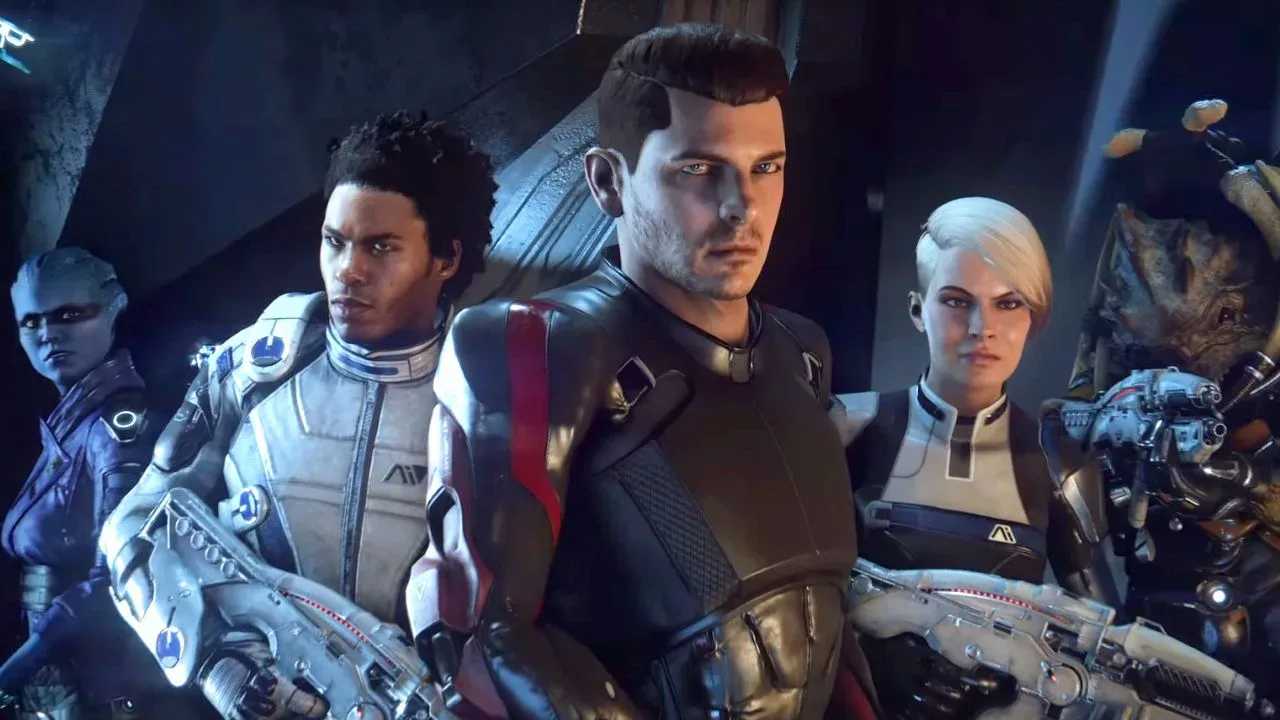
Mass Effect: Andromeda may have been held back by an ambitious idea that its developers pursued far beyond the point it should have been abandoned. Former BioWare producer Mark Darrah has reflected on the troubled project and identified its planned procedural planet-generation technology as a major drain on development time, arguing that it should have been removed one or two years earlier than it ultimately was.
Andromeda launched in March 2017 with a new galaxy, a new cast, and a stronger focus on driving across explorable planetary surfaces than the original Mass Effect trilogy. But the game's release was also shaped by a difficult production, and Darrah's comments offer a specific explanation for why late-stage development could not simply replace a discarded feature with more authored missions, locations, and encounters.
The central issue, in Darrah's telling, was not merely that a big experimental system failed to make the final game. It was that the project had been organized around the expectation that the system would supply a huge amount of content. Once that expectation collapsed, the team was left trying to complete a game with an enormous gap where a major pillar had been expected to stand.
An exploration ambition rooted in Mass Effect's history
Darrah connected the push toward procedural planets to a long-running part of Mass Effect's identity: the desire to make space exploration feel broad, surprising, and less strictly linear. He said former BioWare general manager Casey Hudson was a fan of Star Control, a series strongly associated with travelling between worlds and finding unexpected things across a large universe.
For useful background on this topic, read Marvel Rivals Teams With Ateez for 'Doomsday' Song During Season 11.
Mass Effect had always carried some version of that DNA. The original game let players scan planets, read flavor text, deploy onto uncharted worlds, and roam rugged environments in the Mako. Yet it never fully committed to the kind of expansive, system-driven planetary generation that can define games such as No Man's Sky, or the large-scale procedural exploration associated with Starfield.
That distinction mattered. A franchise can evoke the fantasy of open-ended galactic travel without building its entire production pipeline around procedurally generated worlds. Andromeda appears to have attempted to take a more dramatic step in that direction. Darrah said the concept was seeded before Hudson departed, after which the development team continued chasing it for years.
By Darrah's account, work on the feature continued into late 2016. That placed the experiment uncomfortably close to Andromeda's March 2017 release. Even allowing for the normal pressures of final production, the team was still dealing with a foundational piece of the project at a point when many other games would be focused on polishing, balancing, debugging, and completing authored material.
Why a late cut creates more than a technical problem
Darrah's most revealing point is that cutting a system late does not automatically free a team to make something better. It often does the opposite. If a studio believes a procedural tool will create a substantial percentage of a game's playable material, it makes plans accordingly. Designers, writers, artists, cinematic teams, and QA staff may be scheduled around the assumption that the system will eventually work and fill its assigned role.
Darrah illustrated that problem by suggesting the system may have been expected to account for a very large portion of Andromeda's content, whether that meant 40%, 80%, or some other figure. The exact share is less important than the development logic behind it. If procedural technology is supposed to provide planets, activities, traversal spaces, or repeatable points of interest, the team does not also have the time and resources to create a full handcrafted substitute for all of that material.
Once the feature is removed, the expected content does not suddenly appear in another form. Developers must first recognize that the replacement work is needed, then design it, build it, test it, integrate it with quests and progression, localize it, and polish it. Those tasks are difficult under ideal circumstances. They become vastly harder when undertaken late in a project already moving toward release.
That is why Darrah said the procedural planet effort should have been cut completely, and much earlier. The concern was not that experimentation itself was a mistake. New technology and bold ideas are essential to major game development. Rather, the issue was continuing to invest in a feature after the window for safely relying on it had closed.
Andromeda's final shape reflects a changing scope
The released version of Mass Effect: Andromeda did include several large environments, the Nomad ground vehicle, planetary viability systems, side missions, resource collection, and a broad emphasis on exploration. It was not a small or narrowly structured role-playing game. However, it also did not arrive as a fully procedural galaxy-spanning exploration experience in the vein of the systems Darrah referenced.
That final form makes more sense through the lens of a late scope change. The game still contains the traces of an ambition to make discovering planets a central attraction, but it ultimately relies on a more limited collection of bespoke destinations. Those areas needed to serve many roles at once: story staging grounds, combat spaces, hubs for faction activity, locations for optional tasks, and landscapes built around vehicle movement.
Such spaces can be compelling, but they require careful density and pacing. When a project loses a proposed content engine late, individual environments may be asked to shoulder more responsibility than originally intended. The result can feel uneven even when the remaining pieces represent substantial work by the team.
Darrah did not frame the matter as a simple failure by individual developers. His description instead points to a management and production challenge familiar across large games: leadership must decide when a promising feature remains worth pursuing and when it has become a risk to everything around it. A concept can be creatively appealing, technically impressive, and still be the wrong choice to keep if it prevents the rest of the game from reaching a complete state.
A lesson Darrah says extended beyond Andromeda
Darrah also said a comparable pattern happened during work on Dragon Age 4. He did not identify the equivalent feature in these comments, but the comparison makes his broader criticism clear. The danger is not exclusive to procedural generation. Any major system can distort a project if it is treated as an imminent solution to the game's content needs for too long.
Live-service structures, dynamically generated quests, advanced traversal, multiplayer layers, complex world simulation, and other large-scale concepts can all create this kind of dependency. They may promise efficiency or breadth, but that promise only helps if the system works early enough for every other discipline to build around it with confidence. If not, the project risks losing both the experimental feature and the handcrafted material that was never commissioned because the feature was meant to cover that territory.
The comments arrive amid a bleak retrospective view of BioWare's later years, which Darrah discussed in the context of the studio's closure and the cancellation of Mass Effect 5. For fans, that wider context makes the Andromeda discussion more than an argument over one release. It is a look at how decisions made years before launch can shape a studio's confidence, its output, and eventually its future.
What the retrospective means for Mass Effect fans
It is easy to look back at a difficult launch and focus on what players could see immediately: technical problems, animation issues, uneven quests, or areas that felt less developed than hoped. Darrah's account highlights the work players cannot see, including the internal bets that determine where teams spend their time long before a game reaches the public.
Mass Effect: Andromeda remains a game with supporters who value its companions, its more optimistic frontier premise, and its combat systems. At the same time, it has long been a case study in how a blockbuster RPG can struggle when its scope, technology, and content plans do not settle early enough. Darrah's recollection gives that history a sharper focus: the procedural planet initiative was not simply an unrealized feature on a wish list, but a late-running commitment that may have prevented the team from making the content required after it was finally removed.
For any future Mass Effect project, the clearest takeaway is not that exploration or technical ambition should be avoided. The series has always benefited from a sense of scale and discovery. The lesson is that an ambitious system needs an early proof of value, a realistic production plan, and a firm deadline for cancellation if it cannot meet its goals. Without those safeguards, the dream of making a galaxy feel limitless can leave too little time to make the worlds that remain feel complete.
Community
Discussion
Start the conversation.
No comments have been posted yet.