

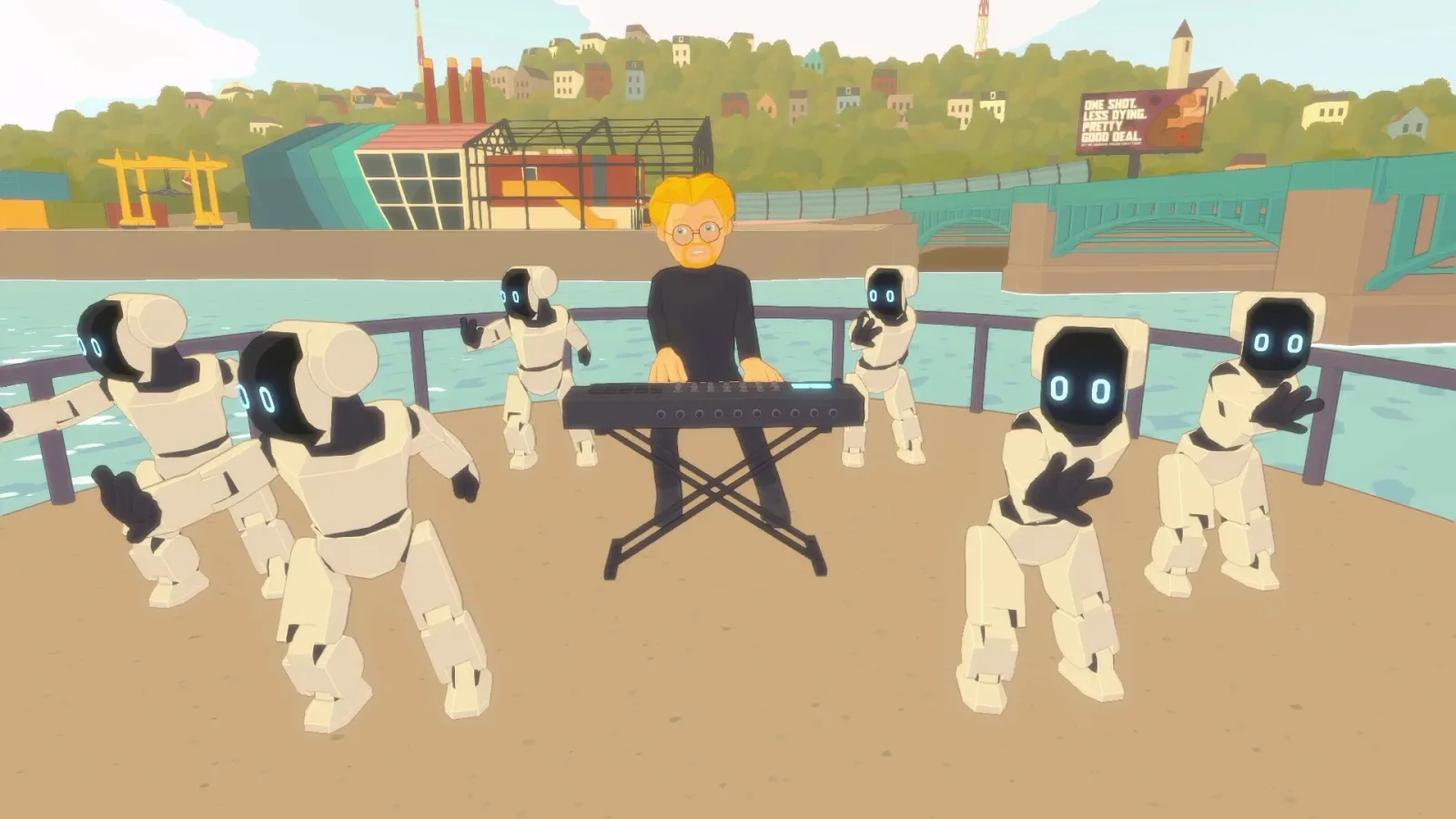
Future? No Thanks!, the adventure game set in an ostensibly improved, climate-conscious future, has become the center of a dispute over generative AI. Developer Paolo Pedercini, known for his work under the Molleindustria name, confirmed that the game originally included AI-generated voices and music. After criticism over the disclosure and the apparent contradiction with the game's political framing, Pedercini said the non-code AI material has now been removed.
The game launched in September and presents a future in which climate change is being addressed, democratic institutions are flourishing, and technology is meant to serve the public. Its protagonist is an elderly, irritable man who finds himself out of place in that society and sets out to finish his bucket list before pursuing assisted suicide. That setting, along with the project's description as an "ecosocialist utopia," made the revelation about generative AI particularly contentious among players and observers.
Pedercini had previously described the project as being made with locally sourced talent and with minimal participation from capitalists, marketers, or profiteers. The subsequent confirmation that generative tools had been involved raised questions not just about the game's assets, but about the standards audiences reasonably expect from a developer whose games have frequently taken overt political positions.
What AI was used in the game
In a blog post addressing the issue, Pedercini said that Future? No Thanks! included two text-to-speech voices and two music loops generated through Suno. He also said that a very small portion of code had been debugged using ChatGPT and Claude.
For useful background on this topic, read Capcom Legal Request Prompts Ultimate Frame Data to Remove Street Fighter 6 Hitbox Tools.
The disclosure arrived alongside unusually harsh language about AI itself. Pedercini characterized AI as a "technofascist, anti-human and anti-art project," a view that made the earlier implementation of generated content seem especially inconsistent to critics. For many players, the issue was not merely whether a small number of assets appeared in the final game. It was whether a work that explicitly imagines technology functioning for social benefit could rely on systems widely criticized for their energy demands, labor practices, training-data concerns, and effects on creative industries.
The distinction between generative material used directly in a game and software assistance used during development also became important in the discussion. Pedercini's later update says the voices and music were removed, but the code-related use he described was not presented as having been eliminated from the game's development history. That means the announced cleanup concerns the AI-generated audiovisual content rather than every instance in which an AI tool may have influenced the production process.
Audio content has been removed
In a follow-up post published Friday, Pedercini clarified that the AI-generated material has been taken out of Future? No Thanks!, apart from the previously mentioned code debugging. He said the game is now slightly worse in his view without those elements, though he framed the difference as extremely minor.
Pedercini also defended the original creative rationale for the material. The generated music loops, he said, were intended in early demonstrations to mock people who enjoy low-quality AI-produced media. He similarly argued that the synthetic voices worked better in that particular satirical context.
That explanation has not necessarily settled the larger criticism. Satire can depend on uncomfortable material, and games have a long history of using parody, imitation, and deliberately unpleasant aesthetics to make a point. But critics of the decision argue that it is possible to satirize generative AI without incorporating generative AI output into a finished work--particularly when the technology being criticized is associated with real economic and environmental consequences.
The debate also shows how context can change as a project moves from prototype or demo to commercial release. An intentionally abrasive or mocking element may read differently when it becomes part of a product players buy, especially if its origin was not plainly disclosed before or at launch. For some players, the later removal is a meaningful correction. For others, the initial lack of clear disclosure remains the central problem.
Refunds offered to disappointed buyers
Pedercini is offering refunds through PayPal and Venmo for people who bought the game and still feel betrayed by the initial use of AI. The offer gives dissatisfied customers a direct option even after the content has been removed.
He also said that his next game will be entirely hand-coded. That commitment addresses one of the most pointed parts of the reaction: the concern that a politically engaged independent developer would normalize AI use in the course of making games. Hand-coding a future project would not undo the dispute surrounding Future? No Thanks!, but it establishes a stated boundary for Pedercini's next production.
At the same time, the tone of the refund announcement has drawn its own criticism. The post uses sarcasm while engaging with objections to generative AI, including comparisons meant to ridicule the idea that limited use of a harmful tool can be acceptable. That approach may reflect Pedercini's frustration with the backlash, but it also risks worsening the disconnect with players who saw the matter as a good-faith concern rather than a demand for ideological purity.
In controversies involving creative tools, apologies and changes in policy are often judged on both action and presentation. Removing the assets and offering refunds are concrete actions. Defending the original choice in combative terms can make it harder for some members of an audience to accept that those actions represent a clear shift rather than a reluctant concession.
Why the contradiction has resonated
Pedercini is not a developer whose political themes are hidden beneath vague marketing language. His broader catalog of browser games has regularly engaged with subjects such as nationalism, media power, labor, class, war, and historical memory. The work is often playful and compact, but it tends to be direct about what institutions or ideas it is examining.
That history helps explain why the reaction has been so intense. Players familiar with Molleindustria's work may have expected a project about an eco-social future to take a firm position against tools viewed by many artists and labor advocates as extractive. Generative AI is not a neutral topic in creative communities: debates around it encompass copyright, consent, job displacement, concentrated corporate ownership, misinformation, and resource use. A game that imagines a better relationship between society and technology naturally invites closer scrutiny of the technology used to make it.
There is also a difference between criticizing technology in fiction and choosing production tools in reality. Future? No Thanks! can depict technology serving public interests, while its development can still involve services controlled by major private companies. That tension is not unique to this game; most software is built with complicated supply chains, proprietary platforms, and tools whose politics do not align neatly with the politics of their users. But generative AI has become an unusually visible flashpoint because the tool itself is often the subject of the critique.
A broader challenge for politically minded games
The episode surrounding Future? No Thanks! illustrates a broader challenge for creators who make politically explicit games. Audiences do not only assess a game's story, characters, or stated message. They increasingly look at how it was funded, marketed, staffed, distributed, and produced. That scrutiny can be difficult, especially for small teams and solo developers working within an industry dominated by large platforms and commercial technology providers.
Still, transparency matters. If a developer uses a controversial tool for even a limited purpose, openly explaining that decision before players purchase the game gives audiences a chance to make informed choices. It also lets developers explain the practical constraints, artistic intentions, and boundaries involved. Delayed disclosure leaves room for audiences to feel that information was withheld, whether or not the omission was deliberate.
For now, the practical outcome is straightforward: the AI-generated voices and Suno music loops have been removed, refunds are available to buyers who remain unhappy with the original implementation, and Pedercini says his next game will be hand-coded. The broader question--whether limited AI use can coexist with a game's anti-capitalist and ecological aspirations--will likely remain unsettled.
That uncertainty is part of why the story has endured beyond a narrow dispute over a handful of assets. Future? No Thanks! is built around the possibility of a better future. Its development controversy has instead become a reminder that the tools chosen to build a future-facing work can be inseparable from the values that work claims to champion.
Community
Discussion
Start the conversation.
No comments have been posted yet.