

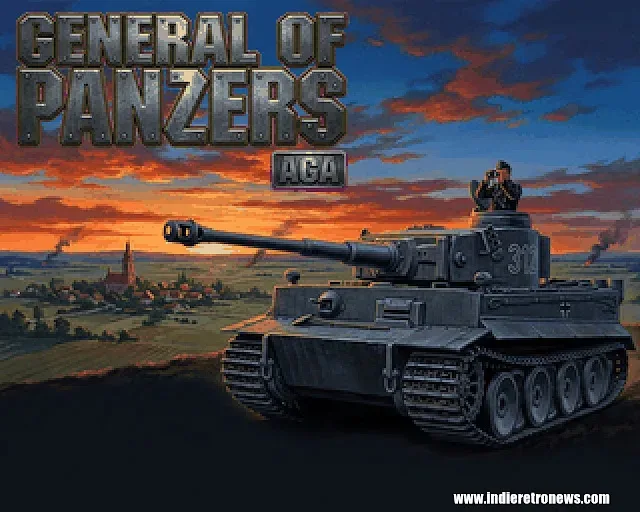
General of Panzers, a new turn-based World War II strategy project for the Commodore Amiga 1200, has released a version 0.5 demo. Developed by Fliegeralarm, the AGA title is a hex-grid military game that takes clear inspiration from classic campaign-focused strategy games while pursuing its own Amiga-native presentation and systems.
The current demo gives players access to the opening two missions in both its German and American campaigns. Its battles cover the 1939-to-1943 period and place infantry, tanks, paratroopers, naval units, and aircraft on historically themed battlefields. The project is still in development, but the playable build already aims to offer more than a simple skirmish test: campaign progression, unit experience, supply considerations, changing weather, fog of war, and a computer-controlled opponent are all part of the package.
It is also a notable release for a platform whose strategy catalogue remains a point of interest for retro enthusiasts. Rather than being a port of a modern PC game, General of Panzers has been built for the Amiga 1200 and its AGA chipset, using the ACE engine. The game was made with AI support, a point that may be relevant to players assessing the project's development process, but its advertised focus is a traditional, mechanics-heavy turn-based command experience running on original-compatible Amiga hardware.
A battlefield built around hexes and layers
At the centre of General of Panzers is a detailed hex map. Hex-based movement has long been a natural fit for military strategy games, allowing distance, terrain, positioning, and attack angles to matter without the uneven movement rules that can arise on square grids. Here, players are expected to plan the advance of ground forces while also accounting for a separate air layer.
For useful background on this topic, read Yoniq Duo Dual-Screen Handheld Appears With £117.99 Early Price.
That division means aircraft are not merely visual effects attached to ground attacks. Air power has its own place in the tactical picture, potentially allowing players to use aircraft alongside the formations fighting over roads, towns, rivers, open fields, and defensive positions below. With armor, infantry, airborne troops, warships, and air units all listed among the available historical unit types, the game is designed to represent several dimensions of wartime operations rather than concentrating solely on tank warfare.
The title's battlefields are drawn from the early and middle years of the Second World War, beginning in 1939 and extending through 1943. That span gives the campaigns room to explore changing military conditions and equipment without making promises about later-war content. The version 0.5 demo specifically provides the first two missions for each of its two currently playable sides: German and American forces.
Although the game lets players command armies from the era, it does not display Nazi symbols. Its named "Aces" are also fictional creations rather than portrayals of historical people. That distinction is important given the setting: the game uses a real conflict as its backdrop while keeping those special commander characters invented.
For another perspective on this story, read General of Panzers Demo Targets Amiga 1200 Strategy Fans.
Campaign persistence gives survival real value
General of Panzers is built around the idea of maintaining a core force over multiple scenarios. A unit that survives is not simply a counter that remains available for the next map. It can gain experience, earn medals, and receive specialized refits. This creates a reason to think beyond a single mission's immediate objective.
For players, that can turn apparently easy decisions into costly ones. Sacrificing an experienced tank formation to seize an objective may secure a win, but it can also remove a battle-tested unit that would have been more valuable in a later scenario. Conversely, withdrawing a weakened formation, protecting it with infantry, or delaying an offensive until support arrives may preserve a unit's long-term development. These types of choices are a defining appeal of campaign strategy games, particularly when the same force follows the player from battle to battle.
The Ace system adds another layer of risk and reward. Certain units can be joined by unique fictional commanders, each with a biography and special combat bonuses. These characters can make a formation more effective, but their fate is linked to the unit they accompany. If that unit is destroyed, the Ace is gone permanently. The mechanic should make high-value formations feel even more important, while discouraging careless use of a powerful bonus in an exposed position.
The version 0.5 demo includes the first two missions of the German and American campaigns, giving players an early look at the game's persistent-force structure and battlefield systems.
Weather, supply, morale, and the hidden enemy
The project's tactical ambitions go beyond moving counters and trading attacks. General of Panzers includes fog of war, preventing players from treating the map as a fully visible puzzle. Information must be uncovered and interpreted, which can make reconnaissance, cautious advances, and the protection of vulnerable flanks more significant.
Supply lines are another stated consideration. In many military strategy games, an otherwise powerful unit becomes far less useful if it cannot receive fuel, ammunition, or other necessary support. A supply system can therefore make roads, rear areas, and captured positions strategically meaningful. It may also stop a rapid advance from being automatically successful if the player leaves the supporting network behind.
Morale and entrenchments further reinforce the importance of battlefield condition. A dug-in defender can be difficult to dislodge, especially when terrain and support work in its favour. Morale systems can make an assault's consequences extend beyond raw casualties, potentially influencing whether units hold, retreat, or remain capable of fighting effectively. Together, these mechanics suggest the game wants players to prepare attacks and manage formations rather than simply target whichever enemy is closest.
Weather changes during play as well. This can add an unpredictable element to operations, particularly in a game with separate ground and air layers. Poor conditions may alter how a player times an offensive or uses aircraft, while clear weather could create an opportunity to press an advantage. The precise impact of individual conditions will be something players can evaluate directly in the demo.
Fliegeralarm also describes the computer opponent as planning counter-moves in the manner of a chess player. That is an ambitious comparison, but the important practical question will be how convincingly the AI responds to aggressive pushes, weakly guarded objectives, and battlefield openings. Strategy players who try the demo will be able to see whether enemy forces can create the kind of pressure that makes reconnaissance, reserves, and careful positioning necessary.
An Amiga-focused presentation
General of Panzers is presented in a 256-colour palette suited to AGA-equipped Amiga hardware. The game includes music, animated environments, historical details, and period photography, combining tactical map play with material intended to establish the setting around each operation. Multilingual support is also planned within the demo's feature set.
A built-in undo function is one particularly welcome quality-of-life inclusion. Turn-based strategy can involve complicated sequences of moves, accidental clicks, and situations where a player wants to reconsider a decision after seeing the board more clearly. An undo tool does not remove the need for planning, but it can make experimentation less punishing and reduce frustration on a platform often associated with older design conventions.
The combination of animated battlefields, music, and a 256-colour interface gives the game a different identity from a minimalist tabletop-inspired wargame. At the same time, its systems list remains firmly rooted in traditional military strategy: unit preservation, visibility, terrain, defensive preparation, logistics, air support, and campaign growth are the elements likely to decide whether a mission succeeds.
Requirements for the version 0.5 demo
The demo requires an Amiga 1200 or compatible system with the AGA chipset and a Motorola 68020 processor or better. Players will need 2 MB of Chip RAM, 2 MB of Fast RAM, and a hard-disk installation with approximately 10 MB of free space. A mouse and keyboard are required.
- Amiga 1200 or compatible AGA machine
- 68020 processor or better
- 2 MB Chip RAM
- 2 MB Fast RAM
- Approximately 10 MB of hard-drive space
- Mouse and keyboard
Those specifications place General of Panzers squarely in the Amiga 1200 ecosystem rather than the broader range of older Commodore systems. For owners of real hardware, compatible setups, or retro-focused configurations that meet those requirements, the demo offers a chance to explore a contemporary strategy release tailored to AGA capabilities.
An early but promising tactical test
Version 0.5 should be viewed as an in-progress demonstration rather than a statement of a final, complete campaign. Still, two opening missions on each side provide enough material to examine the game's foundations: how movement feels on its hex maps, whether the AI can present meaningful opposition, how air and ground layers interact, and how much weight the persistent-unit systems carry from one operation to the next.
For Amiga strategy fans, General of Panzers stands out because it is pursuing a substantial format on appropriate period hardware. It is not content to present World War II merely as a visual theme. Its announced systems point toward a game where supply, morale, weather, entrenched enemies, veteran units, and irreversible Ace losses all affect the pace of a campaign. The version 0.5 demo now gives commanders an opportunity to put that design to the test on the Amiga 1200.
Community
Discussion
Start the conversation.
No comments have been posted yet.