

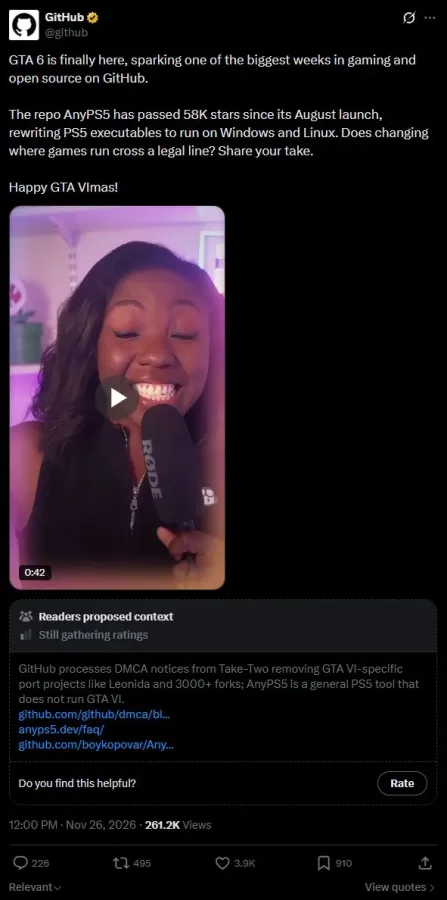
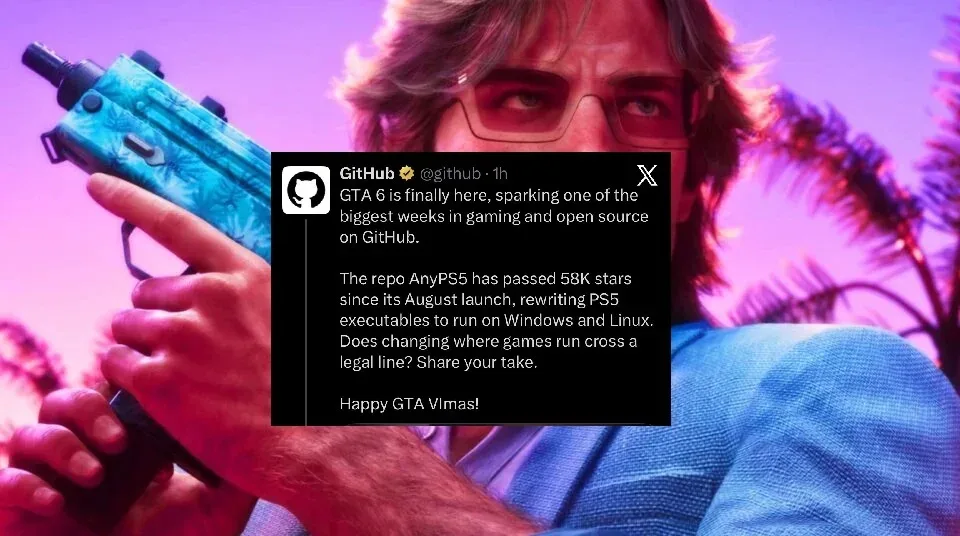
GitHub has deleted a social-media post that drew attention for celebrating the popularity of AnyPS5, a PlayStation 5 emulator project, in the wake of Grand Theft Auto 6 launching. The post said the project had surpassed 58,000 stars on GitHub since its August debut, while framing the moment around one of gaming's biggest releases and asking a pointed question about whether changing where games run crosses a legal boundary.
The now-removed post was notable not simply because it discussed emulation, but because GitHub is owned by Microsoft. Microsoft completed its acquisition of the collaborative software-development platform in 2018 in a deal valued at $7.5 billion in stock. That corporate connection made the messaging especially conspicuous: GitHub's official account was publicly spotlighting a PS5 emulation project at a moment when enthusiasm around GTA 6 had apparently helped send attention and contributors toward it.
Its opening treated GTA 6 as the catalyst for a major week across both gaming and open-source development. A video included with the post emphasized that activity surrounding AnyPS5 had accelerated in relation to the game's arrival. It highlighted a comment attributed to an AnyPS5 contributor urging others to get to work with only three days remaining before GTA 6.
GitHub subsequently removed the message. No explanation for the deletion was included in the available details, but the post's language, its unusually celebratory tone, and the legal implications attached to high-profile console emulation all make it easy to understand why it attracted scrutiny.
For useful background on this topic, read Xbox Wireless Controller Falls to $43 in Black Friday Deal With USB-C Cable Included.
A Viral Moment for a PS5 Emulator
GitHub stars are not downloads, sales, or a measure of fully functioning software. They are, however, a highly visible marker of interest on the platform. Users can star a repository to bookmark it, signal support, follow development, or simply acknowledge that a project has become a notable topic of conversation. Passing 58,000 stars shortly after an August launch is an enormous level of visibility for any open-source effort, particularly one centered on current-generation hardware.
That visibility matters because PlayStation 5 emulation remains a technically demanding and legally sensitive subject. Modern consoles are complex systems with custom hardware behavior, security measures, firmware, operating-system components, and tightly integrated software ecosystems. Building an emulator is vastly different from merely taking a game file and making it run elsewhere. The work often involves painstaking attempts to reproduce behavior through independently developed code, testing, reverse engineering, compatibility work, and contributions from a broader community.
But public attention does not always distinguish between those technical details. When a major game is attached to the discussion--especially one as commercially important as GTA 6--the conversation rapidly shifts from programming challenges to questions of access, exclusivity, piracy, platform control, and whether players might expect a game to run on hardware not sanctioned by its publisher or console manufacturer.
That is why GitHub's decision to directly connect AnyPS5's momentum to GTA 6 was so striking. The post did not present the emulator as an abstract preservation experiment or a small technical curiosity. Instead, it placed it next to one of the industry's highest-profile releases and invited readers to contemplate the legal consequences of moving games from one environment to another.
Emulation Is Not a Simple Yes-or-No Legal Question
The question posed in the deleted message--whether changing where games run crosses a legal line--does not have one universal answer. The legal status of emulation can depend on jurisdiction, the methods used in development, the ownership and origin of software files, the use of copyrighted firmware or encryption keys, anti-circumvention rules, and the specific conduct surrounding distribution.
In broad terms, an emulator is software intended to reproduce the behavior of another computer system. That concept has legitimate applications. It can support research, interoperability, archival work, homebrew development, and the continued study of older platforms whose original hardware has become scarce or unreliable. Emulation has also long been part of the PC gaming and preservation landscape.
At the same time, a project can become much more legally precarious depending on what it contains or enables. Distributing copyrighted game code, console firmware, proprietary BIOS files, decryption keys, or material that defeats technological protections may bring a very different set of concerns than distributing independently written emulation code alone. Public messaging that appears to encourage people to use an emulator for a newly released commercial game can create reputational and legal pressure even before any court has ruled on a particular project.
That distinction is essential here. Interest in AnyPS5, as represented by GitHub stars, does not establish that the emulator can run GTA 6, that it provides access to the game, or that everyone engaging with the repository is doing so for the same reason. A surge of stars is a measure of online attention, not proof of capability or misuse. Yet tying the project's development activity to GTA 6 inevitably invites audiences to infer a connection between the emulator and playing that game outside its intended ecosystem.
GTA 6 Has Already Put PC-Port Efforts Under the Microscope
The legal sensitivity around the issue is heightened by recent action involving GTA 6-related projects on GitHub. Take-Two, the publisher of Grand Theft Auto 6, has been actively moving to remove GitHub repositories that attempted to create a PC port of the game through AI-assisted or "vibe-coded" development efforts over the past week.
Those projects are not the same thing as a console emulator. A purported PC port and an emulator involve different technical approaches and can raise different legal issues. Still, both sit near the same volatile public debate: whether people can reproduce, adapt, redistribute, or run a blockbuster game in a way that the rights holder has not authorized.
For a platform that hosts vast numbers of open-source repositories, that context matters. GitHub has to balance its role as an important home for software collaboration with its obligations to respond to intellectual-property complaints and its interest in maintaining rules for hosted content. A social post that sounds as though it is cheering on a PS5 emulator because of GTA 6 attention risks undermining the neutral, process-driven posture a code-hosting service would generally need when disputes emerge.
The wording also put GitHub in an awkward position with Sony, whose PlayStation 5 is the hardware being emulated. While GitHub itself is owned by Microsoft, the company's Xbox business is a direct competitor to PlayStation in the console market. Nothing in the deleted post establishes any formal Microsoft or Xbox position on AnyPS5. Still, the optics of a Microsoft-owned platform celebrating a PlayStation emulator--and doing so while invoking GTA 6--were bound to generate speculation and criticism.
Why the Deleted Post Matters
Technology companies frequently highlight unusual, fast-growing, or culturally relevant open-source projects. In many cases, that is straightforward community engagement. The AnyPS5 post demonstrates why the same approach becomes riskier when the project touches current console hardware and a massive new release.
There is a meaningful difference between recognizing a technical project's popularity and framing that popularity as part of a rush to make a specific blockbuster run somewhere else. The first can be read as coverage of developer interest. The second can sound like a celebration of bypassing a platform holder's control over where its software ecosystem operates.
It is also a reminder that a viral social-media message can flatten a complicated subject into a provocative slogan. "Does changing where games run cross a legal line?" is a compelling engagement question, but it does not convey the many factual and legal distinctions involved. What code was written independently? What files are required? How are they obtained? Are technical protection measures being circumvented? Is the game being copied or redistributed? Which country's laws are relevant? Each can change the analysis.
For players, the discussion can be equally confusing. Consumer frustration over exclusives, delayed ports, preservation limitations, and hardware costs often fuels enthusiasm for emulation. Publishers and platform holders, meanwhile, have strong incentives to defend copyrighted works, platform security, distribution agreements, and revenue from new releases. Those interests frequently collide most aggressively when a game is new rather than decades old.
Open Source Visibility Comes With Responsibility
AnyPS5's sudden prominence illustrates how quickly an open-source project can become a mainstream flashpoint when a major game is nearby. Developers may be interested in architecture, compatibility, experimentation, and technical achievement. Some followers may care about long-term preservation. Others may simply be watching because they hope a current game will become playable in an unauthorized context. A star count cannot separate those motives.
That makes careful communication especially important. Platforms such as GitHub can recognize software development and host legitimate technical discussion without implying that they endorse copyright infringement, unauthorized distribution, or attempts to defeat console security. Likewise, observers should avoid treating the existence of an emulator repository as automatic evidence that a particular game is playable, available, or being unlawfully distributed.
GitHub's deleted post brought all of those tensions into one unusually public moment: a Microsoft-owned development platform, a PlayStation 5 emulator, GTA 6, and an explicit legal prompt. Its removal does not settle the larger debate over emulation. It does, however, show how quickly the conversation changes when open-source enthusiasm is presented alongside a newly released, immensely valuable game.
For now, the clearest takeaway is not that every emulator or every emulation developer occupies the same legal or ethical position. It is that the details matter--and they matter even more when social-media messaging turns a complicated technical project into a headline-grabbing celebration tied to one of gaming's biggest releases.
Community
Discussion
Start the conversation.
No comments have been posted yet.