

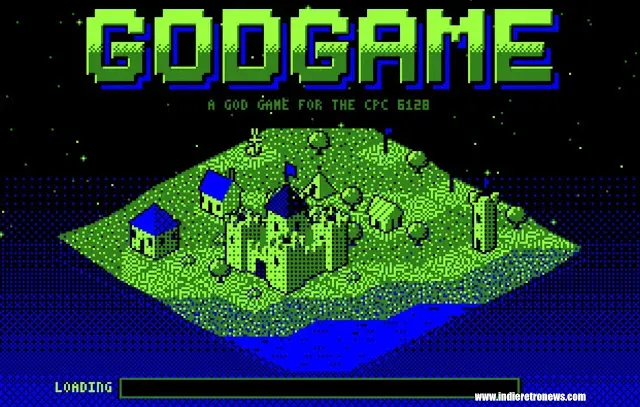
A new strategy project is taking shape for one of the 8-bit era's most enduring home computers. GODGAME, an in-development title from SoftDevil, is being created for the Amstrad CPC 6128 and CPC machines equipped with 128K of RAM. Its central idea will be immediately familiar to fans of god games: players oversee a growing people, encourage settlement and expansion, measure their strength through their followers, and ultimately face a competing deity in a fight for survival.
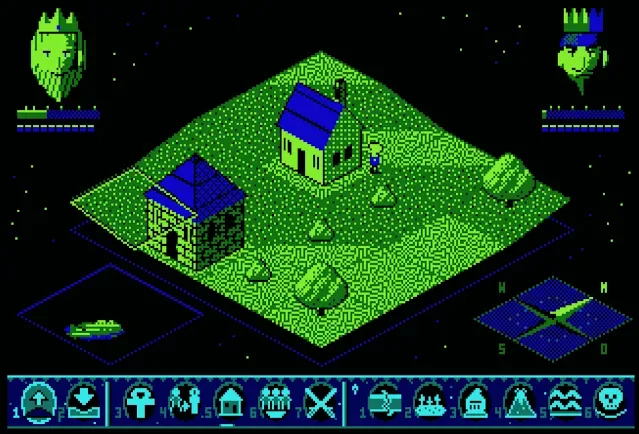
The project clearly takes inspiration from Populous, the landmark strategy game that helped establish the god-game format. Rather than simply commanding individual units through conventional military orders, the player occupies a higher-level role. GODGAME presents that role with a bearded, crowned ruler avatar in the upper-left portion of the screen, a visual shorthand for the divine presence guiding events across the map.
For Amstrad CPC owners, the appeal is not only the return of a genre that was hugely influential in the late 1980s and early 1990s. It is also the prospect of seeing that style of strategic simulation tailored specifically for the CPC's Z80-based hardware. GODGAME is still being actively developed, so its systems, presentation, and final feature set remain subject to change. Even so, the details shown so far point toward a design concerned with readable settlement management, rising population totals, and efficient use of limited 8-bit resources.
Population Is the Measure of Divine Power
At the heart of GODGAME is a straightforward but potentially rich strategic equation. Players guide loyal people as they occupy suitable flat ground and establish residential villages. Those homes do more than decorate the landscape: the game links a deity's overall power directly to population. The number of people supported by houses, combined with the collective strength of the citizens themselves, determines the player's standing.
For useful background on this topic, read Il Marinaio Brings Popeye-Style Arcade Action to Amstrad CPC.
That means growth is not an abstract background statistic. Each successful settlement contributes to the wider contest, while the loss or failure to grow a population can put a player at a serious disadvantage. The design turns demographic management into the core resource economy. Instead of accumulating a familiar stockpile of gold, wood, or technology points, the crucial question is whether a god can maintain enough followers to outlast the rival.
This gives the game's conflict a particularly clear win-and-loss condition. Should the player's followers run out, a DEFEAT screen signals the end of their reign. The opposing deity, meanwhile, receives VICTORY. The result is a battle of demographic endurance, where expansion and settlement are not optional side activities but the basis of survival.
There is an appealing elegance to that premise on a machine such as the CPC. A god game can become complex very quickly, especially when it needs to portray terrain, villages, autonomous citizens, opponents, menus, and changing numerical values simultaneously. Anchoring the contest in population may allow GODGAME to preserve the tension of a larger strategy experience while keeping the player's priorities understandable: find or create useful space, help people build, protect the momentum of growth, and ensure the rival cannot overwhelm your side's numbers.
Flat Land and Growing Villages
Settlement is framed around the use of flat land. Players are tasked with helping their people establish themselves on terrain suitable for homes, then watching those residential areas develop into active villages. This focus naturally makes the shape of the map important. Land is not merely a backdrop for units to cross; it defines where expansion is possible and how easily a population can sustain itself.
While the current information does not detail every available divine action, the emphasis on flat land evokes one of the defining ideas behind classic god-game design: altering or managing the world so a civilisation can flourish. The player's responsibility is less about personally constructing each building and more about creating the circumstances in which followers can do so. That perspective is what separates the format from a standard city builder or real-time strategy game.
GODGAME's village growth also promises a visible representation of progress. A rising count is useful strategically, but seeing houses populate the map gives that number meaning. When a game makes its citizens the source of power, a busy settlement becomes both an achievement and a vulnerable asset. Every village matters because it represents the people keeping a god's influence alive.
That relationship could make individual matches feel increasingly tense as populations diverge. A player who establishes an early advantage may gain more power through a larger citizen base, yet an opponent may still be dangerous if it can expand into better terrain or maintain its followers more effectively. Since the project remains in development, it is not yet clear how much direct interference, defensive play, terrain manipulation, or enemy pressure will shape that contest. The confirmed foundation, however, is deliberately focused: followers determine power, and followers must be housed and sustained through expansion.
Built for the CPC 6128 and 128K Machines
The target hardware is significant. GODGAME is being developed for the Amstrad CPC 6128, as well as a CPC configuration with 128K of RAM. That places it firmly in the enthusiast-driven world of new retro software, where developers continue to create original games for systems long after their commercial peak.
The CPC is a particularly interesting home for this kind of game. Its Z80 processor and constrained memory demand careful choices from any developer attempting a strategy title with dynamic maps, settlements, interface text, and potentially numerous simulated citizens. The game's development notes show that performance is an active concern rather than an afterthought.
SoftDevil has described counting instruction cycles and replacing loops with unrolled code, a classic optimisation technique in which repetitive operations are written out in sequence to avoid some of the processing overhead associated with loop control. On a modern system, such low-level trade-offs may seem obscure. On an 8-bit computer, they can be the difference between a feature feeling responsive and one that asks too much of the processor.
The developer has also pointed to older Z80 programming discussions as useful resources for further optimisation methods. That is part of what makes contemporary CPC development compelling: new projects often combine a modern creator's ambitions with decades of accumulated technical knowledge from the machine's original community. The goal is not merely to reproduce old ideas, but to revisit them with a deeper understanding of how the hardware can be pushed.
A Custom Proportional Font Engine
One specific technical feature already mentioned is a custom font engine. GODGAME uses a true proportional font, rather than assigning every character the same fixed width. In practical terms, narrow letters can take less horizontal space than wide ones, allowing text to look more natural and helping dialogue, menu labels, and information displays fit more efficiently on screen.
That may sound like a small detail next to the prospect of managing an entire civilisation, but interface clarity is crucial in strategy games. Players need to absorb population values, status messages, commands, and outcomes without fighting the display. A proportional font can make a compact CPC interface feel less cramped while also giving the game a more polished identity.
The same font technology is said to have been used in an Elite clone project, suggesting that it is not a one-off experiment. Reusing proven tools can be especially valuable in retro development, where every byte of memory and every slice of CPU time deserves attention. It also indicates that GODGAME is benefiting from techniques developed across more than one project rather than being assembled entirely from scratch.
Community Feedback Will Help Shape the Game
GODGAME is not being presented as a finished product. It is currently in the middle of development, and SoftDevil is inviting constructive feedback and feature suggestions from the Amstrad community. For a game in this genre, that openness could prove especially important. God games depend on the balance between player control and citizen autonomy, and small decisions about information, pace, terrain, or rival behaviour can substantially change how satisfying the overall experience feels.
Early feedback can help identify whether the population model is easy to read, whether the settlement rules offer enough strategic choice, and whether the interface communicates the player's divine influence clearly. It can also help ensure that ambitions remain suited to the 128K CPC target. The most memorable retro projects are often not those that try to imitate modern scale, but those that find an idea that works beautifully within the strengths and limitations of their original hardware.
The developer has also acknowledged the use of AI during development, while stressing that further transparency will be provided closer to the end of the project. No additional specifics have been given at this stage about how AI has been used. That leaves the current focus on the game itself: a technically ambitious, population-driven divine strategy game being built for classic Amstrad hardware.
An Encouraging Prospect for CPC Strategy Fans
It is too early to judge GODGAME as a complete game, and no release timing, price, or distribution details have been confirmed. But its premise is promising. A Populous-inspired struggle between deities is a natural fit for a system whose library still attracts developers eager to explore new ideas. By making followers, homes, and village growth the basis of power, GODGAME has a concise strategic hook that should be easy to grasp while leaving room for meaningful competition.
Its development also highlights the craft still involved in making new software for 8-bit computers. Cycle counting, hand-tuned Z80 code, memory-aware design, and bespoke typography are not nostalgia props; they are practical tools for getting an ambitious idea to run well on a CPC 6128. If SoftDevil can turn those technical efforts into a clear and satisfying contest of settlement growth and rival divine power, GODGAME could become a notable addition to the modern Amstrad scene.
Community
Discussion
Start the conversation.
No comments have been posted yet.