

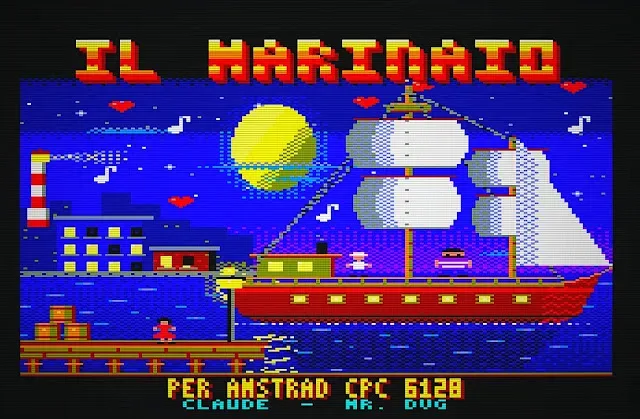
Il Marinaio is a newly released game for the Amstrad CPC 128K, bringing a familiar style of single-screen arcade action to the classic 8-bit computer. Directed by Andrea "Mr. DVG" Pastore, the game takes clear inspiration from the 1982 arcade version of Popeye, placing players in control of a sailor attempting to collect tokens of affection while avoiding increasingly troublesome enemies and the ever-present danger of falling into the water.
Rather than being presented as a direct conversion, Il Marinaio builds its own sailor-and-sweetheart setup around the mechanical foundations that made the old arcade formula so memorable. Hearts, music notes and love letters descend through three distinct environments. The player must gather every required item on each stage while navigating platforms, ladders and hazards, and while being pursued by a larger rival determined to interrupt the romantic mission.
The project was built from scratch in pure Z80 assembly language. Its listed credits identify Claude, Anthropic's AI, for programming, with Mr. DVG handling direction. That combination makes Il Marinaio an unusual entry in the still-active Amstrad CPC homebrew scene: a newly created game for original hardware that explicitly credits an AI system as part of its development process.
A sailor's arcade challenge
The core objective in Il Marinaio is immediately approachable. Players guide a lovesick sailor across compact, obstacle-filled stages to catch the objects sent down by his sweetheart. Success does not simply come from moving underneath each falling collectible, however. The sailor needs to stay mobile, manage enemy positions and use the layout of each scene to avoid being cornered or knocked into the icy water below.
For useful background on this topic, read Skyshift Brings High-Speed Alternate-Reality Shooting to Amstrad CPC.
A brutish bully stalks the stages as the primary close-range threat. He can pressure the sailor's route choices and force quick decisions when a collectible appears on the opposite side of the screen. The game also introduces a witch who becomes more dangerous during higher-difficulty rounds, throwing bouncing skulls that add a moving projectile hazard to the action. With enemies operating alongside the stage-specific environmental complications, collecting items becomes a balancing act between speed and survival.
The sailor is not entirely defenseless. Spinach appears as a temporary power-up, echoing one of the most recognizable ideas from the arcade inspiration. Picking it up grants a brief period of invincibility and gives the sailor the opportunity to punch his rival into the sea. It is a useful reversal of momentum, especially when the bully is blocking a key route or when the player needs room to finish the last few remaining objectives.
Il Marinaio centres on arcade-style collection goals, platform hazards and short-lived spinach-powered retaliation against its pursuing bully.
Three stages with different goals
Il Marinaio is structured around three recreated stages, each with its own set of objects to collect and a different environmental hook. This approach gives the game more variety than a single repeating arena, while retaining the focused, replayable nature of an early arcade challenge. Completing a stage means learning not only where to move, but also how that stage's special mechanic can be used to the player's advantage.
The Docks
The opening Docks stage asks the sailor to collect 24 hearts. It establishes the basic flow of chasing descending items while coping with the bully's movement around the screen. A bucket is placed as a tactical environmental tool: with good positioning, the sailor can trap the bully's head in it. That can create an opening to cross the level more safely or reach a heart that would otherwise be too risky to pursue.
The bucket mechanic is especially fitting for an arcade game of this type. It does not eliminate the threat permanently, but it rewards observation and timing. Players who merely run from the bully may survive for a while, yet those who use the scenery intelligently can turn the stage layout into an advantage.
The Streets
The second setting shifts to the Streets, where the objective is to collect 16 musical notes beneath a moonlit backdrop. Here, a seesaw catapult changes the rhythm of movement. The level's machinery introduces another element to account for when choosing routes, giving players a reason to consider not just where a note is falling, but how they can reach the relevant area of the stage.
By moving from hearts to notes, the game maintains its romantic theme while giving each environment its own visual and gameplay identity. The Streets also provide a natural escalation after the Docks: players familiar with the base movement and enemy pressure must now incorporate the seesaw's potential into their decision-making.
The Ship
The final stage takes place aboard a ship. Instead of gathering a numerical set of matching items, the sailor needs to collect letters spelling H-E-L-P. This scene includes a diving bird and requires players to scale the main mast, adding another major hazard to the route. The change in objective gives the last stage a more dramatic feel, with a clear word to complete while the player contends with the airborne threat.
Across all three areas, the goals are easy to understand but demand careful execution. The format is rooted in the design values of classic coin-operated games: rules can be explained quickly, but mastery comes from repeated play, precise movement and recognizing when a power-up or piece of scenery can change a dangerous situation.
Designed for the CPC's visual and audio strengths
On the presentation side, Il Marinaio uses 16-colour Mode 0 graphics, a display mode well suited to colourful arcade-style artwork on the Amstrad CPC. The game aims for a bright, characterful look in keeping with its early-1980s inspiration, with the sailor, his pursuers and the different themed locations forming the centre of the screen action.
Performance is listed at 25 updates per second, using flicker-free double buffering. For a game built around quick movement, falling objects and bouncing hazards, stable visual updates are an important part of making the action readable. The stated use of double buffering is intended to keep the presentation clean as the screen changes from moment to moment.
Sound effects were created for the CPC's AY sound chip. These include a deliberately retro-styled crunch when the sailor lands a successful hit on his opponent. The emphasis on a punch sound may be small on paper, but it supports the payoff of finding spinach and shifting from evasive play to a brief offensive opportunity.
Options and replay value for 8-bit players
Beyond its three-stage structure, Il Marinaio includes menus, high-score tracking and gameplay configuration options. Players can adjust the number of lives and select a starting level, features that make the game more accommodating both for newcomers learning the layouts and for experienced players seeking a faster route into later challenges.
High-score support is a natural fit for the design. The game's individual stages, item-collection requirements, enemy pressure and potential for cleaner runs all lend themselves to score chasing. The ability to begin from different levels also means players can practise the Streets or Ship without always having to replay the Docks first.
- Three themed stages: Docks, Streets and Ship.
- Collection objectives involving hearts, musical notes and the letters in H-E-L-P.
- A pursuing bully, plus bouncing skulls thrown by a witch at higher difficulties.
- Spinach power-ups that provide temporary invincibility.
- Mode 0, 16-colour CPC graphics and custom AY-chip sound effects.
- Flicker-free double buffering at 25 updates per second.
- Menus, configurable lives and starting levels, and high-score tracking.
An old-school formula for a continuing retro platform
The Amstrad CPC remains a platform for new games decades after its original era, and Il Marinaio is firmly aimed at players who enjoy that continued tradition. Its structure favours immediate action over extensive exposition: begin a stage, gather the required objects, survive the enemies, exploit the layout and push for a better score. The familiar ingredients are intentional, but the game's own setting, three-stage progression and technical presentation give the sailor a distinct journey.
For retro players, the appeal is likely to be the combination of recognisable arcade sensibilities and purpose-built CPC development. The game does not need a sprawling campaign to create tension. A bully standing between the sailor and a falling heart, a skull bouncing into an escape route, or a diving bird threatening the climb to the mast can be enough to turn a routine collection run into a scramble.
Il Marinaio therefore arrives as both a tribute to a classic style of arcade game and a modern homebrew release for the Amstrad CPC 128K. With its Z80 assembly foundation, explicit AI programming credit, colourful Mode 0 presentation and score-driven three-stage design, it offers another reminder that vintage machines can still receive original games built around the strengths that made them memorable in the first place.
Community
Discussion
Start the conversation.
No comments have been posted yet.