

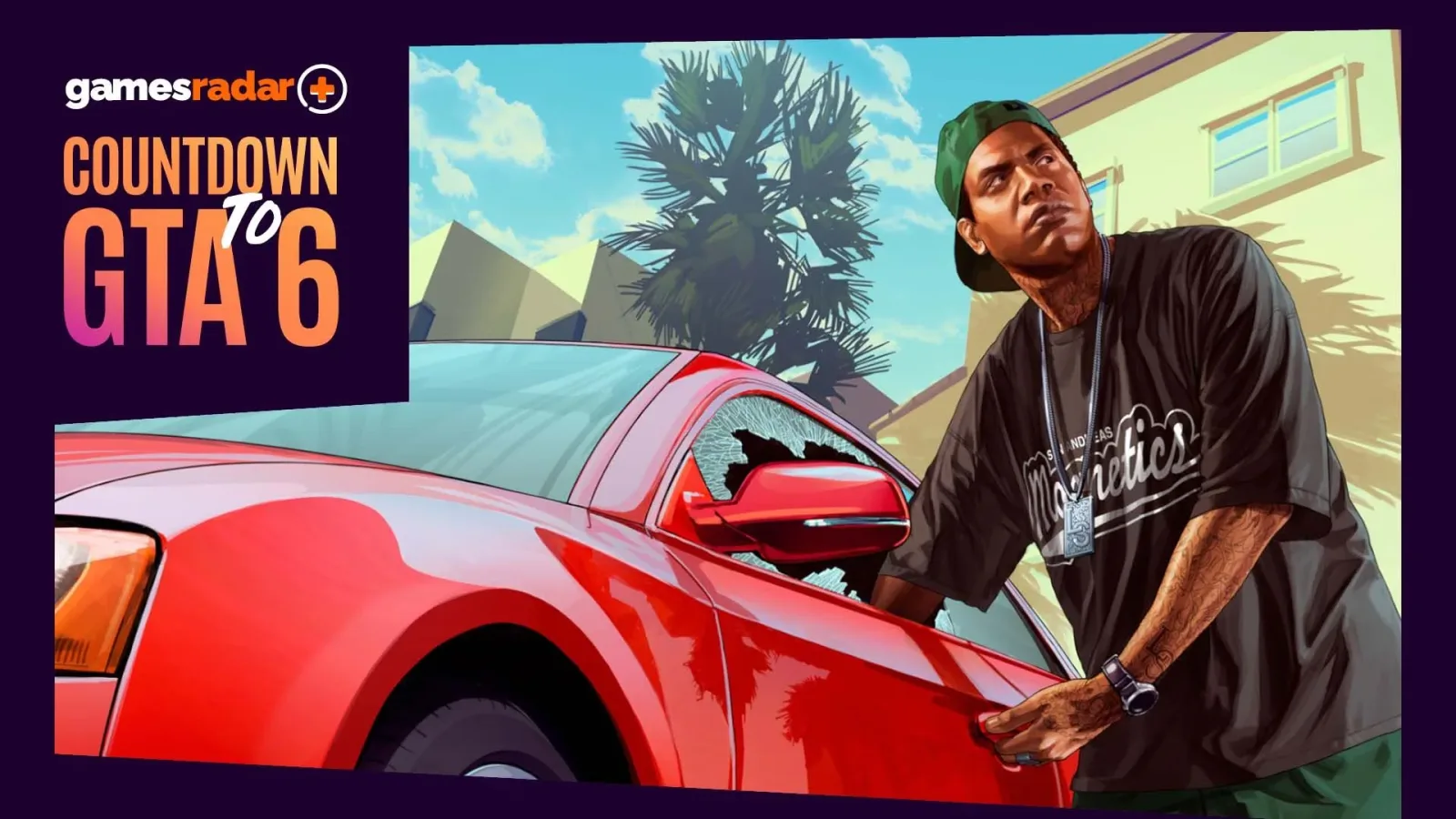
Grand Theft Auto 5 has had an unusually long life. Rockstar Games' Los Santos first arrived on PlayStation 3 and Xbox 360 in 2013, subsequently moved through another console generation, and later returned again in enhanced form on PlayStation 5 and Xbox Series hardware. Across that span, the game has sold more than 170 million copies. It has outlasted the normal cadence of the series that once delivered several major 3D entries between 2001 and 2011, and it remains an unavoidable point of comparison as attention turns toward Grand Theft Auto 6.
That longevity can create a strange distance. A game that has been continuously available, updated, streamed, roleplayed, memed, and expanded through multiplayer can feel less like a finished 2013 release than a permanent piece of the medium's infrastructure. Returning to its single-player campaign after time away is therefore revealing. Los Santos still has a startling capacity to make a player believe in its streets, weather, social geography, and rhythms. Yet the game's harsh comic worldview, its treatment of several characters, and some of its mission design carry more visible wear than the city itself.
A city that remains convincing in motion
GTA 5 does not look brand new in every close-up. Character models, older animation details, and certain environmental surfaces can betray its origins. But the larger impression remains remarkably strong, particularly while driving through the city at speed. The visual revisions introduced over successive versions have helped: clearer textures, higher resolutions, HDR presentation, and ray-traced lighting on newer console editions all make a meaningful difference to the mood of the place.
Lighting is especially important. Rockstar has long used it to establish regional identity, from the neon intensity associated with Vice City to the dusty atmosphere of San Andreas. In Los Santos, early daylight can look brittle and bright, sunsets spread into pink along the Pacific horizon, and nighttime illumination bounces from glass towers, vehicles, signs, and wet-looking streets. On PlayStation 5, DualSense feedback adds another small layer of sensation, transmitting the road beneath a vehicle and even complementing the bass-heavy sound of nightlife spaces.
For useful background on this topic, read Nivalis Nights Passes 1 Million Steam Wishlists Before September PC Release.
Those upgrades are not the sole reason the world still works. Los Santos was built with an extraordinary density of incidental detail and a clear sense of lived-in contradiction. There are billboards designed to be ugly, scattered rubbish, cramped lots, oversized luxury homes, cheap storefronts, traffic, noise, and occasional animal life in the corners of the frame. More recent additions include stray cats that dart toward alleys when vehicles pass. First-person mode, added after the original release, gives players another way to stop and examine those smaller touches.
Other open worlds may surpass GTA 5 in individual assets or character-detail fidelity. Insomniac's New York in Marvel's Spider-Man, for example, can appear more technically polished in places. But Los Santos has an edge in the messier question of social texture. It does not merely present a recognisable city skyline. It conveys a city shaped by people with competing ambitions, money, resentment, boredom, and a constant desire to get somewhere else.
Los Santos tells its story through distance and altitude
One of GTA 5's most effective qualities is how clearly it maps class division onto physical space. The journey between Franklin's neighborhood, Michael's affluent surroundings in Rockford Hills, and Trevor's rural territory does a great deal of narrative work without requiring a cutscene. Franklin's early environment is made up of closely packed homes and neglected spaces. Michael's world sits higher, cleaner, wealthier, and more insulated. Beyond that lies a comparatively empty countryside whose lawlessness and distance fit Trevor's personality.
For another perspective on this story, read GTA 5's Long Los Santos Afterlife Shows What Still Works--and What Has Aged Poorly.
That geography reinforces a recurring Rockstar theme: the wealthier and more powerful a person is, the further removed they tend to be from the immediate consequences of the city's disorder. It is a simple observation, but GTA 5 communicates it elegantly through travel. Moving uphill toward an assignment from Michael is not just crossing the map; it is moving through an economic hierarchy.
The same approach creates the game's distinctive mixture of beauty and ugliness. A player can pause at a spectacular coastal vista, then turn toward a crude advertisement or a discarded pile of debris. Los Santos is inviting because it is varied and richly staged, but its inhabitants frequently seem disgusted by it. That tension is part of the point. The game's California parody is not an aspirational metropolis so much as an expensive, sunlit pressure cooker.
The protagonists still offer useful contrasts
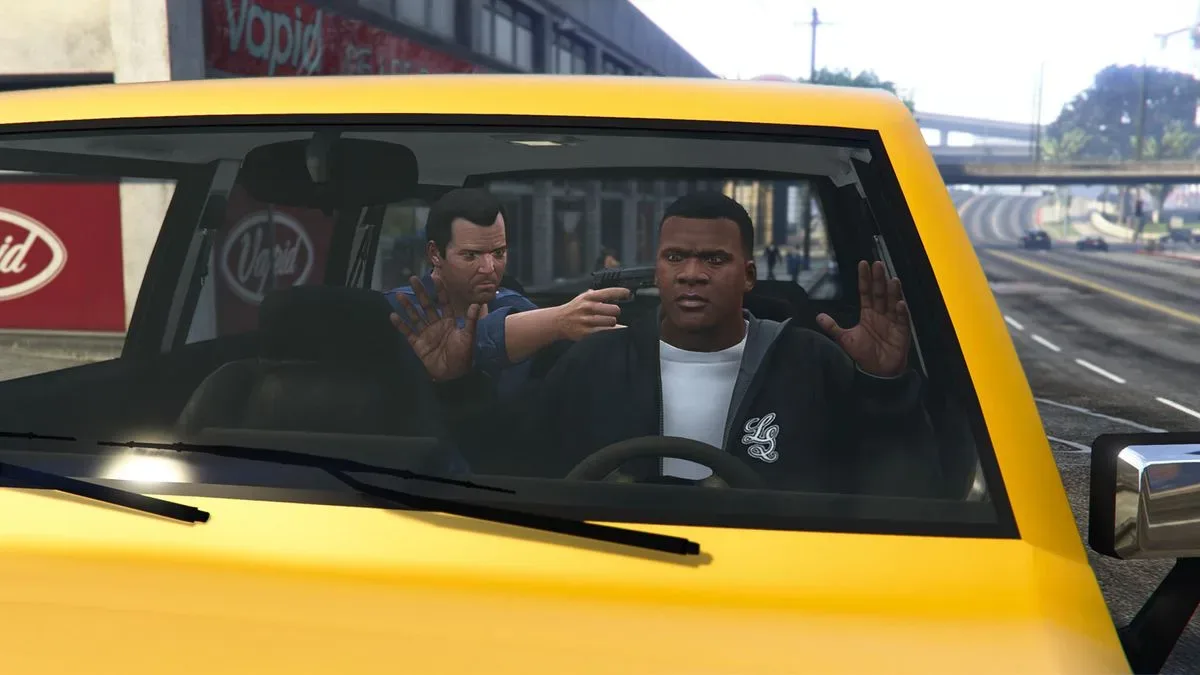
The three-character structure remains one of GTA 5's smartest design decisions. Switching between Michael, Franklin, and Trevor gives the campaign momentum, helps cover the enormous distances of the map, and functions as a story-friendly form of fast travel. When a player is far from the next objective, shifting to another protagonist can put them into an entirely different situation rather than forcing a long drive across the state.
More importantly, each character supports a different flavour of play. Franklin can suit more controlled driving and measured progress through the city. Michael's middle-aged criminal nostalgia brings a different tone, as does his association with classic rock stations. Trevor invites chaos: reckless violence, rural detours, and a deliberately abrasive energy. The system anticipates, in a broad sense, the enormous variety of identities and activities that would later flourish in GTA Online roleplay communities.
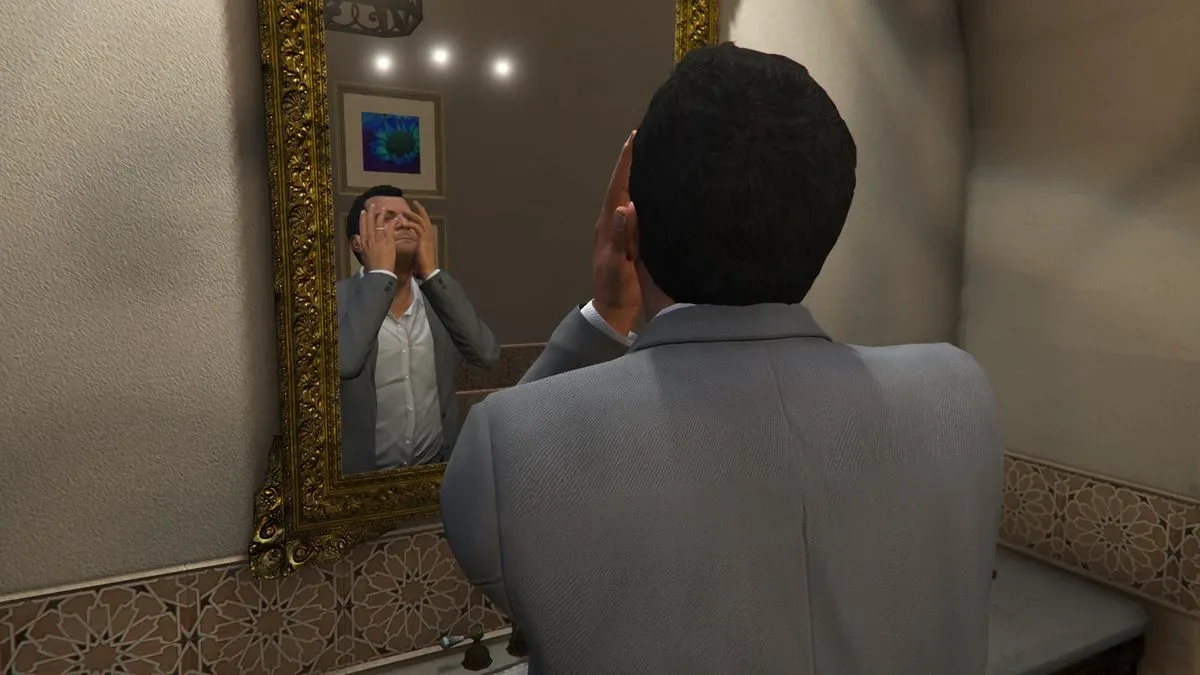
Michael and Franklin remain relatively legible archetypes. Michael is a former criminal who has exchanged danger for wealthy suburban dissatisfaction, only to find that the safety he purchased has not made him content. Franklin is the ambitious young criminal trying to decide whether the opportunities in front of him represent escape or simply another trap. Their pairing gives the early game a recognizable crime-story foundation.
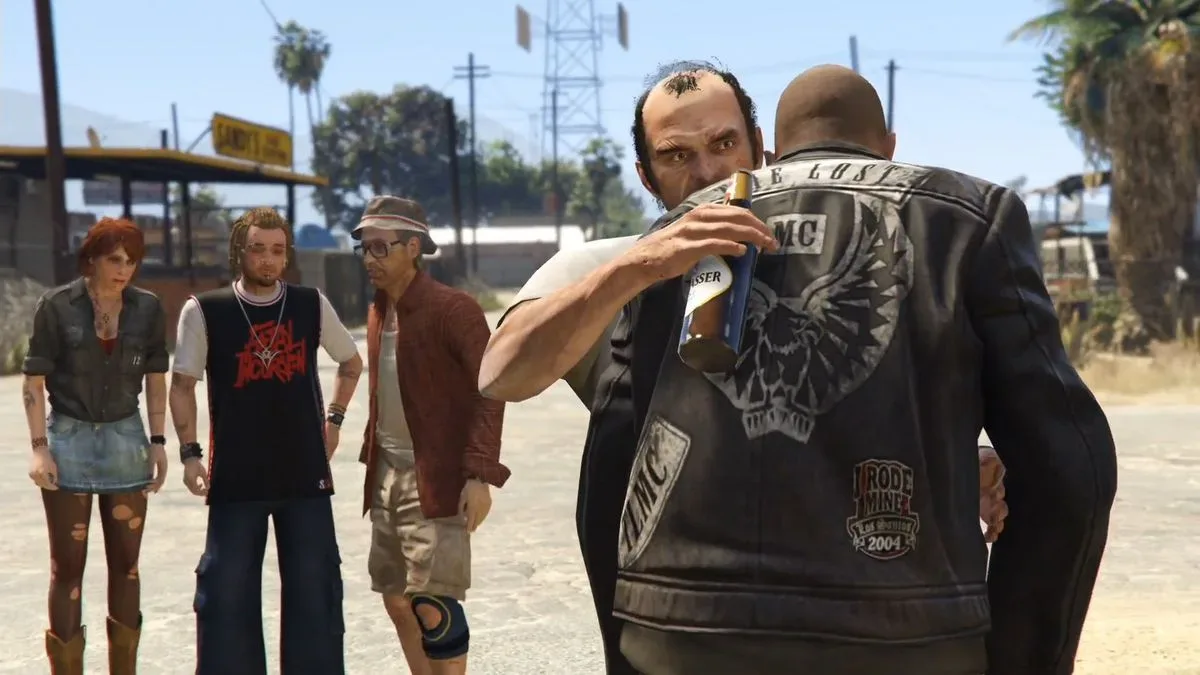
Trevor's arrival changes the temperature. He is presented as an embodiment of the player's most destructive impulses and as a rejection of restraint. His introduction includes the violent death of Johnny Klebitz, the protagonist of The Lost and Damned, the 2009 expansion connected to GTA 4. The message is difficult to miss: the more emotionally serious direction associated with GTA 4 is being aggressively shoved aside for something louder, uglier, and more confrontational.
Satire that lands unevenly after more than a decade
That confrontational quality is also where GTA 5 has aged least gracefully. Its satire often seeks targets in American wealth, corporate power, celebrity culture, technology, policing, and government authority. When it connects, it can still feel sharp. The mission involving Life Invader chief executive Jay Norris remains an effective attack on the self-important mythology around social-media empires, even if much of the immediate comedy is aimed at office workers, startup aesthetics, and hipster culture.
Rockstar's wider suspicion of the wealthy and powerful has endured well, perhaps because those concerns have only become more familiar. GTA Online later introduced Avon Hertz through the 2017 Doomsday Heist update, another technology magnate parody whose resemblance to Elon Musk became easier to read as public attitudes changed. In July 2022, the Operation Paper Trail storyline brought a deadly heatwave and energy crisis into the game's fiction at a time when real-world events made those anxieties feel uncomfortably immediate.
But GTA 5 often mistakes cynicism for insight. Its preferred joke can be to identify a real social ill, mock everyone involved, and move on before saying much else. That approach feels rooted in an older cultural moment that valued provocation and treated earnestness as something to ridicule. It is exhausting in long stretches, particularly because the game regularly directs its harshest contempt at characters with relatively little power.
The limited and frequently demeaning roles available to women stand out more plainly now. Michael's wife and daughter, as well as Franklin's aunt, are repeatedly filtered through a narrow set of sexualised and dismissive gags. Jimmy, Michael's son, is treated as an equally broad caricature: a headset-wearing young gamer shouting slurs while playing a shooter. Michael sees him as evidence that a new generation is hopeless; the game itself often seems content to make him a punchline for its own audience.
Some changes have been made over time. Players noticed in 2022 that transphobic material had been removed from the game. New radio stations, advertisements, and talk-radio segments have also allowed the world to comment on newer cultural subjects. These revisions do not rewrite the original campaign, but they show that Los Santos has not been entirely frozen in its 2013 assumptions.
The torture mission remains a difficult test case
No return to GTA 5 can avoid its notorious torture sequence. Trevor assists federal agents in interrogating a man who appears to be innocent, and the player is required to select methods including electrocution and waterboarding before using controller inputs to carry them out. It was unpleasant at launch and remains unpleasant now.
There is clearly an attempt at critique. Trevor, who is rarely a moral authority, ultimately argues that torture is ineffective for obtaining reliable information. At the same time, he admits that he enjoys inflicting pain. The scene therefore raises an unresolved question about the game itself: is it condemning violence, indulging it, or deliberately trying to make those impulses inseparable? The ambiguity is not necessarily artistically useless, but it leaves the sequence with an uneasy aftertaste. GTA 5 wants the player to feel discomfort, yet it also turns that discomfort into an interactive spectacle.
GTA Online became the larger Los Santos
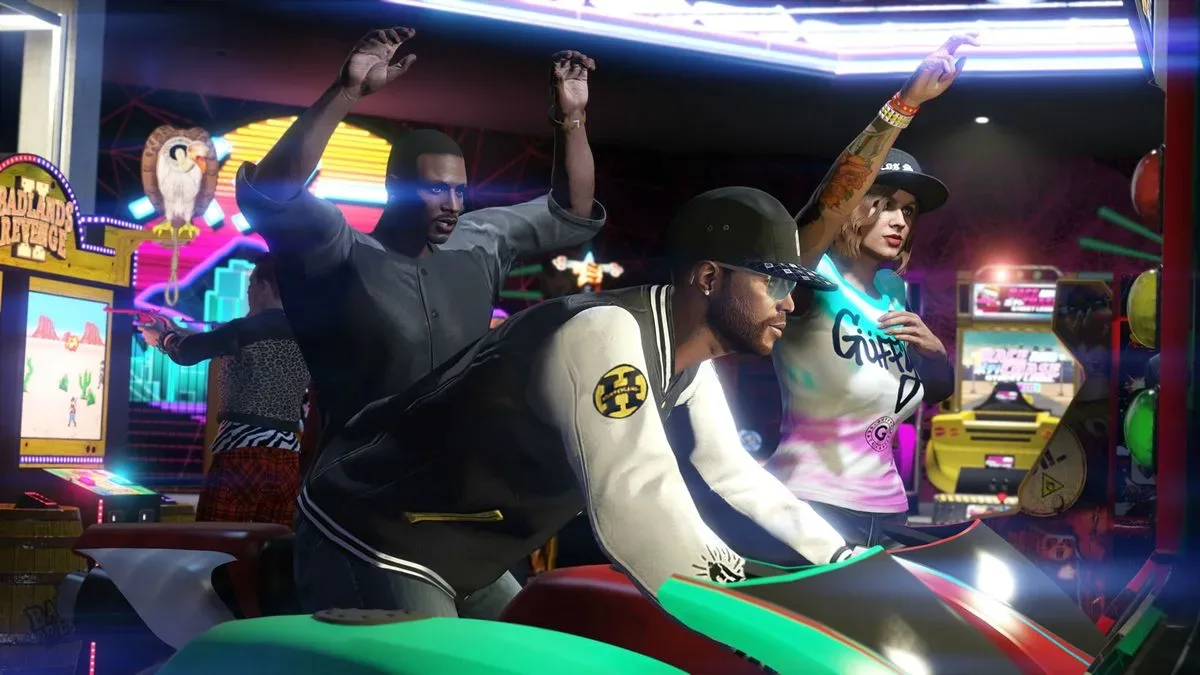
The most significant change to GTA 5's identity has come from GTA Online. For many players, the multiplayer component is now the main game, while the original campaign is effectively stored behind a menu tab. Online did not invent virtual social spaces, live-service design, multiplayer performances, or the idea of a persistent action-game playground. Still, few games have demonstrated the commercial and cultural power of that model at quite this scale.
Its additions have kept Los Santos in a kind of moving present. New music arrives through radio stations, nightclub sets by real DJs, and releases such as a Dr Dre EP. Supporting characters from the single-player story can reappear years later. New missions attach contemporary anxieties to a familiar map. The underlying structures can feel dated--driving from marker to marker and surviving repeated waves of enemies was already a familiar formula--but the world has proved unusually able to absorb new stories and new social rituals.
That is why GTA 5's long afterlife is more than a story of remasters. It is a story of a single city becoming a platform. The original game did not reshape the industry in the immediately identifiable way GTA 3 did, but it found a near-perfect place in the era of continuously updated games and online communities.
GTA 5 remains worth revisiting because Los Santos still feels more alive than many newer open worlds. Its technical upgrades have preserved its atmosphere, its geography remains brilliantly expressive, and its character-switching structure is still inventive. Yet a revisit also makes its limitations clearer: repetitive mission rhythms, satire that too often settles for cruelty, and writing that can turn ugly rather than incisive. Both truths matter. The game's strengths explain why it has endured across three console generations; its weaknesses help define what many players will hope changes when the series moves forward.
Community
Discussion
Start the conversation.
No comments have been posted yet.