

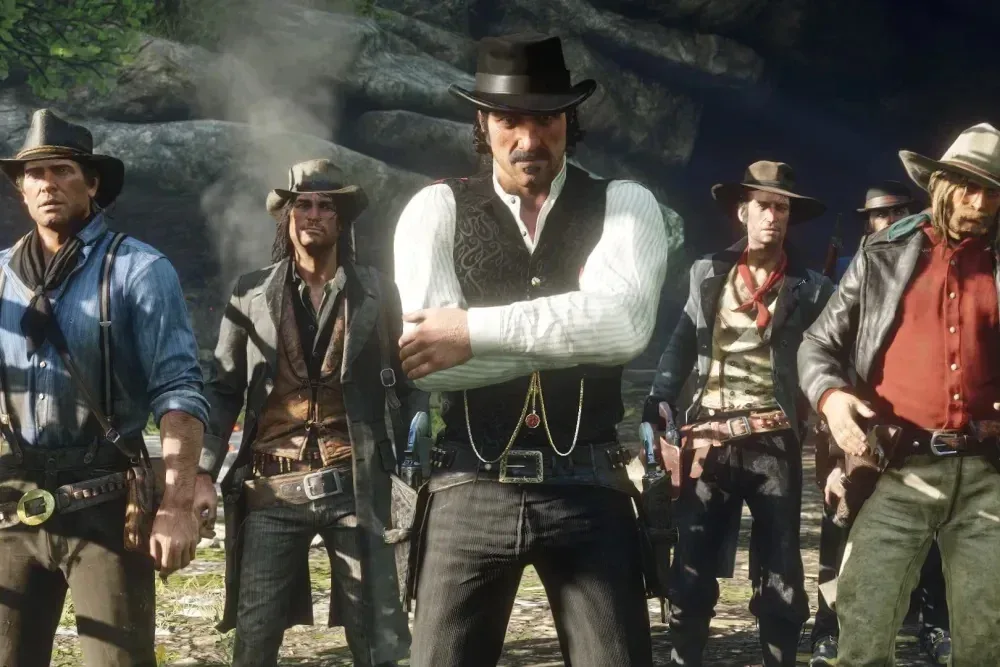
Grand Theft Auto may be one of entertainment's most valuable brands, but that does not mean a movie is inevitable. Despite Hollywood's accelerating interest in video game adaptations, Rockstar Games is reportedly not pursuing a theatrical version of its open-world crime series. Instead, any move from Take-Two Interactive and Rockstar into film or television appears likely to remain highly selective, with Red Dead Redemption emerging as the property more plausibly suited to a screen adaptation.
That restraint stands out at a moment when major studios and streamers are scrambling for recognizable game franchises. Video game stories are no longer treated as automatic genre curiosities: they are increasingly viewed as potential event entertainment with established audiences, global recognition, and worlds that can support multiple seasons or films. Yet Take-Two's leadership has repeatedly argued that a successful game does not automatically become a sensible movie or television investment.
For the company behind Grand Theft Auto, Red Dead Redemption, NBA 2K, and other major releases, the calculation is not just about an adaptation fee. It is about whether a project can meaningfully enhance the brand without exposing it to the considerable risk of a high-profile failure.
Why Grand Theft Auto does not need a movie
Grand Theft Auto is, in many respects, already built around cinematic ambition. Rockstar's games combine large-scale open worlds with scripted missions, character-driven stories, satire, radio programming, licensed music, and a level of production polish that has often invited comparisons with film and television. Players are not simply watching protagonists rise through a criminal underworld; they are participating in sprawling cities and choosing how much chaos, exploration, racing, or role-playing they want alongside the central narrative.
For useful background on this topic, read BioWare's 12 Most Memorable Romances, From Garrus to Dorian.
That is precisely why translating GTA to a conventional film format could be difficult. A movie would need to select one story, one tone, and one set of characters from a series whose identity is partly defined by player freedom and the feeling that its fictional cities are living systems. It could certainly be done, but it would also risk reducing a giant interactive playground into a more familiar crime drama.
There is also little commercial urgency. Grand Theft Auto is not a brand trying to regain relevance through Hollywood exposure. Its games already command enormous attention on their own. The reported day-one revenue for Grand Theft Auto VI eclipsed that of Avengers: Endgame, a striking example of how the largest games can now compete with -- and in some circumstances surpass -- the financial scale traditionally associated with cinema's biggest launches.
When the games themselves can produce cultural moments and revenue on that scale, a licensed movie becomes a potential distraction as much as an opportunity. A hit would be welcome, but it might not materially transform Take-Two's core business. A weak adaptation, meanwhile, could become a highly visible problem for one of gaming's most closely protected names.
Red Dead Redemption may fit television more naturally
Red Dead Redemption is a different proposition. The Western series shares Rockstar's blockbuster production values and open-world design, but its storytelling is more readily comparable to prestige television. Its stories are rooted in a specific historical period, revolve around outlaws navigating a changing America, and lean heavily on character relationships, betrayal, violence, loyalty, and the decline of the frontier.
Those ingredients make it easy to imagine a long-form television drama built around the series. A strong adaptation could explore the texture of the world beyond the games' missions: camp life, shifting towns, lawmen, railroads, family tensions, competing gangs, and the social change that defines the series' setting. The format could also provide the time needed to give an ensemble cast room to breathe.
There have reportedly been discussions around the possibility of licensing Red Dead Redemption for film or television, with a figure of $100 million said to have been floated at one point for the rights. That number should not be read as a confirmed deal or a declared asking price, but it illustrates the premium that could be attached to a franchise with Red Dead's reputation and reach.
For perspective, Amazon paid $250 million for television rights to The Lord of the Rings. The comparison does not mean the properties are equivalent, but it reflects a market in which companies are willing to make substantial commitments for globally recognizable universes. Red Dead has a different sort of appeal: less fantasy spectacle, more frontier drama. In the right hands, it could occupy a space that combines the critical ambitions associated with Western dramas such as Deadwood with the broad audience appeal of modern ranch-set hits such as Yellowstone.
Take-Two's leadership sees adaptation as a risk calculation
Take-Two CEO Strauss Zelnick has been clear that the company's willingness to license its intellectual property is conditional. Speaking on The David Rubenstein Show on November 12, Zelnick said that the company would consider a film or television project if its creative teams were genuinely enthusiastic and believed it could engage and delight consumers. He described that as a high threshold and stressed that Take-Two remains very selective.
"We're very careful about line extensions because this is a creative company and our goal is to make the best entertainment on earth," Zelnick said. "We would make a movie or television show based on our intellectual property if our creative teams were passionate about it."
His reasoning has been consistent for years. In comments to shareholders in 2023, during the period of intense attention around the simultaneous success of Barbie and Oppenheimer, Zelnick contrasted the predictability of Take-Two's interactive business with Hollywood's less reliable hit rate. He said successful console properties can have an 80% to 90% hit ratio for the company, while even a well-run movie studio may land closer to 30%.
That gap matters. A movie based on a Take-Two property might generate licensing income, but the possible financial reward does not necessarily outweigh the danger of harming the game brand. If the adaptation fails creatively or commercially, the company could face negative attention while gaining little from the transaction. For a publisher whose games already operate at the center of its business, maintaining trust in the underlying IP may be the more valuable objective.
The adaptation boom has not erased the downside
Hollywood's enthusiasm for game adaptations is understandable. Successful projects have demonstrated that audiences will turn out when a production understands the strengths of its source material. At the same time, the results remain inconsistent. One adaptation can become a major crossover success, while another can struggle critically and commercially despite using a familiar game name.
That contrast is especially relevant to Take-Two after the poor reception for the Borderlands movie. The film entered production before Take-Two acquired Gearbox Entertainment, the studio behind the series, but the experience still offers an obvious reminder that an adaptation cannot be treated as guaranteed promotional value. A screen project based on a beloved game has to stand on its own while preserving what players recognize and value.
Rockstar and Take-Two also have a historical reason to be cautious. The 2008 Max Payne film, starring Mark Wahlberg, achieved moderate box-office results but was widely criticized, earning a 15% score on Rotten Tomatoes. Remedy Entertainment developed the original game, while Rockstar publishes the franchise. The movie did not end Max Payne as a game series -- Max Payne 3 followed, and remakes of the first two titles remain planned -- but it is hardly a template for the kind of creative extension the company now appears to want.
Rockstar cofounder Dan Houser, who has since departed to establish his own entertainment company, discussed earlier conversations around adaptations last year. He said the company had viewed its franchises as multibillion-dollar intellectual property and found that the economics and risks of screen deals did not make sense. At the time, there was also a widespread view that video games routinely made for poor movies.
Expensive competition for gaming's biggest names
The race for game properties is continuing regardless. Amazon, Netflix, and FX are reportedly spending between $15 million and $25 million per episode on adaptations tied to Tomb Raider, Assassin's Creed, and Far Cry. Those budgets are substantial enough to resemble the cost of mid-range Hollywood blockbusters when spread across a season.
Such spending demonstrates why Red Dead Redemption could attract serious interest. But it also reinforces why Take-Two can afford patience. The company does not need to license a property simply because buyers are willing to pay. It can wait for a pitch, creative team, format, and partner that make sense for the particular franchise.
For now, that appears to leave Grand Theft Auto outside the adaptation race. Its absence should not be mistaken for a lack of Hollywood value; it is arguably the opposite. GTA is so successful as an interactive series that any movie would face an unusually difficult challenge: proving it can add something that the games do not already deliver.
Red Dead Redemption has a clearer route if Take-Two chooses to take one, particularly as a carefully developed television drama. Even then, the company's public stance suggests that a recognizable logo and a large check will not be enough. The project would need to protect the game's identity, give its creative teams confidence, and offer audiences a reason to visit that world in a form they cannot get from the games themselves.
Community
Discussion
Start the conversation.
No comments have been posted yet.