

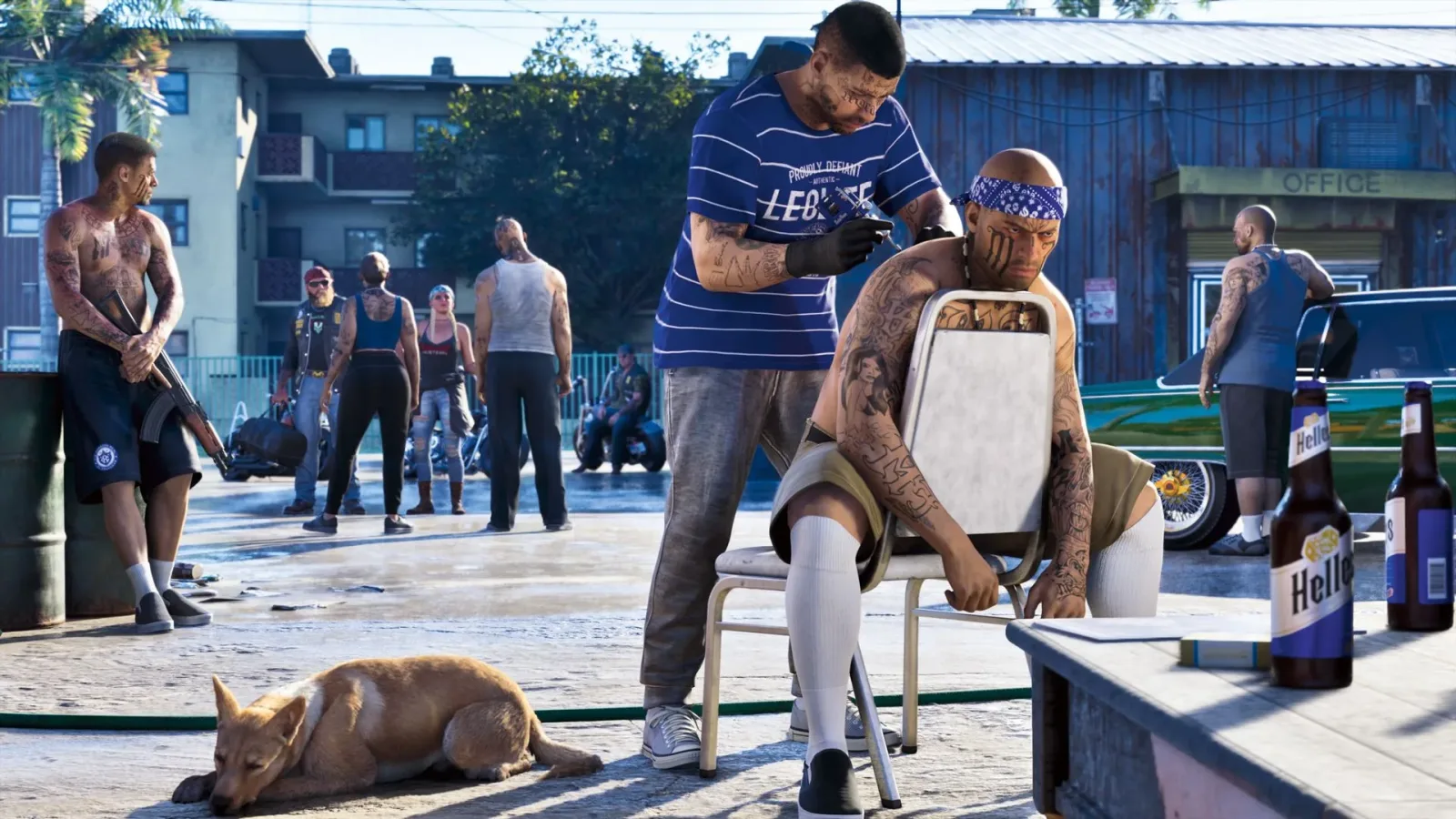
Grand Theft Auto 6 is shaping up to push further into role-playing territory than previous entries in Rockstar's open-world series, but its developers say the goal is not to bury players beneath an endless stack of mandatory mechanics. Instead, the team wants Vice City to support different kinds of play, allowing people to settle into the activities and routines that matter to them.
That could mean pursuing the explosive missions, driving, and Wanted-level evasion traditionally associated with Grand Theft Auto. It could also mean spending time on quieter, more everyday pursuits: visiting stores, going out to clubs, riding the train, or simply using the city's buses to get around. The ambition is for the world to feel flexible enough that players can treat it as a place to inhabit rather than merely a backdrop between objectives.
In an interview with Edge, Rockstar head of development Aaron Garbutt described an experience intended to accommodate a broad range of player priorities. Some may want a role-playing-focused session built around mundane interactions and sightseeing, while others may be more interested in action, crime, or the game's larger story. The key idea, Garbutt suggested, is that the game can become whatever players want it to be at a particular moment.
A broader definition of what it means to play GTA
Grand Theft Auto has always offered diversions beyond its main missions. Past games have let players explore cities, buy food, listen to radio stations, take on side activities, and generally spend time causing trouble outside the central campaign. GTA 6 appears to be looking at that freedom through a more explicitly role-playing-oriented lens.
For useful background on this topic, read GTA 6's Higher Fidelity Forced Rockstar to Slow the World Down.
The distinction is important. An open world can contain a huge number of activities without necessarily making them feel like part of a player's chosen identity or routine. Rockstar's comments point toward a design in which smaller interactions are not just extra checkboxes on a map. They may instead help players decide what a given day in Vice City looks like, whether that is a night out, a journey across town on public transit, or a focused stretch of criminal activity.
Garbutt's examples are deliberately low-key: buying cigarettes and beer, taking a train for the day, or going to a club. Those are not presented as replacements for Grand Theft Auto's established formula. Rather, they illustrate how much more room the game may give players to slow down and create their own stories between major events.
For a series famous for spectacular car chases and chaos, that emphasis on ordinary behavior is notable. It suggests that Rockstar sees immersion as more than visual detail or a large map. A convincing city also needs to feel usable in ways that are not always mission-critical. If the systems work as intended, Vice City could be a setting where a player's preferred pace has as much value as the next set-piece.
Rockstar wants optional systems, not obligations
More systems can make a game richer, but they can also create a familiar open-world problem: players can feel pressured to engage with every new mechanic, even when those mechanics do not match the way they want to play. Rockstar head of development Rob Nelson acknowledged that tension directly.
Nelson said the team does not want to force features onto players only for those features to be rejected. The focus, instead, is on letting players move toward the styles of play that appeal to them. That means GTA 6 is not simply trying to accumulate more activities over time for the sake of scale. It is aiming to give players enough freedom to identify their favorites and establish a rhythm around them.
That approach could be especially important for a game as expansive as GTA 6 is expected to be. A giant activity list can be exciting at first, but it can become exhausting if each system feels essential or if the game constantly interrupts a player's preferred approach with demands to learn something new. Rockstar's stated balance is therefore between depth and accessibility: offer a city full of possibilities, while making sure the player remains in control of which possibilities matter.
It also leaves room for very different relationships with the same game. One player may gravitate toward the systems connected to Grand Theft Auto's core criminal structure, including the Wanted system. Another may spend long stretches exploring the city, visiting venues, or traveling without driving. Both approaches could be valid expressions of the intended experience rather than one being treated as a distraction from the "real" game.
Finding a personal loop
The notion of settling into a rhythm is perhaps the most revealing part of Rockstar's comments. In many games, side content exists as a detour: something players briefly complete before returning to the main story. GTA 6's developers appear to be describing a model where those activities can become a player's habitual loop.
- A player might prioritize story missions and use the city primarily as a route between objectives.
- Another might focus on nightlife, shopping, and informal exploration during free-roam sessions.
- Someone else may use the transit network simply because they enjoy moving through the city without being behind the wheel.
- Players looking for familiar Grand Theft Auto tension can still engage with driving, crime, and police attention.
None of those possibilities requires Rockstar to turn GTA 6 into a conventional RPG with rigid classes or a prescribed moral role. The role-playing aspect discussed by the developers is closer to player expression: deciding what kind of time one wants to have in the city and being supported by the world's systems while doing it.
Vice City's buses are receiving unusual attention
One detail from the developers' discussion provides a particularly clear example of that philosophy. Rockstar developer Phil Hooker said he is intensely focused on Vice City's bus network, to the point that he will board a bus during playtesting rather than drive himself to his next destination. His reason is practical as well as personal: he wants to verify that buses are running as expected and taking the correct routes.
Hooker said he has memorized the routes, a small but telling indication of how seriously the team is treating the city's infrastructure. In a game where players are often expected to steal or race cars, dependable public transport might sound like a minor feature. Yet it can make a substantial difference to the feeling of a living place.
A functioning bus system provides an alternative to the standard GTA routine of immediately getting into a vehicle and speeding toward a waypoint. It allows a player to observe the city from a different perspective, travel at a slower pace, and choose a method of movement that is less about performance and more about participation in the world. The train and bus examples also reinforce that Rockstar is designing for sessions where players may not want to drive at all.
Of course, the developers have not said that every player will want to use public transit regularly. That is precisely where the proposed balance comes in. These systems do not need to become compulsory in order to add value. Their presence can enrich the city for players who seek them out, while everyone else remains free to play in a more traditional fashion.
Depth without losing Grand Theft Auto's identity
The prospect of deeper role-playing raises an obvious question: how far can GTA 6 expand its everyday simulation without losing the immediacy that has long defined the series? Rockstar's comments indicate that it is aware of that risk. Rather than framing its work as a push toward maximum complexity, the team is describing an attempt to provide options that players can accept, ignore, or return to when the mood strikes.
That could be a sensible fit for Grand Theft Auto. The franchise's strength has often been the contrast between authored missions and unscripted play. GTA 6 may be extending the unscripted side of that equation, making the gaps between major events feel more intentional and more responsive to individual tastes.
There is still much to learn about the precise systems behind that vision and how they will interact with the campaign. Rockstar's developers have offered a design direction rather than a complete breakdown of mechanics. But the message is clear: Vice City is meant to support more than one fantasy.
For some players, that fantasy will involve high-speed escapes and the pressure of the Wanted system. For others, it may be as simple as taking a bus across town, visiting a club, or spending an afternoon following a self-made routine. If Rockstar can make both ends of that spectrum feel worthwhile without turning either into an obligation, GTA 6 could deliver its most flexible open world yet.
Community
Discussion
Start the conversation.
No comments have been posted yet.