

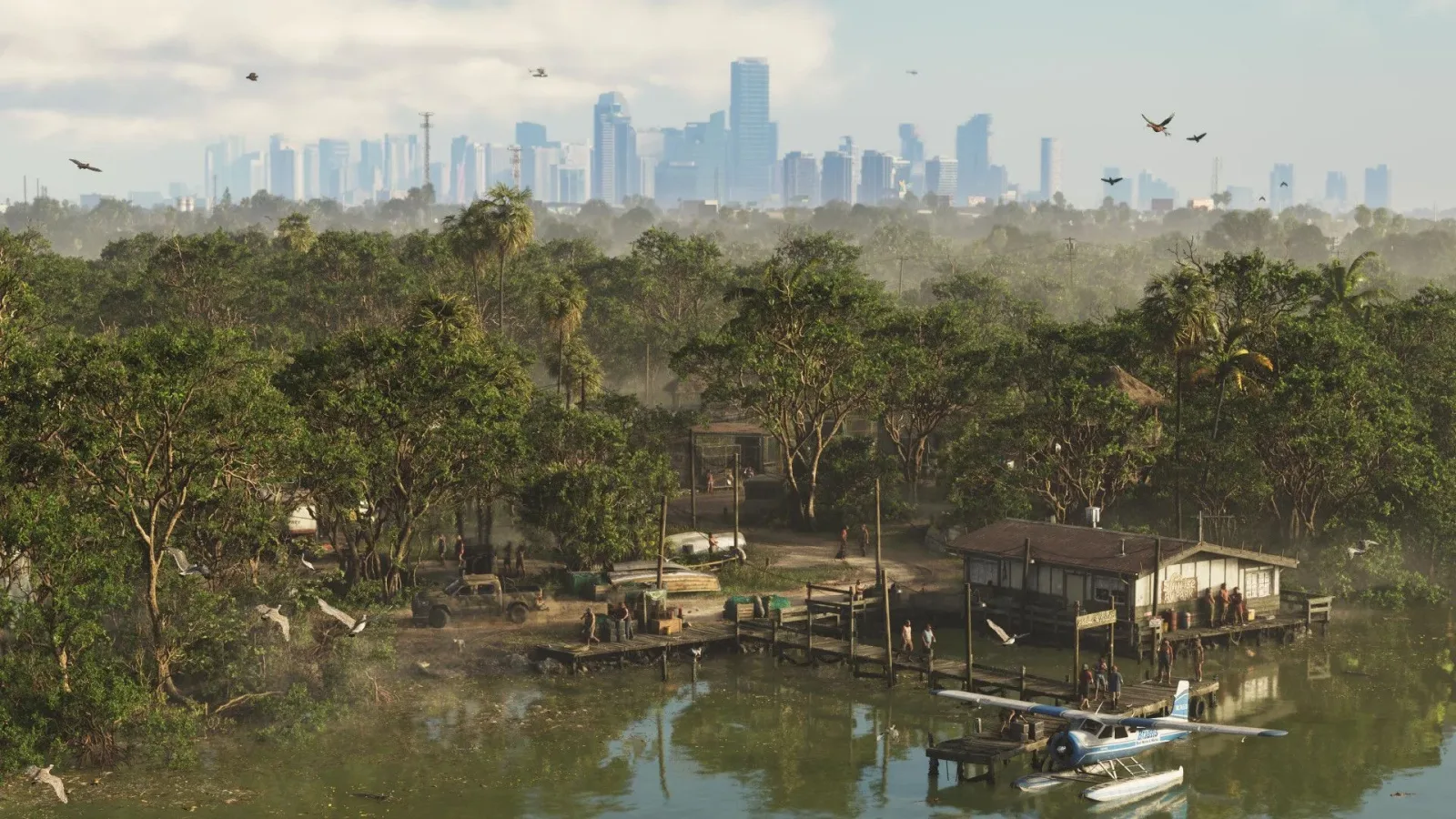
Grand Theft Auto 6 is aiming to make its version of Leonida feel less like a map to clear and more like a place players gradually come to understand. In development notes shared with the press, Rockstar vice president of design Stephen Donkin outlined an ambition that runs against one of the most familiar habits in modern open-world gaming: treating every activity, collectible, and map marker as an item on a checklist.
Donkin's message is straightforward, even if achieving it is far from simple. Rather than fixating on percentages, tasks, or guides that reveal every hidden opportunity, he hopes players will give themselves room to wander and let the world reveal itself naturally. Leonida, the state that includes the newest incarnation of Vice City, is being positioned as a setting dense enough to reward a slower and more personal style of play.
That does not mean there will be nothing to do. Quite the opposite. Donkin stressed that Leonida contains a huge amount of activity and discovery. The intended difference is in how that material reaches the player. Instead of feeling like a long set of obligations delivered through a menu, the game is meant to produce encounters that emerge through movement, curiosity, and the player's own decisions about where to go next.
A world meant to unfold rather than be completed
Open-world games have increasingly been designed around clarity. Maps fill with icons. Activities are categorized. Progress meters quantify nearly every major diversion. Those systems can be useful: they give players direction, make large games easier to navigate, and offer a satisfying record of what has been accomplished. But they also encourage an approach where the player is always thinking one step ahead, looking at what remains instead of paying attention to what is happening now.
For useful background on this topic, read Winter Burrow: Below the Ice DLC Adds Fishing, Bright Wetlands and New Quests December 9.
Donkin's comments suggest GTA 6 wants to challenge that mindset. His ideal player is not someone racing toward total map completion or consulting an online guide before every major choice. It is someone willing to move through Leonida at the game's rhythm, allowing the next interesting event to come from a detour, an unexpected encounter, or simple curiosity.
The key promise is a balance between scale and specificity. Donkin described the potential experience as almost limitless when viewed from a broad perspective, while maintaining the sense that individual moments were made deliberately by people rather than generated as generic distractions. That is a difficult line for any large game to walk. Huge worlds can feel expansive but repetitive; authored missions can feel memorable but overly controlled. Rockstar's stated target is a world with enough depth to sustain freeform discovery without losing the authored detail that gives encounters personality.
For players, the most important part of that idea may be how much agency it leaves in their hands. A world does not need to be empty of guidance to feel inviting, nor does it need to conceal every meaningful thing from view. The more compelling possibility is that GTA 6 could make its discoveries feel connected to a player's behavior. Taking an unfamiliar road, lingering in a neighborhood, following a small lead, or reacting to a chance situation could matter because it creates a different path through the game.
Why the checklist conversation matters
Completion percentages have long been part of Grand Theft Auto's identity. They give especially dedicated players a way to measure everything they have seen and done beyond the main storyline. Side jobs, minigames, collectible hunts, stunt challenges, and other diversions have traditionally contributed to the sense that a Grand Theft Auto city is packed with things to pursue.
Yet completion can become its own kind of pressure. Once a game shows the player a percentage, it quietly creates a question: what is missing? Once there is a collectible count, an activity log, or a trophy tied to exhaustive exploration, the world can begin to feel less like a city and more like a set of remaining requirements.
Earlier Grand Theft Auto side releases demonstrate the tension particularly clearly. Vice City Stories and Liberty City Stories were smaller in scale than the biggest numbered entries, but their collectible searches could still become a grind for players pursuing everything. Tracking down red balloons or stray pigeons may have added longevity, but it could also turn the final stretch of play into a painstaking clean-up operation.
Donkin's remarks do not confirm that GTA 6 has eliminated collectibles, progress tracking, or optional objectives. There is no reason to assume those familiar elements are gone. What they do indicate is a shift in emphasis. Rockstar wants the player's relationship with Leonida to be about immersion first, not an accounting exercise. If completion systems exist, the design goal appears to be preventing them from becoming the entire reason people explore.
Leonida's ambition goes beyond a larger map
It is easy to discuss open-world ambition purely in terms of landmass, number of activities, or the density of a city. Donkin's comments point toward a different definition of scale. Leonida is not only intended to have a lot of content. It is intended to feel like it has enough interconnected possibility that players can keep finding meaningful situations without being steered through them in a rigid order.
That ambition helps explain why the description of GTA 6 can invite comparisons beyond the series' usual action-game foundations. If its systems create opportunities for players to experiment, improvise, and observe consequences, the result could borrow some of the appeal associated with role-playing games and immersive simulations. Such games often thrive on giving players tools and letting them discover unusual uses for those tools, rather than simply directing them to a prescribed objective.
Nothing in Donkin's comments confirms specific mechanics or a particular structure for GTA 6's missions. Still, the philosophy is notable. An open world can feel more alive when its activities are not merely isolated attractions scattered across a map. The strongest discoveries are often those that seem to arise from the player's own attention: noticing something odd, deciding to investigate, and finding a moment that feels surprisingly tailored to that decision.
The challenge, of course, is that players do not all approach games in the same way. Some will want clear objectives, reliable markers, and a visible route through the content. Others enjoy the uncertainty of setting off without a plan. A successful version of Donkin's vision would need to accommodate both groups. It would give focused players enough structure to avoid frustration while ensuring that exploration-minded players are not constantly pulled away from spontaneous discovery by notifications and map prompts.
Open worlds are still searching for the right balance
The wider genre offers plenty of examples of both approaches. Many large action games have embraced activity lists and collectible-driven progression, offering a dependable stream of rewards in exchange for systematic exploration. That structure can be enjoyable, particularly for players who value order and clear goals. But it can also make a giant setting feel predictable: travel to an icon, complete an activity, collect a reward, then repeat.
Other games have made a stronger case for trusting players to find their own fun. The Witcher 3 is frequently remembered not simply for the quantity of its quests, but for the way many diversions deliver stories with their own identity. The Legend of Zelda: Breath of the Wild and Tears of the Kingdom lean heavily into experimentation, allowing the player's use of tools and the landscape itself to become a major part of the adventure. Their worlds encourage playfulness instead of reducing every journey to a route between markers.
GTA 6 does not need to resemble either model exactly. Grand Theft Auto has its own tone, traditions, and strengths, centered on sprawling urban spaces, criminal stories, satire, driving, and the unpredictable friction created by its sandbox. But the desire to make Leonida feel like somewhere players inhabit rather than merely finish places it in the same broader conversation about what an open world should ask of its audience.
Patience may be the intended way to play
Ultimately, Donkin's most revealing point is that pace matters. He believes the game can open up in a powerful way when players take their time and engage with it on its own terms. That is not a promise that every player will see every piece of content without effort. It is a statement of design intent: Leonida should reward those who resist the urge to optimize every minute.
For a series as enormous as Grand Theft Auto, that could be a meaningful evolution. Players have become accustomed to launching into a vast digital city and immediately asking how much there is to do, where the best rewards are, and how quickly they can reach 100%. GTA 6's design leadership is asking them to consider a different question: what happens if they simply follow their curiosity?
Whether Leonida fully delivers on that aspiration will only become clear through play. For now, Donkin's comments establish a compelling goal. GTA 6 is not merely seeking to offer a bigger open world. It wants to make the act of being in that world--the drifting, noticing, detouring, and discovering--feel valuable in its own right.
Community
Discussion
Start the conversation.
No comments have been posted yet.