

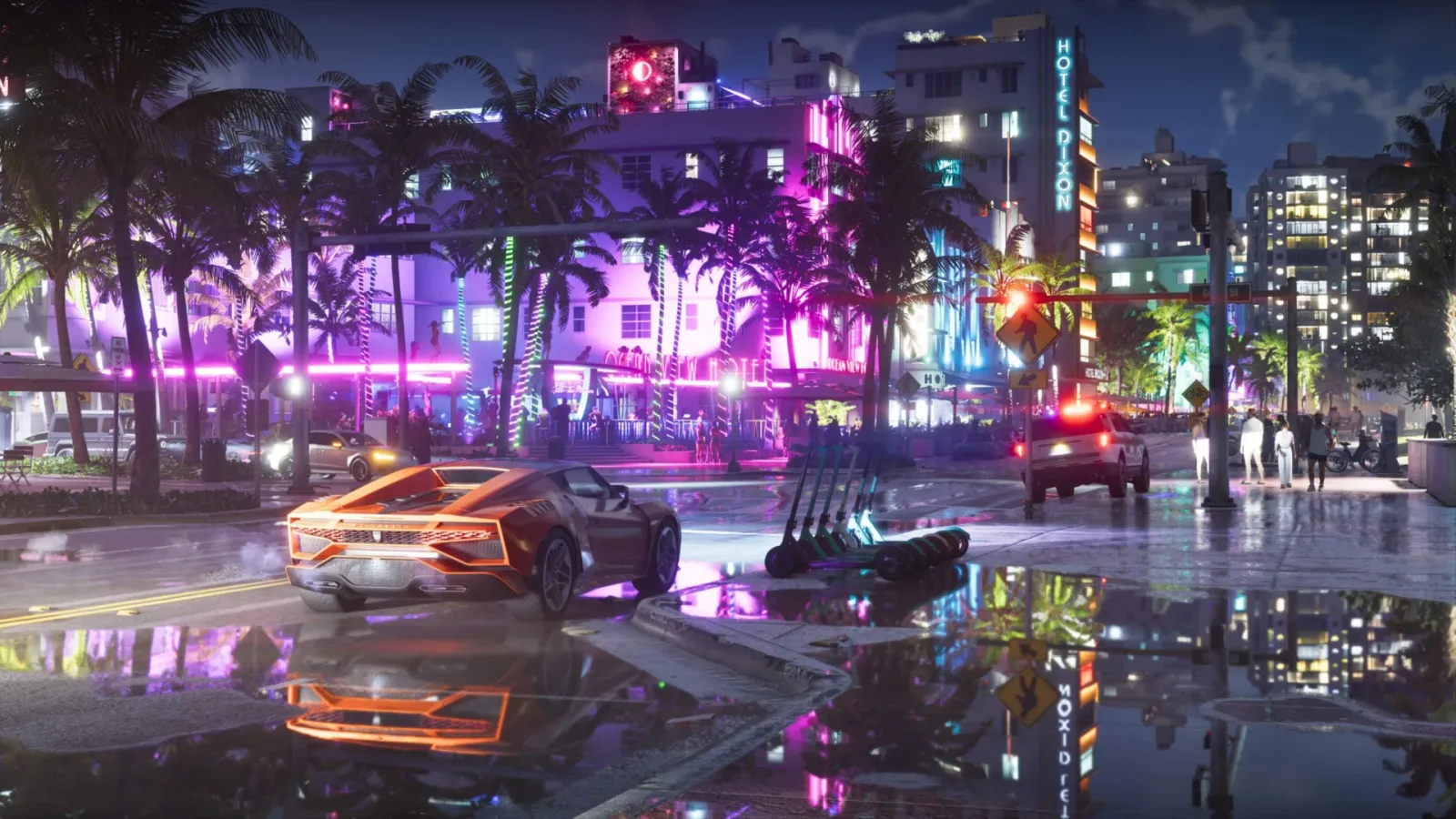
A newly released Grand Theft Auto 6 screenshot has set off a familiar kind of internet argument: it looks so good that some fans are questioning whether it could possibly represent the game as it will actually run on consoles.
The image, shared as part of Rockstar Games' October 8 update on GTA 6's music and radio lineup, depicts a rainy Vice City street after dark. Cars move along reflective pavement, pedestrians occupy the sidewalks, and the neon signage of the Ocean View Hotel spills color across puddles and nearby buildings. At a glance, it has the polish of a carefully composed cinematic render. The wet asphalt, vehicle reflections, dense lighting, and haze-heavy nighttime atmosphere make it one of the most striking looks yet at Rockstar's return to Vice City.
But while the screenshot has understandably fueled disbelief, a closer look points toward a more grounded conclusion. It appears to be an in-engine image, likely captured under highly favorable conditions and possibly using internal developer tools, rather than a fabricated render or a totally unrepresentative piece of marketing art.
Embedded X/Twitter post
Why the image has drawn so much attention
Rain is one of the most demanding visual conditions for a modern open-world game. A clear daytime scene can lean on bright light and straightforward materials. A wet city at night has to manage a much more complicated mix: artificial lighting, glossy and rough surfaces, reflections in standing water, illuminated signs, cars with different paint finishes, moving pedestrians, shadows, and a large environment extending into the distance.
For useful background on this topic, read Kyle Gallner Signals Interest in Playing V in Paramount's Cyberpunk 2077 movie.
That is precisely what makes this GTA 6 scene so effective. Neon lights reflect across the road while the street remains convincingly dark. The image does not just show a wet ground texture; it gives the impression of a living downtown space in which headlights, storefronts, hotel lighting, and puddles all react to one another. Cars and people also provide scale, making Vice City feel busy rather than like a static technology demonstration.
For fans who remember the long lead-up to previous Rockstar releases, the response is not surprising. High-end promotional screenshots regularly produce skepticism, especially when they are viewed on high-resolution displays or compressed and reposted across social media. The concern is usually the same: will the game really look like this during ordinary play, while driving at speed through a large open world, on a retail console?
That question is valid, though it does not mean the screenshot should automatically be dismissed. A carefully staged capture can be both genuine and more flattering than the average moment players will see during a hectic mission or a high-speed chase.
Small imperfections matter more than first impressions
Visual analysis from Digital Foundry's Oliver Mackenzie helped put the image into perspective. Mackenzie noted that Rockstar could be using a debug-style photo setup capable of raising image quality or resolution for promotional screenshots. That possibility would make sense for a major first-party-style marketing push: developers often have tools that let them pause scenes, select camera angles, arrange characters, and capture clean images without interface elements or the motion blur of normal play.
Crucially, however, the image also contains flaws that would be unusual if it were simply a pre-rendered artwork designed to look perfect. The more closely viewers inspect the scene, the more they can spot familiar limits of real-time rendering.
- Reflections deeper into the frame show noticeable dithering.
- Some distant pedestrians do not appear to receive fully drawn shadows.
- Very far-off characters look less detailed, with geometry that may be lower in polygon count.
None of these issues ruin the shot. Most viewers would never notice them without enlarging the image significantly. Yet they are important because they are the kinds of compromises expected from a game rendering a complex urban environment in real time. Reflections are particularly expensive, and many console games use a combination of techniques that can become less precise with distance. Similarly, reduced detail on characters far from the camera is a standard way to preserve performance in expansive scenes.
In other words, the imperfections strengthen the case that GTA 6 really can produce a scene in this range. The screenshot is exceptional, but it does not look like magic once its technical seams are examined.
A best-case capture is not the same as everyday gameplay
There is still room between "this is real" and "every second of GTA 6 will look exactly like this." A promotional image is inherently selective. Rockstar can choose the weather, time of day, camera placement, traffic density, lighting, and the exact moment when reflections align most beautifully. It can also capture at high resolution and present the result without the distractions that come with active gameplay.
A debug or photo-mode environment could potentially help Rockstar create an especially crisp shot by allowing the team to increase capture settings, adjust the scene, or take the image under conditions that would not represent the game's standard performance mode frame-for-frame. That does not make the picture deceptive. It means it is a showcase image, intended to present the artistic and technical ceiling of the world.
Players should therefore expect some variation once they are controlling the action. Rain will look different depending on location and camera angle. Crowded areas will create heavier performance demands. Fast driving may make it harder to appreciate fine details that stand out in a frozen still. Resolution, anti-aliasing, reflections, shadow quality, and crowd detail may also shift based on the target hardware and Rockstar's final graphics settings.
Even with those caveats, the screenshot offers a persuasive indication of GTA 6's nighttime ambitions. The central ingredients are not isolated showcase tricks. Wet roads, colorful signage, traffic, pedestrians, coastal-city architecture, and nightlife are all fundamental to the Vice City setting. If Rockstar can sustain even a slightly less pristine version of this atmosphere while players explore freely, it will have a major impact on how the world feels.
Rockstar's marketing history offers some reassurance
Rockstar has faced similar doubts before. Ahead of Grand Theft Auto V, many viewers believed its early images had been heavily enhanced or captured on hardware far beyond what the Xbox 360 and PlayStation 3 could deliver. Looking back, those pre-release screenshots were broadly representative of the finished game, even if the final experience naturally varied by scene and gameplay conditions.
The company's other releases have followed a comparable pattern. Games including Red Dead Redemption, Bully, and Max Payne 3 used marketing material that was rooted in the look and technology of the games themselves. Promotional captures may be carefully arranged, and development tools can make them cleaner than an unscripted play session, but Rockstar has a substantial history of showing real in-engine work rather than presenting entirely separate visual targets.
That history does not answer every platform question. GTA 6 is a much more technically demanding project than the games that came before it, and the expectations for a huge current-generation open world are far higher. Still, it offers more reason to view the rain-soaked Vice City image as a legitimate representation of the game's visual direction than as an impossible promise.
What it could mean for PS5, PS5 Pro, and Xbox
Mackenzie's assessment leaves open the possibility that the image was captured on a PlayStation 5 Pro development kit, while also emphasizing that it is not possible to determine that with certainty from the screenshot alone. If that is the case, the capture may represent a particularly strong version of the game's console presentation rather than a direct one-to-one match for every system.
Nevertheless, GTA 6 is expected to look especially impressive at night across PlayStation 5, PlayStation 5 Pro, and Xbox Series X. Rockstar's lighting work, dense environmental detail, and wet-weather rendering are clearly being positioned as major parts of the game's identity. The screenshot suggests that Vice City's urban spaces could become most visually powerful after sunset, when the setting's artificial light, traffic, rain, and nightlife all converge.
Questions remain about the final balance Rockstar will choose between image quality, frame rate, resolution, and effects on each machine. The Xbox Series S is likely to invite the most speculation because of its lower-spec hardware, but no final technical breakdown has been confirmed. Until Rockstar provides platform-specific performance details or the game is available for direct analysis, claims about exact modes and settings remain guesses.
For now, the standout takeaway is straightforward. GTA 6's rainy Vice City scene appears to be an authentic look at what Rockstar's technology can accomplish, even if it is likely an unusually polished, high-resolution showcase capture. Its visible shortcomings are not evidence that the screenshot is fake. They are evidence of a real game confronting the same rendering trade-offs every ambitious console release faces.
And if this is the level of mood GTA 6 can reach on an ordinary wet night in Vice City, the final game's streets may be every bit as memorable as its sunshine.
Community
Discussion
Start the conversation.
No comments have been posted yet.