

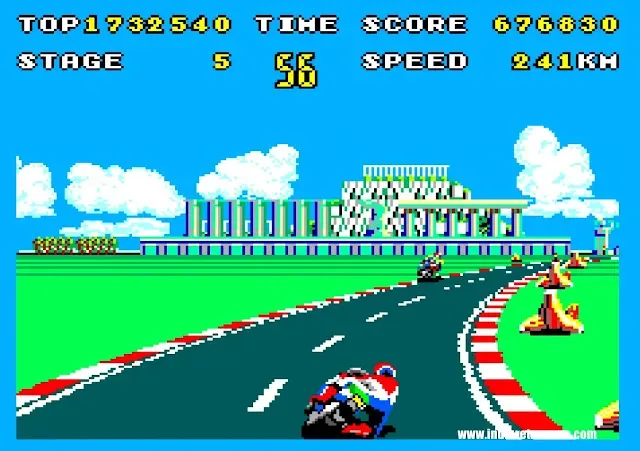
Hang-On Jr., the compact 1986 follow-up to Sega's landmark arcade motorcycle racer, has received a new version 1.0 release for the Sega Mega Drive and Sega Genesis. Developed by yosoynacho, the project brings a game originally designed around more modest arcade hardware to Sega's 16-bit home console, while adding features intended to make the conversion feel more at home on the system.
The new release is built around a 60 frames-per-second performance target and retains the distinctive circuit designs associated with Hang-On Jr., rather than simply attempting to reproduce the better-known original Hang-On. It also introduces an exclusive Mega Drive-focused play option, configurable controls, save support for records and settings, regional display considerations, and compatibility with several unusual peripherals.
For retro racing fans, the release is notable not merely because another Sega arcade property is playable on the Mega Drive. Hang-On Jr. has its own place in the company's arcade history: it was a deliberately simplified version of the 1985 Hang-On cabinet, developed for the less powerful Sega System E platform. Its reduced presentation and sound were part of a lower-cost arcade proposition, but its routes and gameplay identity kept it from being just a diminished copy of the original.
A Different Branch of Hang-On History
The original Hang-On arrived in arcades in 1985 and quickly became synonymous with Sega's large-scale, physically involving arcade design. Its motorcycle cabinet and fast pseudo-3D road effects made a major impression. Hang-On Jr. followed in 1986 with a more streamlined concept intended for Sega System E hardware, a board with substantially tighter technical limits than the hardware behind its predecessor.
For useful background on this topic, read Next Misifu Brings an Alley Cat-Inspired Adventure to ZX Spectrum Next.
Those limitations affected the audiovisual side of Hang-On Jr., but the game's importance lies in how it adapted the core idea. It offered a more economical way to experience a high-speed bike racer while preserving its own selection of courses. That distinction matters for this Mega Drive and Genesis release. The project is presenting Hang-On Jr. as a game worth revisiting in its own right, not as a substitute for the original arcade release or for Super Hang-On.
The Mega Drive's capabilities provide an opportunity to pursue a smoother home-console presentation while staying focused on the older game's course structure. The stated objective is a silky 60fps experience, a particularly welcome fit for a racing game where quick steering corrections and a strong sense of motion are central to the appeal. A stable, responsive update rate can make a substantial difference when players are threading a motorcycle through traffic, reading road bends, and trying to preserve enough speed to reach the next checkpoint.
MD Mode Adds Super Hang-On-Style Inputs
The major gameplay addition in version 1.0 is MD Mode, an option created specifically for the Mega Drive and Genesis version. This mode adds turbo and braking mechanics inspired by Super Hang-On, Sega's later and more mechanically expanded motorcycle racer.
That choice gives players an alternate way to tackle Hang-On Jr.'s courses. Turbo can offer an extra push on straighter stretches or in situations where a player needs to recover time, while braking introduces more deliberate speed management before difficult corners. Together, those additions potentially make the port feel closer to the control vocabulary that many 16-bit Sega fans associate with Super Hang-On.
Importantly, MD Mode is not being folded into the original-style competition structure. Its high scores are kept separate from Arcade mode records. That separation preserves the integrity of traditional Hang-On Jr. score chasing while allowing the new control set to stand on its own. Players seeking the historical arcade-style rules can use Arcade mode, while those interested in the Mega Drive-specific reinterpretation can compete under a separate record list.
It is a sensible approach for a preservation-minded port. New mechanics can make an older title more approachable or more exciting on a home system, but they can also change the balance of a timed racing game. Separate high-score tables acknowledge that the modes are different experiences rather than pretending that identical scores were achieved under identical conditions.
Control Options Beyond the Standard Pad
The release also embraces the kind of controller experimentation that has always surrounded Sega hardware. Alongside conventional gamepad play, Hang-On Jr. supports analog control through the XE-1 AP. That peripheral support is especially appropriate for a motorcycle racer, where analog steering can provide a more gradual sense of directional input than a standard digital directional pad.
There is also compatibility with the Sega Mega Mouse. While a mouse is hardly the first controller most players would associate with a high-speed bike game, support for it underscores the developer's interest in making the port flexible across available Mega Drive and Genesis input hardware. Retro enthusiasts with less common accessories now have another title with which to test them.
Peripheral compatibility is often easy to overlook in homebrew and conversion projects, particularly when the standard controller already gets the job done. Yet it can add genuine value to a release aimed at long-term play. Supporting specialized hardware gives users options, helps demonstrate what the console can accommodate, and adds a layer of curiosity for collectors who enjoy exploring the broader Mega Drive ecosystem.
PAL Optimisation and SRAM Saving
Version 1.0 includes PAL 50Hz optimisations, addressing a practical concern for players using systems in PAL regions. Historically, many games built primarily around 60Hz standards could feel slower or less well-balanced when run at 50Hz. Tailored PAL work does not erase the difference between refresh rates, but it demonstrates that the port has considered more than one regional operating environment.
The game also supports SRAM saving for high scores and custom configurations. For an arcade-style racer, that is a meaningful quality-of-life feature. High-score pursuit is a major reason to return to games such as Hang-On Jr., and keeping records intact without relying on passwords or manual note-taking makes sustained competition much easier. Saving configurations is equally useful for anyone who has settled on a preferred controller arrangement or display-related setting.
These additions help bridge the gap between the immediate appeal of an arcade game and the expectations players now bring to a dedicated home release. The essential goal remains fast repeatable runs, but the surrounding framework removes a few of the small inconveniences that once came with playing score-driven games on original hardware.
A Custom Sound Solution With an Authenticity Option
Audio is another area where the Mega Drive and Genesis port makes a specific technical effort. The developer has included a custom Z80 driver intended to recreate the arcade game's secondary sound chip. This is a notable detail because Hang-On Jr.'s original arcade environment had its own sound architecture, and translating that behavior to different hardware requires more than simply assigning effects to the Mega Drive's standard audio resources.
Players are not locked into that approach, however. The recreated secondary-chip sound can be disabled through the dipswitch menu. The option gives users a degree of control over how they want the game to sound, whether they are interested in the custom recreation or would rather play without it.
Including a toggle is a fitting touch for a project rooted in classic arcade culture. Dipswitch-style settings recall the configurable operator options associated with arcade boards, while giving home players direct access to a feature that might otherwise be fixed. It also recognizes that sound preference can be personal, especially among fans who compare different versions of a vintage game across hardware generations.
Why This Port Matters
Hang-On Jr. is not the most famous name in Sega's racing catalog, but that makes this release all the more interesting. The original game occupies a less frequently discussed corner of the company's arcade lineage: a reduced-cost adaptation that developed its own tracks and identity while carrying the Hang-On name. Bringing it to Mega Drive and Genesis hardware gives it a new audience among players who may know the original cabinet and Super Hang-On but have spent little time with the Jr. entry.
The port also reflects the appeal of ongoing development for legacy consoles. Rather than treating the Mega Drive solely as a museum piece, projects like this continue to explore its hardware, its accessories, and the kinds of arcade experiences that can be tailored for it. The new MD Mode, save support, peripheral options, PAL considerations, and custom audio work are all additions that go beyond a minimal conversion.
For players who want the classic framework, Arcade mode and its independent score table preserve the core challenge. For those who want a version shaped around the 16-bit console, MD Mode offers turbo and braking mechanics inspired by Super Hang-On. Either way, Hang-On Jr. version 1.0 gives Sega's overlooked motorcycle racer a carefully considered new ride on Mega Drive and Genesis hardware.
Community
Discussion
Start the conversation.
No comments have been posted yet.