

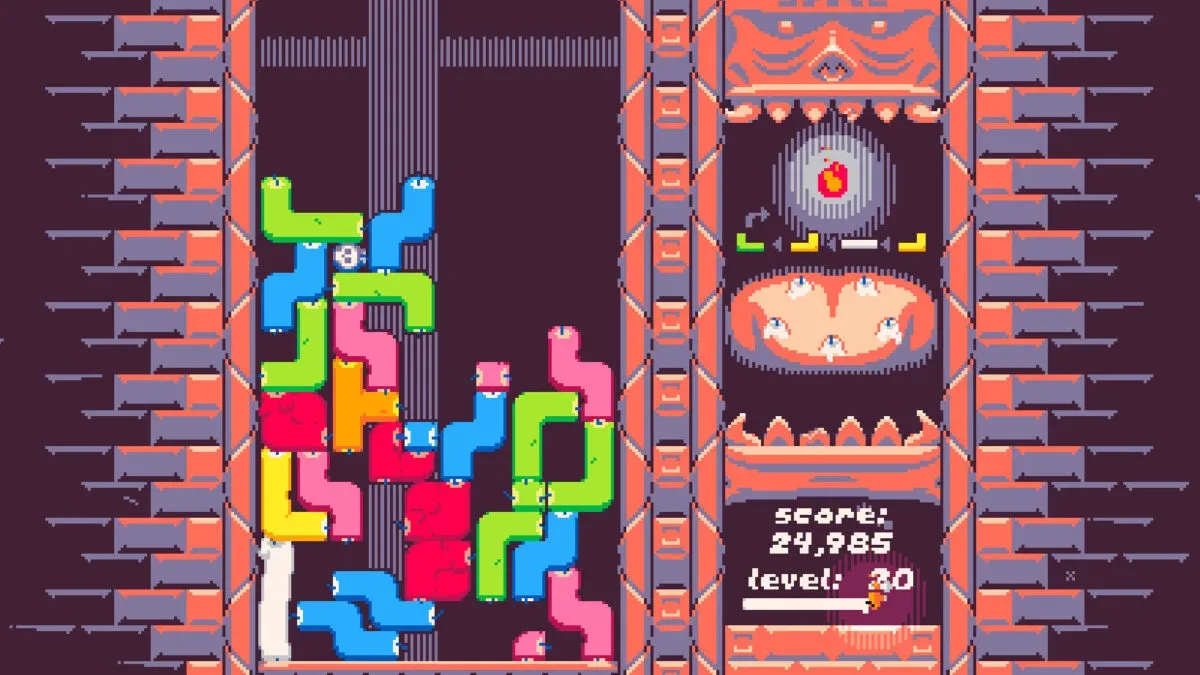
Hot Wax, the upcoming puzzle game from PUNKCAKE Delicieux, takes the familiar language of tetrominoes and sends it somewhere considerably darker. Rather than building clean horizontal lines and watching them vanish, players descend into an unlit dungeon and arrange magical candle-shaped blocks for a summoning ritual. The real objective is not simply to make an orderly stack. It is to create a route for fire.
That twist gives Hot Wax a markedly different relationship with the block-puzzle instincts many players have developed over decades. A tidy arrangement may look efficient, but it can be disastrous if a flame cannot travel through the exposed wick paths needed to burn away the wax. The game is built around the tension between careful placement, controlled destruction, and the shifting structure left behind after each successful burn.
It is the latest project from the team behind Shotgun King, a game that similarly took a highly recognizable format and bent its rules into something more volatile. Where that earlier title reworked chess around a shotgun-wielding monarch, Hot Wax approaches the foundations of falling-block puzzles from a different angle: what happens when clearing the board is a chain reaction that must be deliberately planned?
A fire puzzle rather than a line-clearing puzzle
Hot Wax begins with tetromino-shaped chunks of candle wax. Their outlines may immediately recall Tetris, but their behavior changes the goal completely. Completing a horizontal row does not make the pieces disappear. Instead, wax must be consumed from above by a lit wick, transforming the board into a layered puzzle about exposure, direction, and timing.
For useful background on this topic, read Take Earth Back 2 Expands Mass Effect 3's Final Battle With Choices That Reach the Front Line.
After every few pieces, the player receives a small fireball. Once introduced, that ember travels along a candle's wick and can ignite other exposed lengths of twine it encounters. A satisfying setup can allow the flame to race through a large connected section of the structure, burning through wax in a dramatic cascade. But the system is not a simple reward for making the biggest possible pile. The fire has to remain viable as it moves.
If portions of wax become disconnected and fall, the board changes shape. The behavior has an affinity with digging and collapsing puzzle games: unsupported pieces can tumble into the space below, potentially reshaping a carefully prepared route. Worse, an ember can be extinguished when it is smothered. That can leave behind a basin of wax that is no longer easily reachable, turning an attempted chain reaction into a hardened obstacle.
The result is a game that asks the player to think several moves ahead in a different way from traditional tetromino puzzlers. Positioning blocks neatly still has value, but order for its own sake is not enough. Players need openings, ignitable connections, and room for the wax to fall without burying the fire. A visually messy board might be the perfect arrangement if it lets the flame travel farther and clear more material.
Learning when to let the board collapse
Much of Hot Wax's appeal appears to come from this push and pull between construction and destruction. A new block can provide the missing wick segment for a long burn, but it can also seal a route, add weight above a fragile space, or create a pocket where the flame will die. The game's dungeon setting reinforces the sense that each board is a dangerous ritual device rather than a neutral playfield.
That presentation matters because it gives an abstract puzzle system a physical, almost tactile identity. The blocks are not merely colored shapes waiting to be sorted. They are candle material, the lines inside them are fuel paths, and the fire is an active resource that can either liberate the board or be swallowed by it. It is an evocative way to make every placement feel consequential.
The basic rhythm also creates room for suspense. Players do not appear to receive a flame after every single piece. The interval between fireballs means there is time to build toward a larger opportunity, while also raising the risk that a promising layout becomes too complicated to ignite safely. Instead of repeatedly clearing lines as soon as possible, the player may be preparing a controlled burn and hoping the structure behaves as intended once the spark arrives.
That is a compelling reversal of the usual falling-block mentality. In many games inspired by Tetris, clean flat surfaces are a safeguard. In Hot Wax, a flat surface may conceal an unusable mass of wax. The priority is not just avoiding height; it is preserving pathways. The best move could be one that looks inefficient in the moment but keeps enough wick exposed to turn a future ember into a board-saving blaze.
Different modes, different kinds of flame
Hot Wax will not use exactly the same fire rules in every mode. Its standard ritual mode is more measured: the flame advances one block per turn. This slower pace should place greater emphasis on anticipating what happens as the board shifts and on making sure the ember will not be trapped before it reaches the next connection. Devilish power-ups can also be collected, adding another element to the player's decision-making.
Other modes allow the fire to burn straight through more immediately. Beyond the appeal of a quicker, more explosive payoff, that rule variation helps make the game's systems easier to read. When flames scorch rapidly through linked paths, players can more clearly see why a particular arrangement succeeded or failed. The burning itself becomes a visual explanation of the puzzle logic.
That flexibility suggests Hot Wax is not content to stop at a single clever gimmick. Changing the speed and behavior of the flame can dramatically alter how a player evaluates each incoming piece. A slow-moving ember turns every step into a potential hazard; a fast-burning version can encourage bold, expansive setups. Both approaches keep the central idea intact: fire is not simply an effect applied after the puzzle is solved. It is the puzzle.
From a game jam idea to a full puzzle game
PUNKCAKE Delicieux created Hot Wax from an idea first made for the 2024 Ludum Dare game jam. That origin is fitting. Game jams often produce experiments built around a single sharp concept, and Hot Wax's premise is instantly legible: take familiar falling pieces, give them wicks, then make players think about burning them from the top down.
The developer has established a reputation for treating established genres as malleable starting points rather than fixed templates. Shotgun King did not merely add a weapon to chess; it recast how players considered space, danger, turns, and the value of individual pieces. Hot Wax seems set to apply a comparable philosophy to tetromino puzzles. The recognizable shapes provide an accessible entry point, while the fire-and-collapse rules demand a new set of habits.
There is a long history of puzzle games finding fresh ideas in the shadow of Tetris. Some have focused on routing, others on physics, digging, timing, or unusual piece behavior. Hot Wax joins that tradition with a particularly theatrical image: a dungeon full of magical candles being arranged, lit, broken apart, and melted down in the service of a ritual.
PUNKCAKE Delicieux is also working on If Letters Had Pants, Would They Wear Them Like This?, a project that points toward another playful attempt to disrupt a familiar puzzle format, this time involving word jumbles. Taken together, the projects reflect an interest in uncovering surprising possibilities inside rules players may think they already understand.
Why Hot Wax's twist has potential
The strongest puzzle games make players revise their assumptions. Hot Wax's central promise is that it will make an old reflex actively unreliable. The instinct to build flat, erase lines, and minimize disorder has to give way to a more combustible way of thinking. Players must ask where the wick is, where the wax will fall, which surfaces will remain exposed, and whether the next fireball will create a glorious chain or a useless, smothered ember.
That makes the game's title an apt summary of its design. Wax is soft, shapeable, and satisfying to melt, but it can also become a stubborn barrier once it is in the wrong place. Every turn seems likely to balance the pleasure of setting up a huge burn against the anxiety of realizing the board has become an impenetrable mess.
For players who enjoy block puzzles but want a system that challenges long-held habits, Hot Wax is shaping up as an intriguing experiment. It does not discard tetromino language; it changes what that language means. In this dungeon, the important question is not whether the pieces fit. It is whether they will burn.
Community
Discussion
Start the conversation.
No comments have been posted yet.