

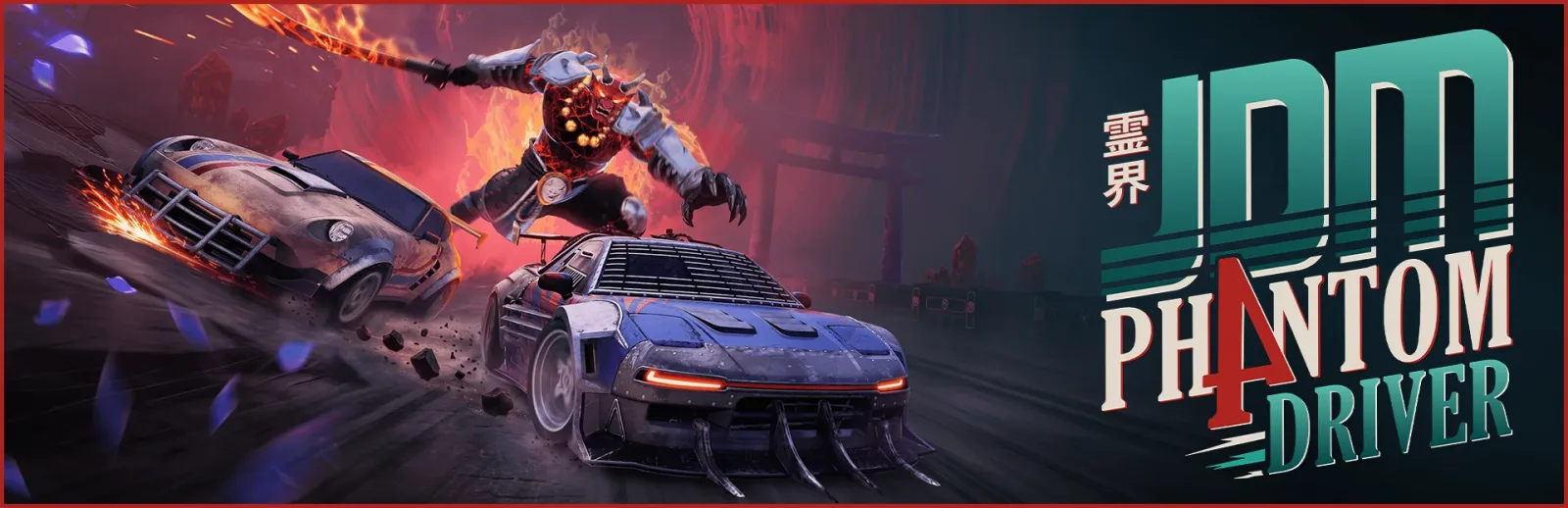
JDM: Phantom Driver is headed to Steam, bringing a very different kind of street-racing fantasy from the team behind JDM: Japanese Drift Master. Rather than simply asking players to master corners, earn cash, and tune cars for the next event, the standalone project puts drivers behind the wheels of modified JDM machines in a demon-conquered alternate Japan. The road is no longer just a route to the finish line. It is a battlefield.
Built as an action-oriented arcade racing game with a brawling focus, JDM: Phantom Driver blends street-car culture with Japanese folklore. Players will drive through the fictional prefecture of Guntama, a place overtaken by a ruthless demon and its Oni armies. Cars are the central weapon in every encounter, with the game explicitly avoiding conventional combat tools such as guns and blades. Instead, the driver's speed, drifting ability, vehicle build, and supernatural destructive power determine how effectively they can survive the territory ahead.
The result is a premise that moves beyond the usual racing-game structure. It is still about cars, driving, customization, and technical control, but its competition comes from dangerous creatures drawn from Japanese folklore rather than rival racers alone. That creates room for a more immediate, stylized kind of vehicle action: slam into enemies, maintain momentum, connect combat abilities, and keep the pressure on while maneuvering through a world transformed by demonic corruption.
A corrupted version of Guntama
The setting is an alternative take on the fictional Japanese prefecture of Guntama. Its streets and built-up areas have deteriorated under supernatural rule, leaving players to explore an open world marked by moss-covered roads and crumbling architecture. That backdrop gives the game a harsher visual identity than a typical urban drift playground. The landscape is still meant to be driven through at speed, but it has also become hostile territory where each journey deeper into the map means confronting increasingly dangerous opposition.
For useful background on this topic, read Xbox Reportedly Asks Players About Bringing Most First-Party Games Back to Exclusivity.
The force behind Guntama's downfall is a demon whose armies include Oni and other youkai, the broad category of supernatural beings and monsters found in Japanese folklore. The campaign will ultimately lead players toward Shouten Douji, described as the Demon King. That progression suggests the open world will function as more than scenery between races. Improving a vehicle is tied to pushing further into demon-controlled areas and becoming capable of facing greater threats.
This approach also gives the car-selection and upgrade loop a practical combat purpose. Better performance should matter not only for reaching higher speeds or holding a cleaner drift line, but for making a driver more effective in fights. Modifications and upgrades are expected to improve both a car's traditional performance and its combat potential, making each build part of the player's overall strategy against Guntama's supernatural occupiers.
Drifting is part of the attack
At the core of JDM: Phantom Driver is an arcade-style handling model built around agile cars that are intended to be easy to control. The game's key driving mechanic is called Nitro-Drift, combining drifting and boosting into a single high-energy tool. Instead of treating a drift merely as a stylish way to take a corner, the system is designed to feed directly into combat.
For another perspective on this story, read JDM: Phantom Driver Sends Arcade Drift Combat Into a Demon-Corrupted Guntama.
Players can use Nitro-Drift to link abilities together and build their Hakai score. Hakai is presented as a supernatural power of destruction, and it is a defining part of the game's action identity. Sustaining the right driving rhythm--sliding through the environment, using boosts effectively, and staying engaged with enemies--should help drivers unleash more destructive potential. It is an idea that fits naturally with an arcade racer's emphasis on flow: the better the movement, the greater the offensive payoff.
There is an important distinction in the game's combat concept. The vehicle itself is the weapon. A player is not stepping out of the car to fight, switching to a firearm, or treating the driving sections as a separate activity from the action. The intended fantasy is one of combat-driving, where a modified JDM car becomes an extension of the driver's power. Speed, impact, positioning, boosts, and supernatural abilities all work together.
That could make the game appealing to players who enjoy the expressive movement systems of arcade racers but want a more aggressive objective than setting the fastest lap. It also leaves space for each encounter to test more than acceleration. Navigating groups of supernatural foes, keeping enough momentum to chain skills, and avoiding losing control in a damaged city could all be as important as raw top speed.
Customization for performance and destruction
Car customization and progression will remain central to the experience. Players will be able to customize and upgrade their cars, with changes affecting performance as well as combat capabilities. No full vehicle list or detailed tuning breakdown has been confirmed, but the focus on modified JDM cars places automotive identity at the center of the adventure.
For a game that treats cars as combat tools, the upgrade system could become one of its most significant features. A build suited to speed and sustained Nitro-Drift may play differently from one oriented around heavier impact or stronger supernatural attacks. The announced premise does not spell out every possible choice, so it remains to be seen how deep those options will go. Still, tying upgrades to the ability to access more dangerous demon territory gives progression a clear narrative and gameplay role.
Just as importantly, this setup should preserve the spirit of vehicle ownership that many racing fans look for. The player is not simply handed a magical combat machine; they are expected to develop a collection of modified cars and improve them as the demands of Guntama escalate. The supernatural framework changes the stakes, but it does not replace the pleasure of building a machine that feels capable, distinctive, and suited to a preferred driving style.
A manga-led single-player campaign
JDM: Phantom Driver will feature a single-player campaign told through hand-drawn manga panels and a fully realized dialogue system. This storytelling format should give the game a clear stylized presentation while allowing its cast, folklore influences, and demonic conflict to take center stage between driving sequences.
The game is a standalone spin-off, meaning newcomers do not need previous knowledge of JDM: Japanese Drift Master to follow its story. That is particularly useful given how dramatically the premise shifts into supernatural action. Players can enter Guntama and understand the campaign on its own terms, without needing to catch up on another game's narrative first.
Veterans of JDM: Japanese Drift Master will not be left out, however. Easter eggs and character cameos are planned for those familiar with the earlier title. That creates a connection between the games without making prior experience a requirement, letting the spin-off pursue its own arcade-combat direction while retaining small rewards for returning fans.
Multiplayer is already being developed
While the confirmed story mode is single-player, a multiplayer component is already in development. Specific multiplayer modes, player counts, competitive features, and release timing have not yet been detailed. As a result, it is not clear whether multiplayer will focus on racing, combat encounters, cooperative driving, or a combination of those ideas.
Even so, the fact that multiplayer work is underway suggests the developers see potential in taking the game's drift-and-destruction systems beyond the campaign. The combination of quick arcade handling, buildable cars, and battle-focused driving could lend itself to a range of social modes if it is carried over effectively. For now, the single-player journey through corrupted Guntama remains the clearest picture of what players can expect.
JDM: Phantom Driver has been announced for Steam, with no release date included in the current information. Its strongest hook is straightforward: take the precision and flair of JDM-inspired drifting, add boost-powered combat and destructive supernatural abilities, then send players into a decaying open world filled with folklore monsters. It is an unusual direction for a racing spin-off, but one that could give every drift, upgrade, and burst of speed a purpose beyond crossing the finish line.
Community
Discussion
Start the conversation.
No comments have been posted yet.